
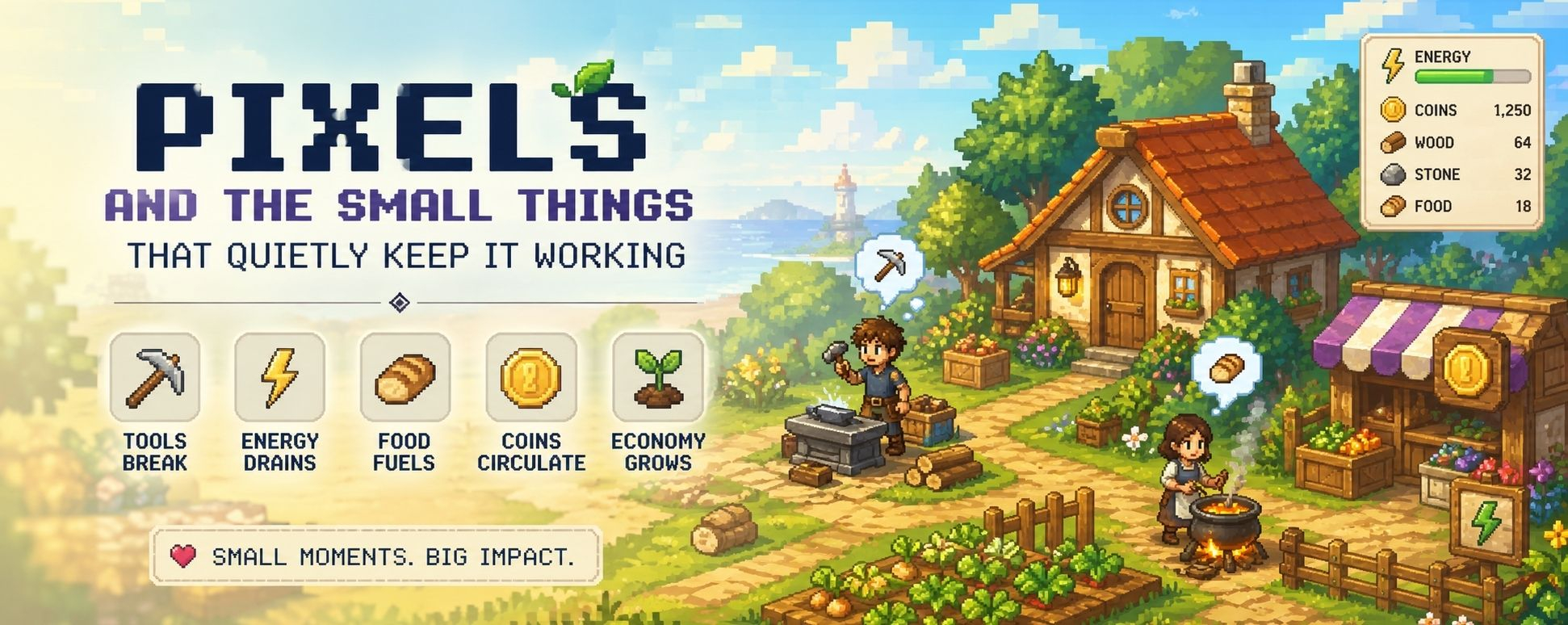
I was sitting outside near the gate, just after dinner, not really doing anything important. The street was half quiet, a few bikes passing, someone talking in the distance. I opened Pixels the same way I always do when I’ve got a few empty minutes.
No plan.
Just habit.
I started going through the usual motions. Cut some wood. Crafted a couple of items. My tool broke halfway through, so I replaced it without thinking. Energy dropped, so I made some food, used it, and kept going.
Nothing felt unusual.
And that’s exactly what made me pause.
Because everything I was doing felt so normal that I didn’t question any of it.
Not the tool breaking.
Not the resources being used.
Not the coins I spent to keep going.
It all felt like part of the game.
And then it hit me—those small, forgettable moments are probably doing more work than anything else in the system.
When people talk about Pixels, they usually focus on the big changes. New features, token updates, announcements, integrations. The things that come with explanations and attention.
Those are easy to see.
But they’re not what keeps the economy steady every day.
It’s the smaller things.
The parts no one really talks about.
The ones that don’t even feel important when you’re playing.
Because they don’t look like systems.
They look like routine.
That’s the difference.
If a game clearly tells you “this is a cost,” you react to it. You slow down. You think about whether it’s worth it. You might even try to avoid it completely.
But if the cost is built into what you’re already doing, you don’t fight it.
You accept it.
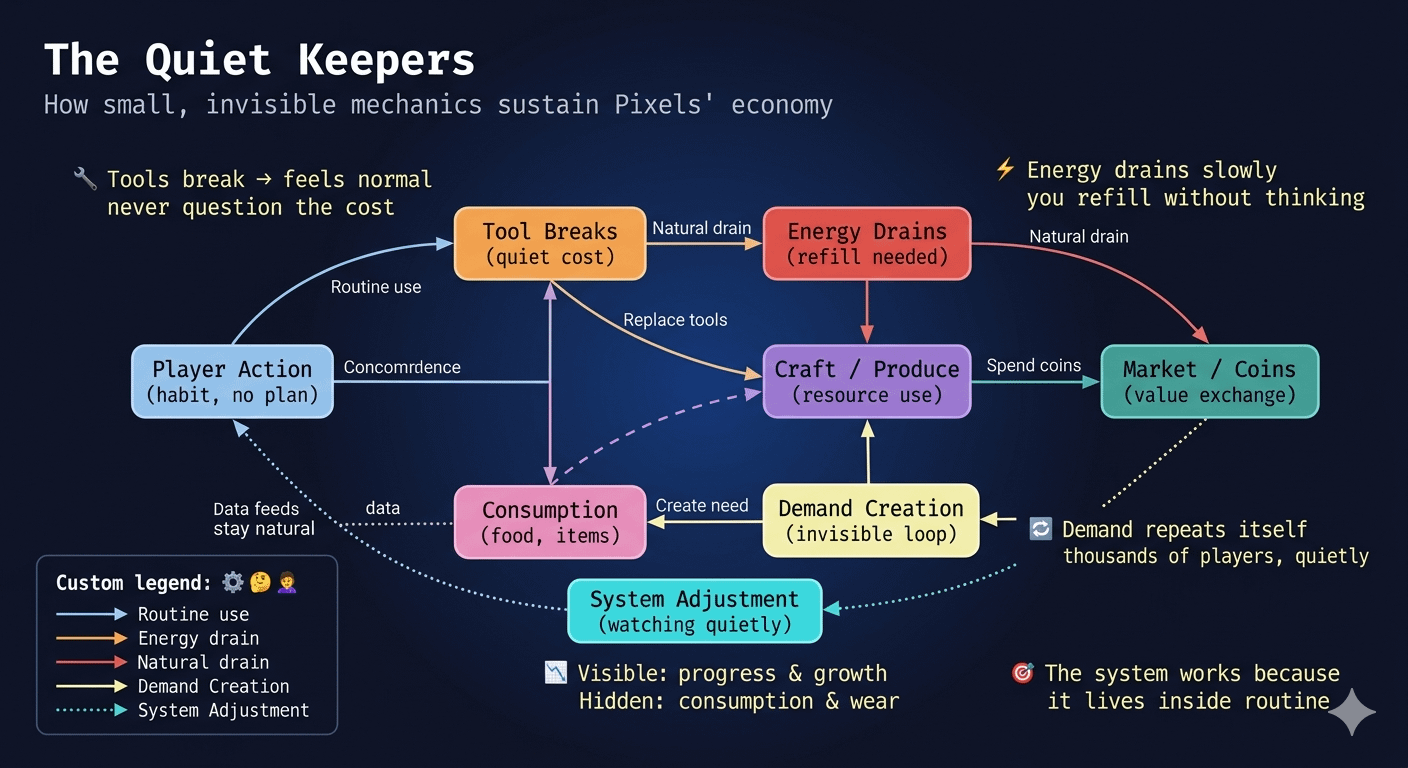
Like when my tool broke that night—I didn’t stop and question it. I didn’t calculate anything. I just replaced it and moved on.
It felt natural.
Tools break. That makes sense.
But behind that simple moment, something else is happening.
Resources leave your inventory. Coins move out. Demand gets created again for someone else to produce that tool.
And it keeps repeating across thousands of players at the same time.
Quietly.
No one celebrates it. No one complains about it.
It just works.
The same thing happens with energy.
Every action slowly drains it. You don’t notice it immediately, but eventually you have to refill. So you craft food, or buy it, or prepare it in advance.
Again, it doesn’t feel like a system pulling something from you.
It feels like part of the flow.
But that one mechanic connects everything—farming, crafting, trading. One small limitation creates demand across the entire loop.
And you never stop to think about it.
That’s what makes these systems so effective.
They don’t announce themselves.
They hide inside normal gameplay.
Even when you craft something like higher-tier items or consumables, you’re focused on what you’re getting out of it. Better efficiency, more output, smoother progress.
You’re not thinking about what you’re spending.
The cost is there—but your attention isn’t on it.
And that’s the key difference.
Because the moment players feel like something is being taken from them too directly, everything changes.
They start noticing.
They start adjusting.
They start resisting.
We’ve seen that happen before.
When certain changes feel sudden or unfair, even if the logic behind them makes sense, players react emotionally first. It stops feeling like part of the game and starts feeling like something being imposed.
And once that line is crossed, it’s hard to go back.
That’s why these quiet systems are a bit fragile.
They only work as long as they feel natural.
The moment they feel forced, they stop being invisible.
And once they’re visible, people treat them differently.
There’s also a bigger layer to all this that most players don’t really see.
Something is always watching how the economy moves—how fast coins are coming in, how quickly they’re leaving, where things start to build up or slow down.
Adjustments happen based on that.
But to really understand what’s going on, it’s not enough to track the obvious parts.
You have to understand the small ones too.
The tool that breaks.
The energy that drains.
The items that get consumed again and again.
Those are the real signals.
Because they show how players behave when they’re not thinking about the system.
And that’s the most honest version of any economy.
Sitting there that night, doing nothing special, I realized something simple.
Pixels doesn’t stay balanced because of big ideas alone.
It stays balanced because of tiny, repeated moments that no one pays attention to.
The game doesn’t ask you to think about cost.
It lets you think about progress.
And while you’re focused on moving forward, something else is happening quietly in the background—
things are being used, replaced, consumed, and circulated.
Not in a way that feels heavy.
Just enough that everything keeps moving.
That’s why it doesn’t feel like a system draining you.
It feels like a system that keeps going.
And maybe that’s the smartest part of it.
Because the things doing the most work…
are the ones you barely notice while you play.