
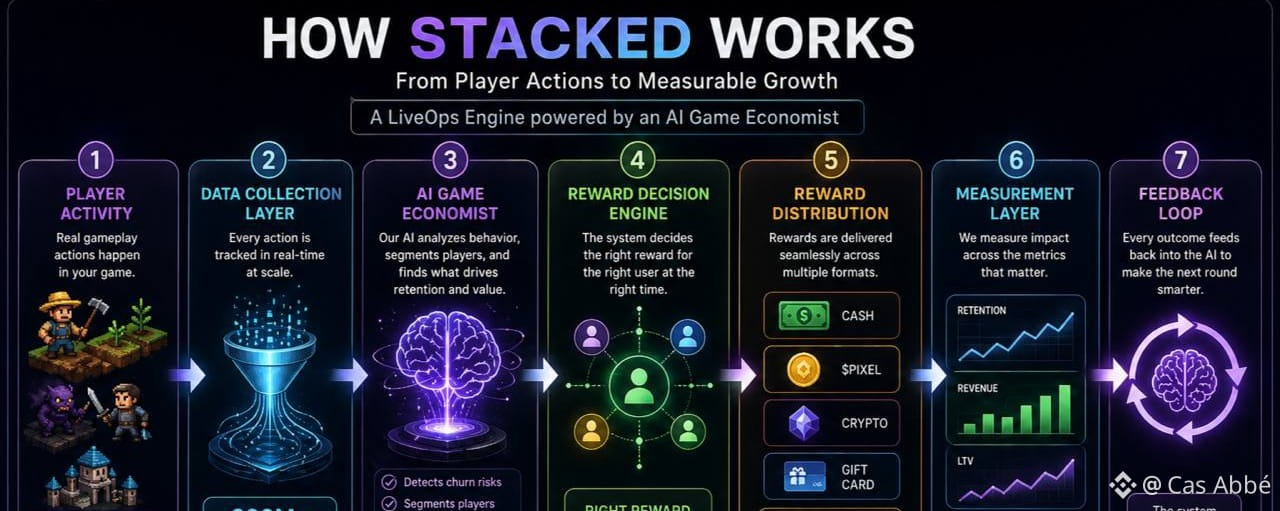


THIS IS WHAT A REAL GAME ECONOMY LOOKS LIKE: PIXELS x STACKED
Pixels replaced play-to-earn because it failed to deliver
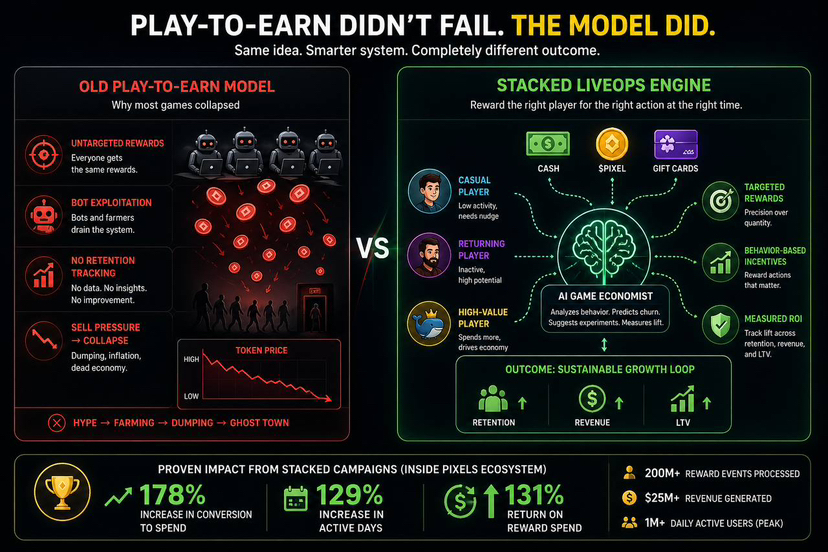
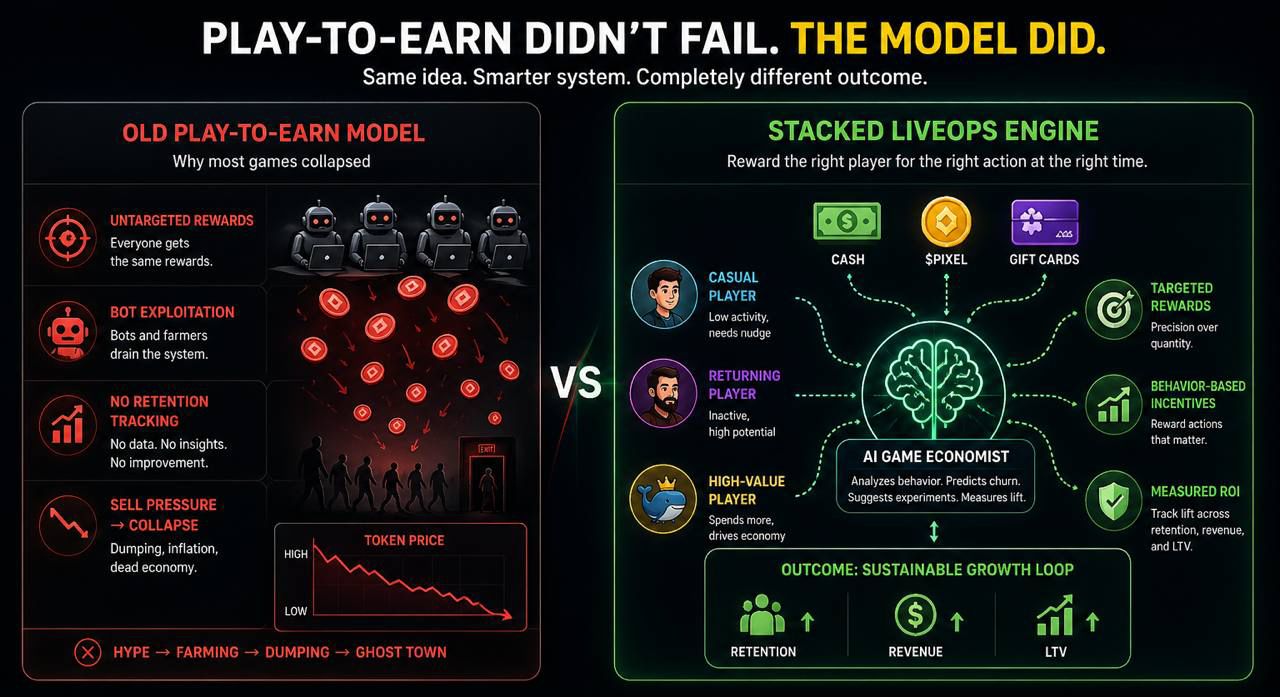
Play-to-earn died because the model was broken from day one. Tokens were thrown at users with zero control, zero targeting, and zero understanding of player behavior. Bots came in first, real players came in late, and the economy collapsed even faster. That cycle repeated across dozens of games. Hype → farming → dumping → ghost town.
Here’s the reality: the problem was never the token. The problem was the system behind it. This is why I’m finally paying attention to Pixels.
Pixels’ Stacked Ecosystem: How a Game‑Built LiveOps Engine Makes Play‑to‑Earn Sustainable
Pixels is not just a farming game. That’s surface-level thinking. The real story is what they built underneath the game something most teams completely ignore.
Stacked.l
And no, this isn’t another rewards app.
It’s a LiveOps engine. That sounds technical, but let me simplify it. Instead of giving rewards randomly, Stacked decides who should be rewarded, when, and for what action and then measures if it actually worked.
That’s a massive shift.
Because in traditional play-to-earn, rewards were treated like marketing hype. In Stacked, rewards are treated like capital allocation. That difference is everything.
Let’s talk about why this matters
Game studios already spend millions trying to get users. Ads, influencers, campaigns. Most of that money disappears into platforms like Google or Meta, and they still don’t know if those users will stay. Stacked flips that model.
Instead of paying platforms you pay your actual players very precisely. You reward the player who was about to quit. You incentivize the user who might convert. You bring back someone who hasn’t played in 30 days.
And then this is the key part you track if it improved retention, revenue, or lifetime value.
That’s LiveOps done right
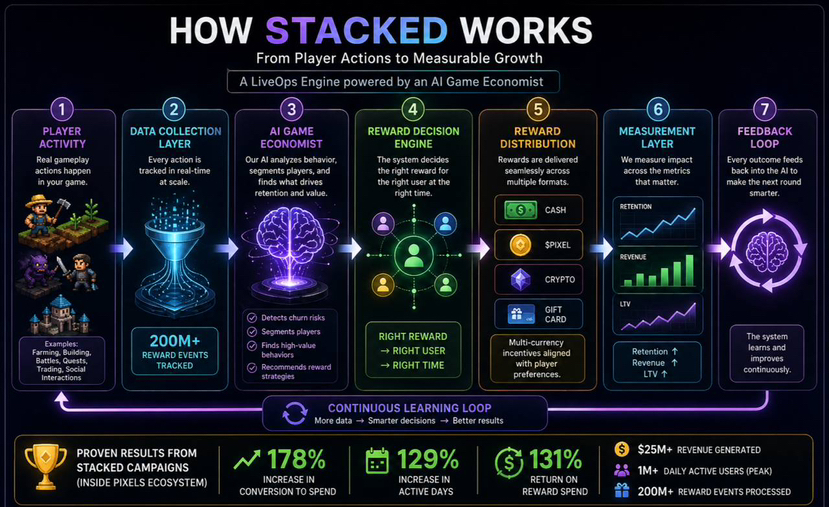
Now here’s where it gets interesting. Stacked isn’t running on guesswork. It’s running on what I’d call a built-in data scientist the AI game economist. Let’s know what this actually does. This system looks at millions of player behaviors and starts asking real questions:
Why are users leaving after day 3?
What do long-term players do differently?
Where is reward money being wasted?
Most teams can’t answer this. They don’t have the data or the tooling but Stacked does. And it doesn’t just answer it suggests actions. Run this reward, target this group or fix this drop-off point.
That’s operational intelligence anf we have proof with real numbers. When Pixels used Stacked to re-engage inactive players, they saw:
• 178% increase in conversion to spend
• 129% increase in active days
• 131% return on reward spend
Pause there!
That means rewards weren’t just costs anymore. They became profitable decisions. This is what you people miss. Stacked turns rewards into a measurable growth engine. This is not a freaking non-sensible giveaway
It gets deeper.
This system has already processed over 200 million reward events. Not simulated. Not theoretical. Real users, real actions, real data. And it contributed to $25 million in revenue inside the Pixels ecosystem.
That’s the part that should make you rethink everything.
Because now we’re not talking about a game. We’re talking about infrastructure that prints results. Built in production
YES!
Let’s address the elephant in the room: tokens
Most Web3 games build a token first and figure out utility later and that’s pretty backwards. Pixels did the opposite
They built the system first and now the token makes more sense. $PIXEL is not tied to one game anymore. Through Stacked, it’s evolving into a cross-ecosystem loyalty currency.
That matters
Because once multiple games plug into the same reward engine, you’re not just earning in one world you’re participating in a network.
More games → more usage → more demand surface for $PIXEL and that is utility driven by behavior.
There’s also a hidden advantage here that people underestimate.
The moat. Anyone can build a quest system. That’s easy.
But building:
• Anti-bot infrastructure
• Fraud-resistant rewards
• Behavioral data across millions of players
• A system that survives real money incentives
That takes years. Pixels already went through the painful part. Bots, farming, broken loops they’ve seen it all. Stacked is what came out of that battle
Now zoom out
This is never just about Pixels winning as a game. This is about a shift in how Web3 games operate.
Stacked is positioning itself as B2B infrastructure. Meaning other studios can plug into it. That changes the risk profile completely. It’s no longer dependent on one game’s success.
It becomes the engine behind many.
And if that happens you’re not betting on a single title. You’re betting on the system that powers them.
So here’s what I think
Play-to-earn didn’t fail because rewarding players is a bad idea. It failed because rewards were dumb, untracked, and easily exploited.
Stacked fixes that
It makes rewards intelligent. Measurable. Targeted. It treats player behavior like data, not noise.
And that’s why I think this matters more than 90% of new gaming tokens you see launching every month. If you ask me where Web3 gaming goes next, this is the direction.
Better systems!
And right now, Stacked looks like the blueprint