
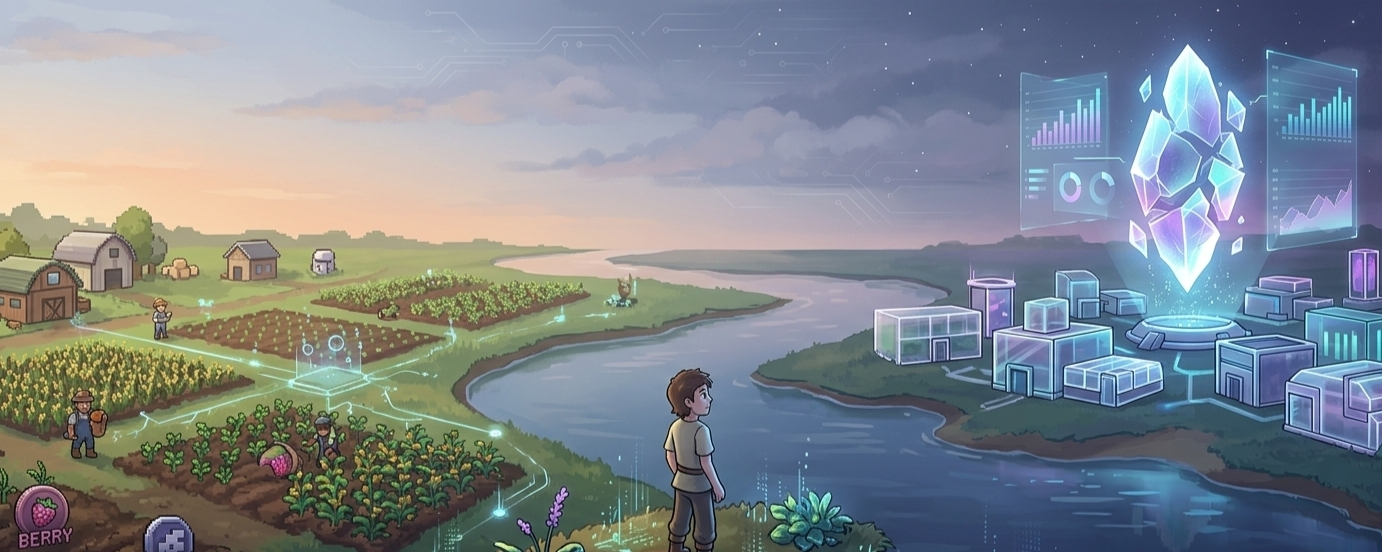

I didn’t expect much when I first wandered into Pixels. Another Web3 game, I thought—probably dressed up in soft colors and friendly mechanics, but quietly orbiting around tokens and speculation. And yet, the longer I stayed, the harder it became to pin down exactly what it was trying to be… or maybe what I was expecting it to be.
At first glance, it feels almost disarmingly simple. You farm, you explore, you gather things. There’s a rhythm to it that reminds me of older, slower games—the kind where progress isn’t about speed but about showing up. I found myself planting crops without really thinking about efficiency, just enjoying the loop. That surprised me. I usually optimize everything, even games that aren’t meant to be optimized.
But then that quiet question starts creeping in: is this actually a game I enjoy, or am I just curious about the system behind it?
Because Pixels exists in that strange Web3 space where nothing is entirely innocent. Every action feels like it might have a secondary meaning—some underlying economy, some future value, some invisible ledger keeping score. And I can’t decide if that adds depth or quietly drains the magic. There’s a subtle shift when you realize your time might be “worth” something. It makes you more aware… but also more distant.
Still, there’s something oddly human about the way people move through the world. You see others farming beside you, building, trading, just existing in this shared digital space. It doesn’t feel competitive in the usual sense. It feels… parallel. Like everyone is walking their own path, occasionally intersecting but never fully colliding.
I keep wondering if that’s the real appeal—not the tokens, not the blockchain layer, but the atmosphere of low-stakes presence. It’s rare to find a game that doesn’t constantly push you, doesn’t demand urgency. Pixels almost resists that pressure. And yet, ironically, the Web3 element introduces its own kind of pressure, just quieter, more psychological.
There were moments where I caught myself thinking: if this game had no tokens at all, would I still be here? And the answer wasn’t obvious. Part of me wants to say yes, because the experience itself is calming in a way that feels genuine. But another part of me knows that curiosity—the “what if this becomes something bigger”—is doing some of the work.
Maybe that’s the tension at the center of Pixels. It’s trying to be both a place and a platform. A game you can sink into, and a system you can benefit from. And I’m not sure those two things fully align, at least not yet.
Still, I keep coming back. Not out of excitement, exactly, but out of a kind of quiet interest. Like watching something evolve in slow motion. I’m not fully convinced, but I’m not dismissing it either. And maybe that in-between feeling—the uncertainty—is what makes it stick in my mind longer than I expected.