
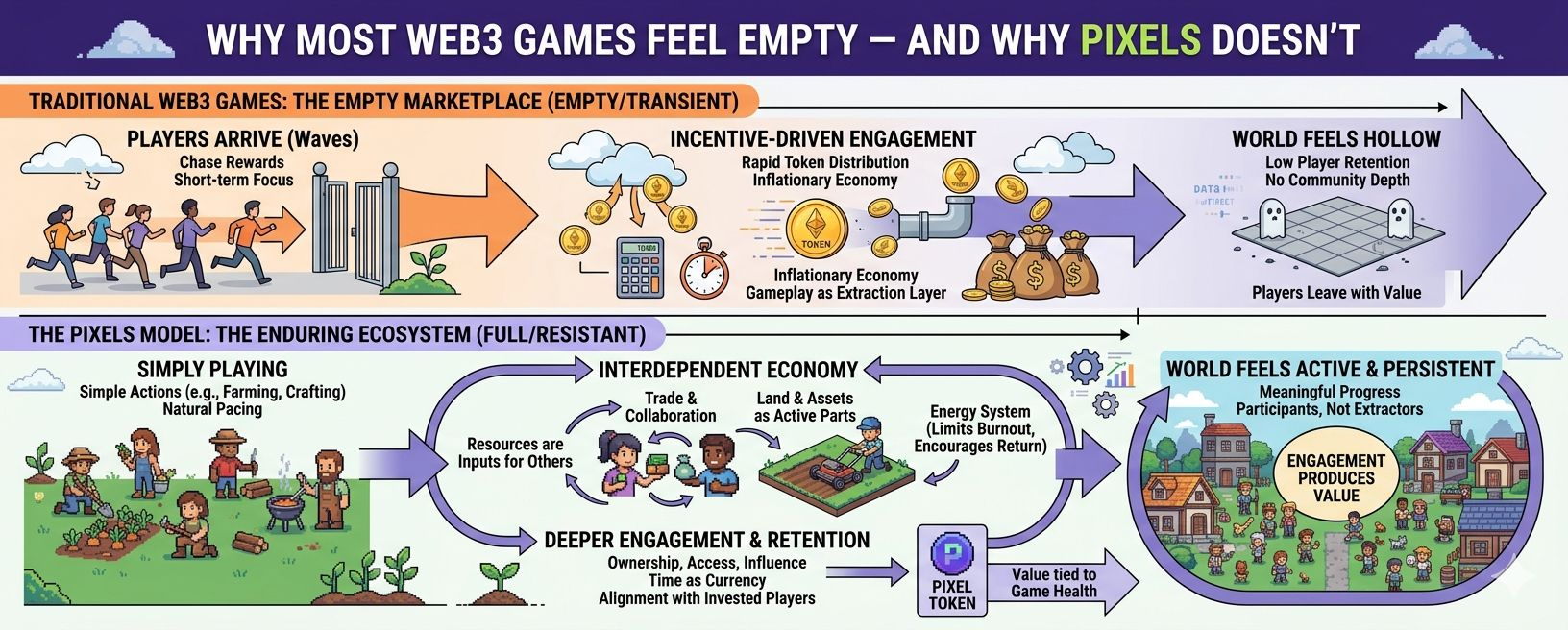
There’s a strange pattern in Web3 gaming: players arrive in waves, chase rewards, and disappear just as quickly. The worlds remain, but they feel hollow—like marketplaces pretending to be games.
The issue isn’t technical. It’s structural. Many Web3 games are built with the assumption that incentives alone can sustain engagement. Tokens are distributed early, economies inflate quickly, and gameplay becomes secondary to extraction. Players aren’t there to stay—they’re there to leave with something.
Pixels takes a different path by shifting the focus away from immediate gain and toward ongoing participation.
When you enter Pixels, nothing pushes you to rush. You plant crops, gather materials, cook, trade—simple actions that don’t scream value at first. But over time, a pattern emerges: everything you do feeds into something that persists. Resources aren’t isolated rewards; they’re inputs for other players, other systems, other decisions. The world doesn’t reset around you—it absorbs what you contribute.
This is where most Web3 games break down. They treat gameplay as a thin layer wrapped around a token model. Pixels does the opposite—it builds a loop where the token depends on the health of the game, not the other way around.
The PIXEL token isn’t handed out recklessly. It’s positioned further down the line, tied to deeper engagement—ownership, access, influence. That distance matters. It filters out short-term behavior and aligns value with players who are actually invested in the system. Instead of asking, “How fast can I earn?”, the design quietly shifts the question to, “How long am I willing to stay involved?”
Ownership also plays a different role here. Land and assets exist as NFTs, but they aren’t just speculative items sitting idle. They function as active parts of the ecosystem. A piece of land can produce, host, or enable other players’ activity. This creates interdependence—value isn’t locked in ownership alone, but in how ownership is used.
Time becomes the real currency. Energy systems limit how much you can do at once, encouraging return rather than burnout. Progress is steady, not explosive. That pacing might seem slow compared to reward-heavy models, but it creates something those models lack: stability.
Another difference is how social interaction is handled. In many Web3 games, other players are either competitors or irrelevant. In Pixels, they are part of the flow of value. Trade, collaboration, and shared spaces aren’t optional—they’re necessary. The economy doesn’t function without them.
This creates a subtle but important shift in behavior. Players stop acting like extractors and start acting like participants. The world feels less like an opportunity and more like a place.
That distinction is what keeps Pixels from feeling empty. It doesn’t rely on constant excitement or inflated rewards. Instead, it builds a system where small actions accumulate meaning over time, and where value emerges from interaction rather than distribution.
Most Web3 games struggle because they try to simulate engagement with incentives; Pixels works because it builds a world where engagement naturally produces value.