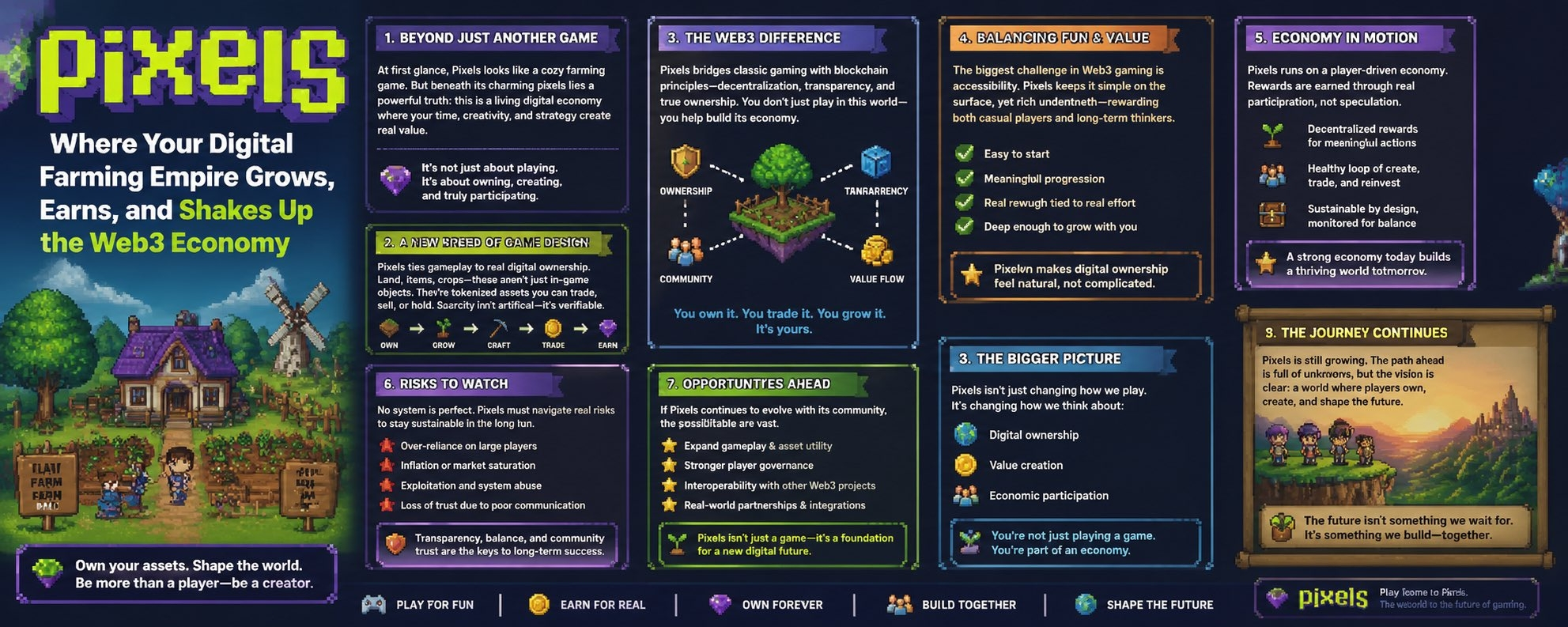

When I first stumbled upon Pixels, I initially thought it was just another game trying to cash in on the hype around Web3 and blockchain technology. I mean, how many more “play to earn” games can there be? But as I delved deeper into its mechanics, something struck me: Pixels is not just about playing it’s about creating, owning, and truly participating in a living digital economy. The game doesn’t just combine fun gameplay with financial rewards; it redefines the relationship between value creation and the virtual world. It’s a glimpse into how the digital farming genre and Web3 economies might intersect to build something truly transformative.
What Pixels does differently is in its fundamental design. It’s not about grinding for virtual currency that’s tied to no tangible value outside the game. Instead, it positions its in game assets such as land, resources, and items as real digital commodities. This design choice has a clear impact: it ties gameplay directly to the Web3 economy, where ownership, scarcity, and tradeable assets aren’t abstract concepts they’re realities that hold true across both digital and real world economies.
In many ways, Pixels exemplifies a bridge between traditional gaming mechanics and the decentralized principles of blockchain technology. But the real story lies in how this integration changes not only how players interact with the game but also how they interact with the economic ecosystem Pixels is creating. The farming world, while still rooted in its fun, casual origins, becomes a framework for building assets with long term value assets that players can trade, sell, or keep for personal growth.
The friction, of course, lies in the practical implications of this model. A major tension in any Web3 game is balancing the allure of earning with the risk of overwhelming complexity. Too many systems, too much jargon, or too steep of a learning curve can drive players away. Pixels faces this challenge head on by building an intuitive system where rewards and value are clear, yet still deeply tied to effort and participation. It’s a fine line between making it accessible to casual players and creating enough depth to engage serious, long term investors. I think Pixels gets this balance right without complicating the gameplay, they offer enough structure to make digital ownership a tangible part of the player experience.
But where does the game go from here? It’s clear to me that the potential for Pixels is immense, but not without its challenges. The broader gaming market, especially within the Web3 space, still struggles with trust and transparency. Despite the promise of blockchain, players are often wary of systems that claim to deliver value without truly explaining the mechanics behind the scenes.
Pixels has made strides in addressing this with its relatively transparent approach to how assets are created, traded, and utilized within the game. But as the ecosystem expands, so too does the need for clear communication about how value is generated and sustained in the long term.
Another key issue is the ecosystem’s ability to maintain a balanced economy. The success of Pixels hinges not just on a few early adopters, but on creating a robust, repeatable cycle of value creation. I’ve seen many Web3 projects struggle when their economy is overly reliant on a few large players or speculative behaviors. Pixels has a built in strategy to avoid this by offering decentralized rewards tied directly to gameplay and meaningful interactions. Still, it’s a system that needs constant monitoring to avoid inflation, market saturation, or exploitation by players seeking to “game the system.”
Ultimately, what stands out to me about Pixels is its ambition to blend gaming with true economic ownership, something that has rarely been done effectively. It’s easy to see how this model could serve as a template for future Web3 games. Instead of simply creating a system where players are paid to play, Pixels makes players active contributors to a broader economic ecosystem.
In this sense, it doesn’t just represent a new way to play it represents a new way to think about ownership, value, and economic participation in the digital age.
Looking forward, it’s clear that the success of Pixels will depend on how well it continues to balance engagement with ownership, depth with simplicity, and fun with financial reward. While these dynamics are never easy to get right, the framework that Pixels has put in place feels promising.
If the game can continue to evolve while maintaining a healthy, sustainable economy, it could reshape the future of how we think about games, value creation, and the convergence of digital and real world economies.
For now, Pixels serves as a fascinating example of what Web3 gaming can achieve. It’s not just about playing it’s about participating, investing, and creating a meaningful digital future. And in that sense, Pixels may just be ahead of the curve.