
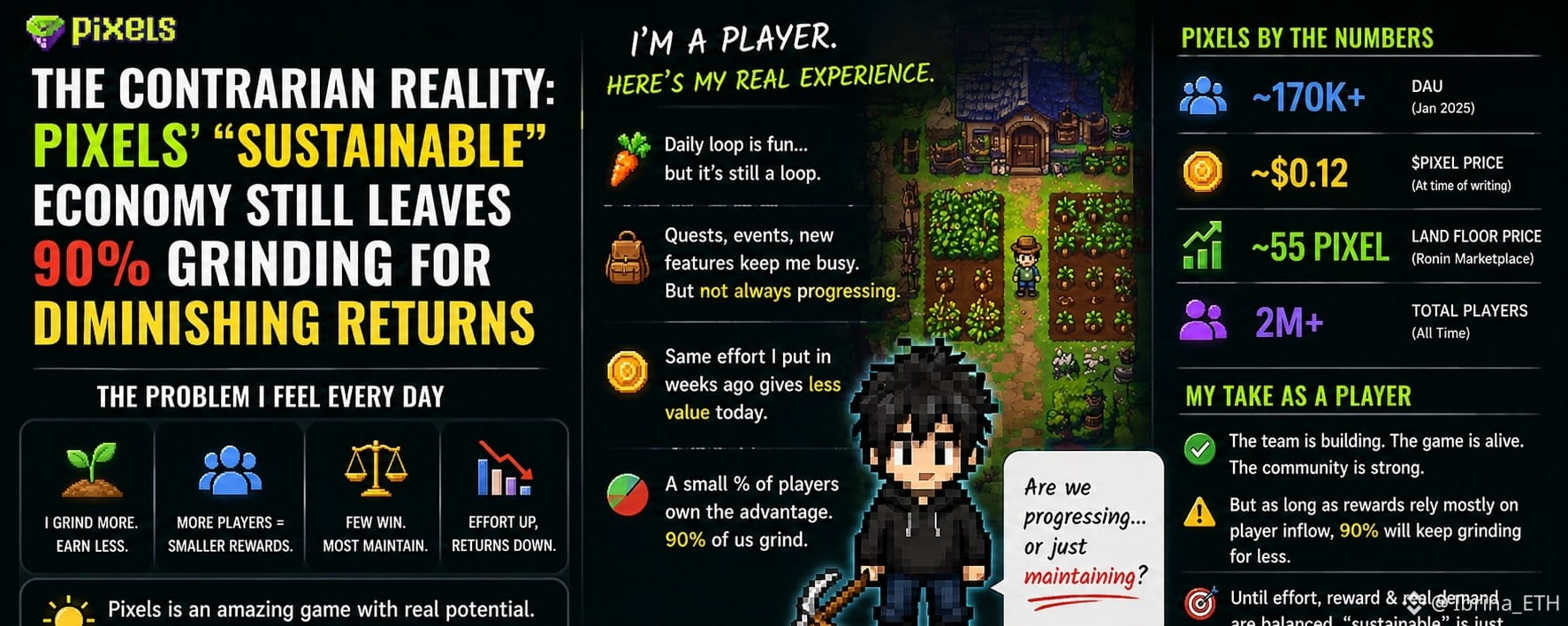

I’m not analyzing this from the outside. I’m inside it.
I log in, I grind, I optimize routes, I test what works and what doesn’t. I’ve spent enough time in Pixels to understand one thing clearly: what looks sustainable on paper doesn’t always feel sustainable when you’re actually playing.
From the outside, everything checks out. The game is active, updates are consistent, and the ecosystem keeps expanding. Built on Ronin Network, it carries the legacy of high-activity Web3 games.
But when you zoom in — when you actually play daily — the experience tells a more complex story.
I’ll explain it the way I’ve lived it.
When I first started grinding, it felt rewarding. Every session had visible progress. Farming, crafting, completing quests everything felt like it was moving me forward.
But after consistent play, the pattern changed.
Now my sessions look like this:
Plant → harvest → process → repeat
Complete tasks → collect rewards → repeat
Optimize time → still repeat
The loop doesn’t change — only the feeling does.
Because over time, I noticed something subtle but important:
The same effort is no longer producing the same value.
This is where the core issue starts to show.
Pixels promotes a play-and-earn system. But what I experience is closer to this:
The more participants in the system, the less impactful each individual action becomes.
At first, grinding felt like growth. Now it feels like maintenance.
I’m not earning “more” by playing more — I’m often just working harder to stay in the same position.
And that’s a big difference.
There’s also a reality most players won’t openly say, but you can feel it when you play long enough.
A small group of players clearly operates at a different level:
Better land ownership
Early positioning advantages
Faster optimization of systems
Meanwhile, most players including myself at times are stuck in basic loops, competing for limited rewards.
That creates a silent imbalance:
A minority extracts higher value
The majority sustains the system through activity
And if you’re honest with your own gameplay, you know exactly which side you fall on.
Now let’s talk about growth — because that’s where things get even more interesting.
From the outside, growth looks bullish. More players, more engagement, more ecosystem expansion.
But inside the game, growth has a different effect.
More players means:
More competition for the same resources
More rewards being distributed across more participants
More pressure on the value of each action
So instead of amplifying earnings, growth often compresses them.
This is something you don’t see on dashboards — but you feel it during gameplay.
Pixels is extremely good at keeping you engaged. There’s always something happening — new quests, seasonal events, feature updates.
But engagement and progress are not the same thing.
I’ve had sessions where I played longer, optimized better, and still felt like I achieved less than before.
That’s when the realization hits:
I’m not progressing faster. I’m just grinding harder.
Then comes the new layer — staking, ecosystem expansion, multi-game vision.
On paper, this is evolution. And strategically, it makes sense.
But from my perspective as a player, the real question is simple:
Does this improve my daily experience?
So far, it feels more like infrastructure expansion than a direct solution to the core issue. The grind remains. The pressure remains. The imbalance remains.
At some point, I started thinking beyond gameplay.
If I’m earning, someone else must be providing that value. If rewards exist, demand must exist somewhere.
But a large part of the system feels internally driven:
Players earning from systems supported by other players
Value circulating within the ecosystem rather than entering it
And that’s where things become fragile.
Because if player growth slows down, the pressure on rewards becomes visible very quickly.
To be clear — I’m still playing.
Not because everything is perfect, but because the project is active, evolving, and still experimenting with solutions. Pixels is far from a dead ecosystem.
But activity alone doesn’t equal sustainability.
From the outside, Pixels looks like a thriving Web3 success story.
From the inside, as someone actually grinding daily, it feels like a system where most players are putting in more time over time… for smaller relative gains.
That doesn’t mean the model will fail.
But it does mean one thing:
The balance between effort, reward, and real demand hasn’t been fully solved yet.
And until that balance is fixed, the idea of a “sustainable economy” remains more of a direction than a reality.
If you’re playing Pixels right now, I’d ask you the same question I asked myself after weeks of grinding:
Are you actually progressing… or just maintaining your position?