

I’ve spent enough time watching these kinds of games evolve to notice when something starts to feel different—not because it’s louder or more polished, but because it’s asking a little more from the player than just showing up.
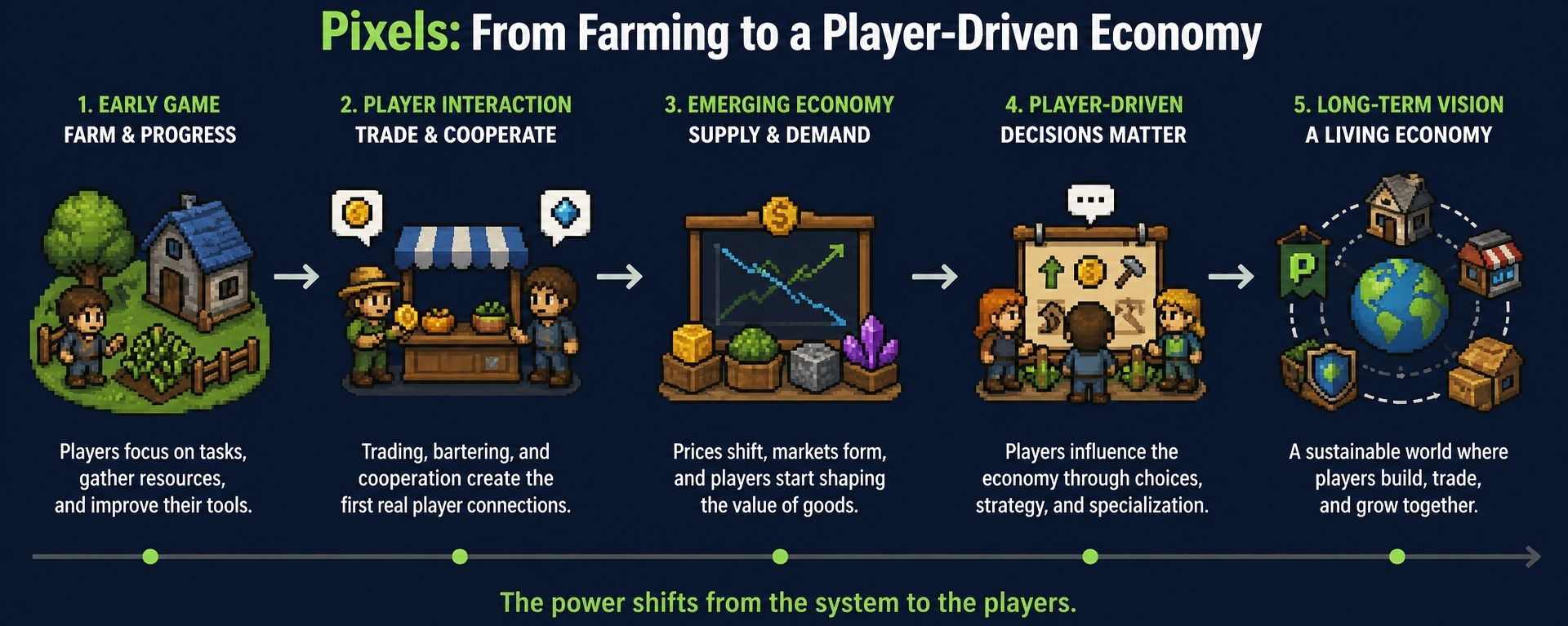
With Pixels, that shift is starting to come into view. It doesn’t feel like a place where you can just log in, follow a loop, and leave anymore. There’s a quiet pressure to pay attention—to what others are doing, to how things are moving, to where you fit into it. Not in an overwhelming way, just enough to make you realize the system isn’t going to carry you as much as it used to.
At first, that’s refreshing. It feels closer to something real. You’re not just playing against the game, you’re playing around other people. Small decisions start to matter. Timing matters. Even hesitation has a cost. It creates this sense that things are happening because players are making them happen, not because the game is feeding outcomes into a loop.
But I’ve seen how this usually plays out over time, and it rarely stays this open for long.
What begins as freedom slowly turns into patterns. People figure out what works, then they repeat it. Others follow, not because they want to, but because it’s the safest way to keep up. And without anyone really deciding it, the system starts to narrow. The range of choices shrinks, even though technically nothing was removed.
You can feel the early signs of that forming if you look closely.
Some strategies already feel a bit too reliable. Certain behaviors are starting to repeat. It’s subtle, but it’s there. And once those patterns settle in, they tend to stick. Not because they’re perfect, but because they’re “good enough,” and most players don’t have a reason to deviate from something that works.
That’s where things usually lose their edge.
Right now though, Pixels hasn’t fully crossed that line. There’s still some uncertainty in how everything fits together. People are still adjusting, still figuring things out. It’s not completely efficient, and strangely, that’s what makes it feel alive. There’s room for mistakes, for small discoveries, for moments where you’re not just following a path that someone else already cleared.
It feels unfinished in a way that’s actually useful.
The tension comes from knowing that this phase doesn’t last forever. Eventually, the system will settle. Players will optimize it, simplify it, reduce it down to something predictable. It won’t happen all at once, and it won’t look like a failure. In fact, it’ll probably look like progress—more stability, clearer strategies, smoother outcomes.
But that’s usually when something quietly disappears.
Because when everything starts making sense, there’s less reason to think, less reason to explore. The economy might still be “player-driven,” but it won’t feel like players are shaping it anymore. It’ll feel like they’re maintaining it, keeping it running the way it’s supposed to.
And that’s a very different experience.
There’s also a kind of imbalance that tends to creep in during this process. The players who figure things out early—who treat the system like something to solve—end up influencing how everyone else plays. Not directly, but through example. Their decisions ripple outward, shaping what becomes normal.
Most people don’t notice it happening. They just adapt.
Pixels seems aware of this risk, at least in how it’s trying to keep things flexible. But awareness doesn’t always stop systems from settling into patterns. If anything, it just delays it. These environments have a natural pull toward stability, even when instability is what makes them interesting.
And that’s where it stands right now—somewhere in between.
Not fully open, not fully predictable. Still moving, still a bit uneven. It works, but not in a way that feels locked in yet. And maybe that’s the most honest version of it. Not a finished system, not a solved economy—just something that still depends on how people choose to play it.
For now, that’s enough to keep it interesting.
What matters is whether that feeling survives once everyone thinks they understand it.