

There was a time when crypto felt like discovery. Now it feels like déjà vu with better graphics.
Every few months, a new wave rolls in. First it was DeFi, then NFTs, then “metaverse,” then AI got stapled onto everything whether it made sense or not. The language changes, the logos get cleaner, the funding rounds get bigger—but underneath, it’s the same rhythm. Hype, inflow, overextension, slow realization, and then silence.
Honestly, I don’t even get excited when I hear about new projects anymore. I just… observe. Maybe that’s what multiple cycles do to you. You stop chasing narratives and start looking for cracks instead.
Crypto gaming is probably where that fatigue hits the hardest.
We’ve already lived through the big promise. Play-to-earn was supposed to onboard millions, turn gamers into stakeholders, reshape digital economies. And for a moment, it looked like it might. Then reality stepped in. Economies collapsed, rewards dried up, and the “players” turned out to be mostly mercenaries optimizing yield.
So when I first came across Pixels, I didn’t feel curiosity. I felt resistance.
A farming game. Social. Open world. Token attached. Built on Ronin Network. It checks all the familiar boxes. If you’ve been around long enough, your brain almost auto-completes the rest.
But then you look a bit closer, and something feels… slightly different. Not revolutionary. Just different enough to pause the scrolling.
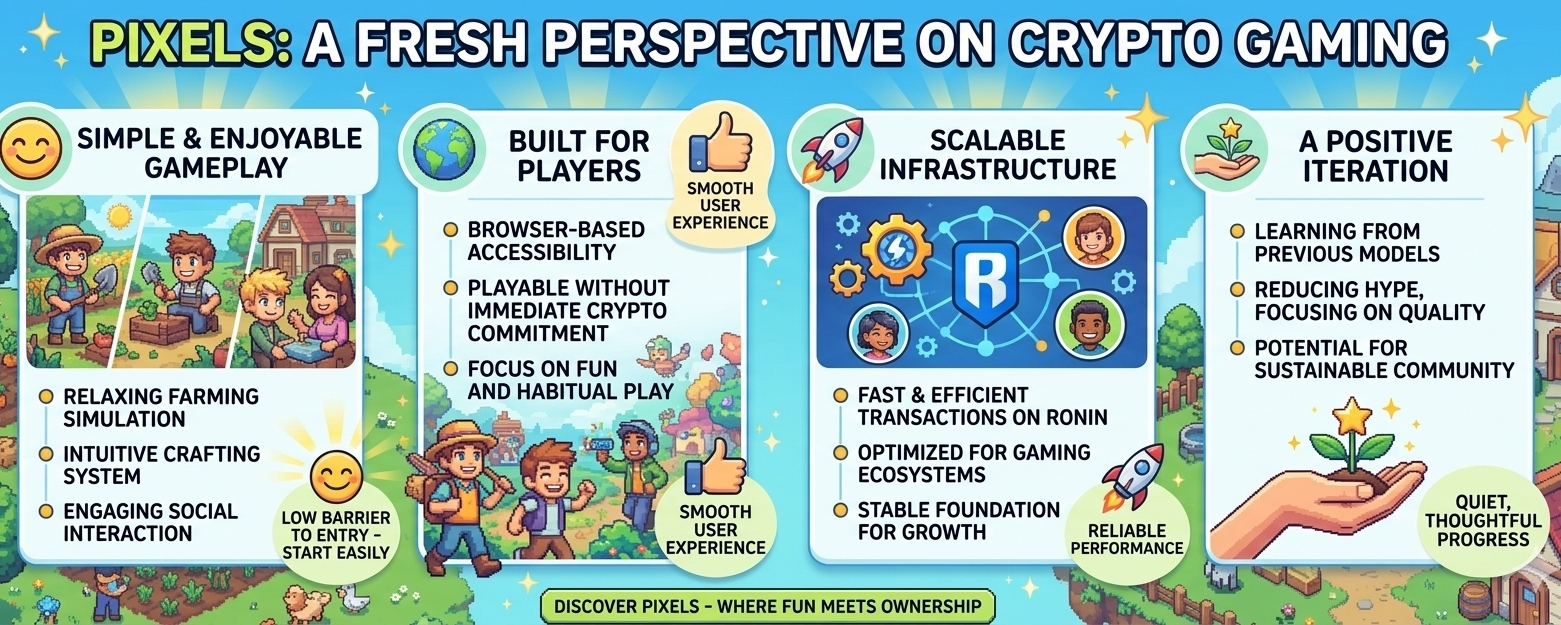
Pixels isn’t trying to overwhelm you. That’s probably the first thing I noticed. The gameplay loop is simple—farming, crafting, wandering around, interacting with other players. It doesn’t scream “financial opportunity.” It doesn’t immediately push you toward optimizing returns.
And honestly, that’s refreshing in a weird way.
Because let’s be real—the actual problem here isn’t complicated. Crypto games haven’t been fun. That’s it. That’s the whole issue. Everything else—tokenomics, scaling, interoperability—is secondary if the core experience feels like a spreadsheet disguised as a game.
Pixels at least seems aware of that. It leans into slower pacing, almost deliberately boring mechanics. And I don’t mean that as an insult. I mean boring in the way that games like farming sims are supposed to be—repetitive, calming, habitual.
But then the tension creeps back in, because this is still crypto.
There’s still a token—PIXEL token—and once a token exists, expectations follow. It doesn’t matter how much you try to position it as optional or secondary. People will speculate. They always do.
That’s the part that worries me.
Because tokens change behavior. They shift the mindset from “playing” to “optimizing.” Even if the design tries to resist that, incentives have a way of bending systems over time. We’ve seen it happen again and again. Early users benefit, narratives build, more users come in chasing the same outcome, and eventually the balance tips.
Maybe Pixels delays that. Maybe it softens it. But I’m not convinced it escapes it.
And then there’s the bigger question that nobody in crypto likes to sit with for too long—do regular gamers even want this?
We keep assuming they do. We keep building as if ownership, tokens, and digital economies are inherently appealing. But most players already have games that work. Games that are polished, stable, and don’t require them to think about wallets or tokens or whether an in-game action has financial implications.
Pixels tries to lower that barrier. It’s browser-based. It doesn’t immediately force you into the deep end of crypto mechanics. That’s smart. It removes friction, at least on the surface.
But friction isn’t just technical. It’s psychological.
Once money enters the system—even indirectly—the experience changes. You start thinking differently. You hesitate differently. You engage differently. And not always in a good way.
Maybe some players like that. Maybe a niche forms around it. But mass adoption? I’m still skeptical.
And then there’s infrastructure, which in crypto is always presented as “solved” right up until something breaks. Ronin is fast, cheap, purpose-built for games. On paper, it’s exactly what something like Pixels needs.
But we’ve all been around long enough to know that “on paper” doesn’t always survive contact with reality.
So where does that leave something like Pixels?
Honestly… somewhere in the middle.
It doesn’t feel like a scam. It doesn’t feel like empty hype dressed up in nicer visuals. It feels like an iteration. A team that looked at what failed before and tried to adjust—not by reinventing everything, but by toning things down.
Less noise. Less promise. Slightly more focus on the actual game.
And maybe that’s the right direction.
Or maybe it’s just a more polished version of the same loop.
That’s the uncomfortable part about being in crypto for too long—you stop trusting first impressions. You’ve seen too many “this time it’s different” moments fade into the same outcome.
So yeah, Pixels is interesting. Not exciting, not groundbreaking—just interesting enough to watch.
Maybe it works, maybe it doesn’t.
Maybe it finds a small, loyal player base that doesn’t care about tokens as much as everyone else assumes they will. Or maybe the token slowly takes over, like it always does, and the game bends around it.
I don’t know.
What I do know is that the space doesn’t need louder ideas right now. It needs quieter ones that actually hold up over time.
Pixels feels like it’s trying to be one of those.
Whether that’s enough… we’ll see.