
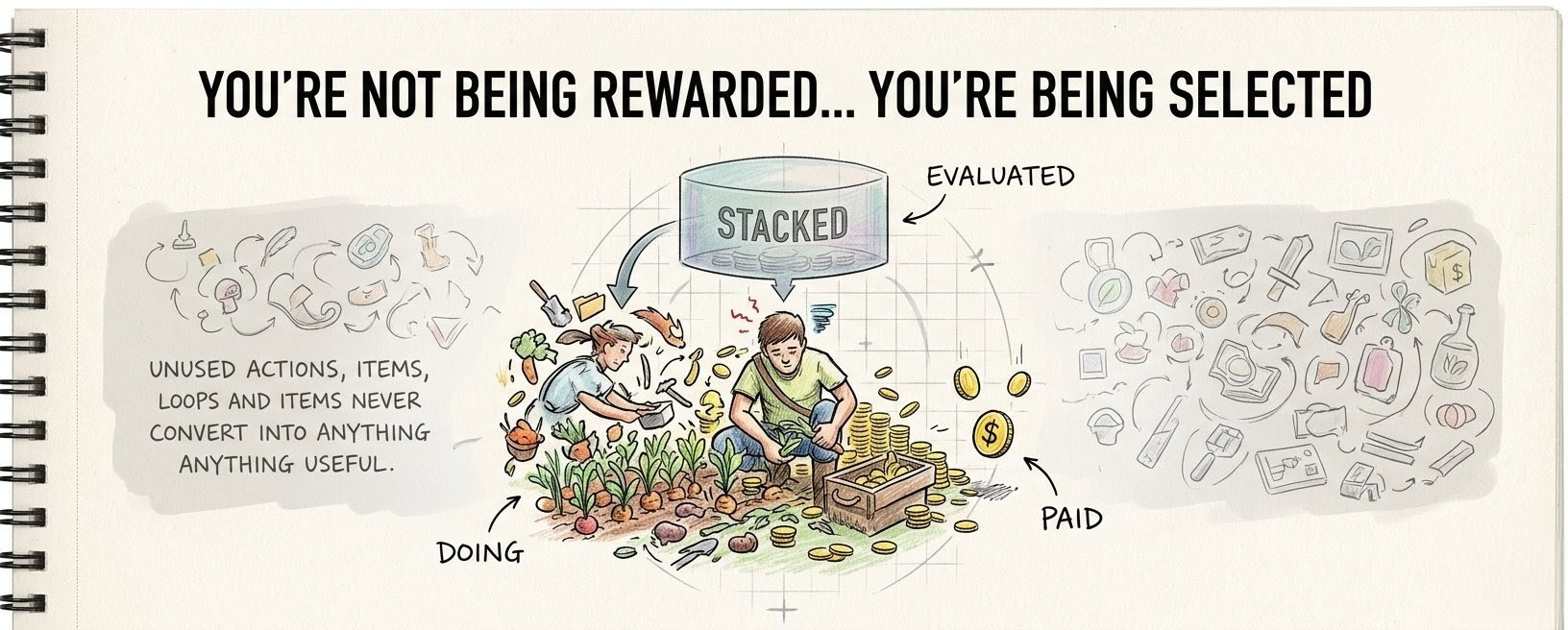

i keep thinking expansion inside Pixels should mean more land opening somewhere… more crops, more houses, more quests, maybe another area on the map that players walk into and call it growth. that is the easy version… more space, more things, more movement. but the longer i sit with Pixels, the less i believe the map is the actual point.
because the Pixels farm already feels like it is doing something beyond being a farm. it is not just a place where crops grow and players run loops. it feels more like a working sample… one playable version of a system that could keep producing other versions of itself if the right rails stay connected underneath.
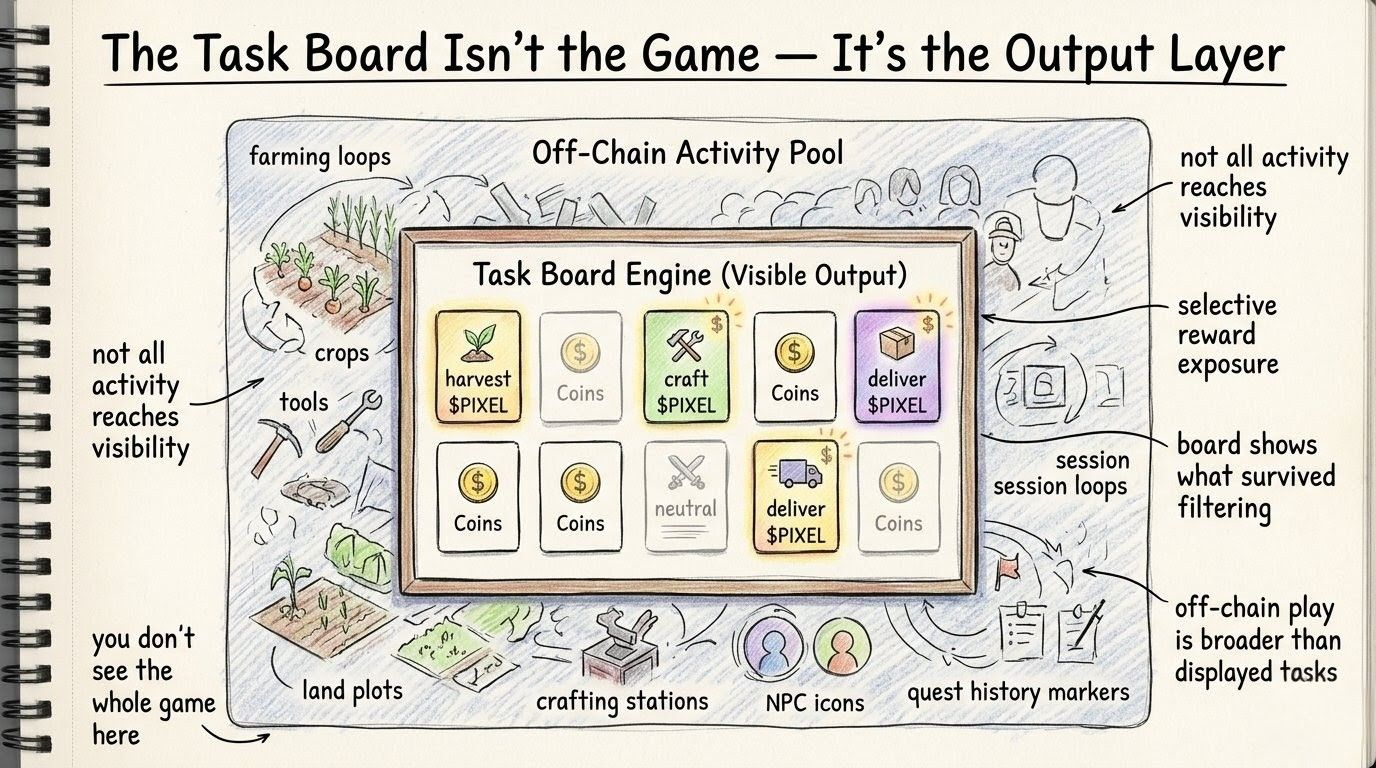
and that thought feels strange because from inside the session, nothing announces itself like infrastructure. i still plant, harvest, craft, check the Task Board, move between plots, burn energy, spend Coins on seeds and small upgrades, maybe touch pixels if the path actually opens… it all still feels like gameplay first. but maybe that is the trick. maybe Pixels had to look like a game before it could become something that launches games.
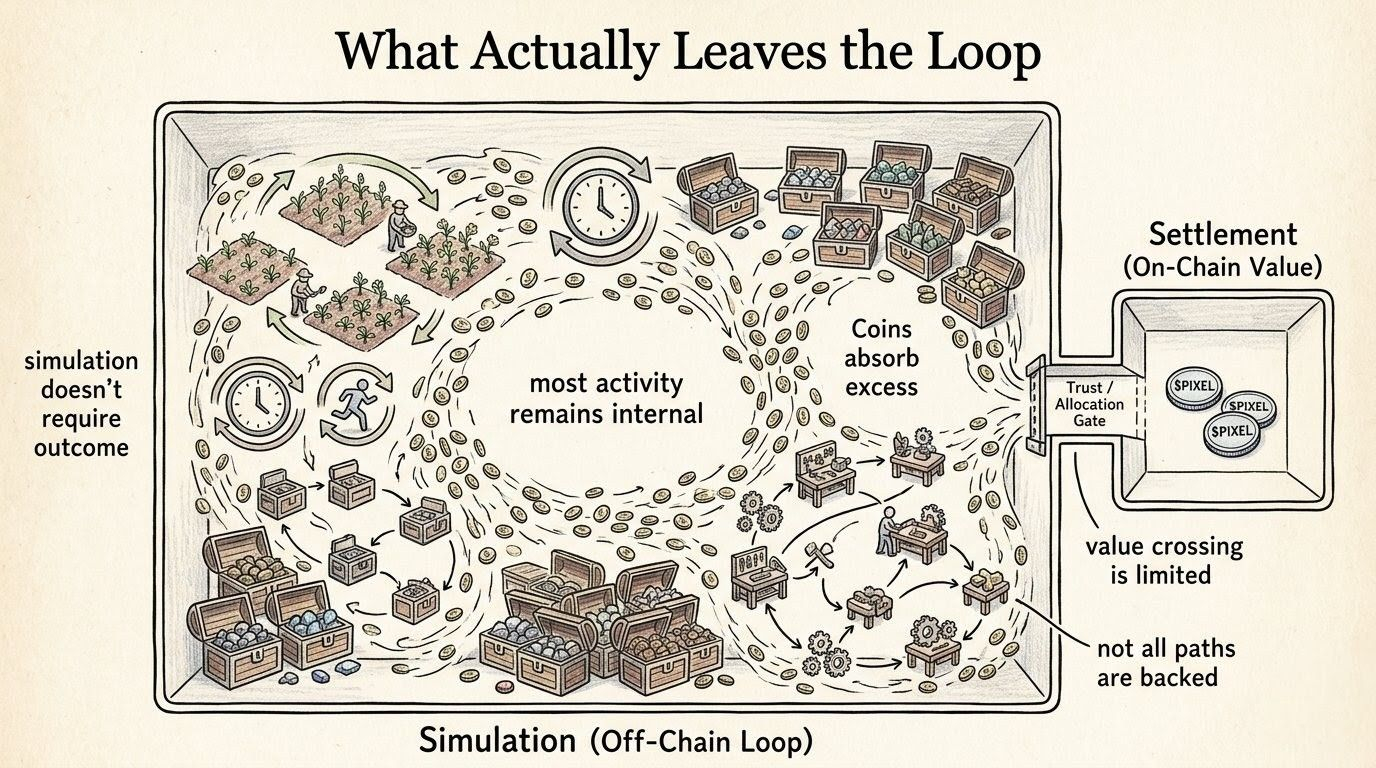
because if the farm loop works, if the off-chain servers can carry all that cheap movement, if Coins can keep daily activity alive, if pixels can stay selective for land, pets, guilds, premium paths and rewards, if Trust Score can filter exits, if RORS can stop reward spend from turning into pure leakage… then the farm is not just content anymore. it becomes proof that a loop can run without putting every action on Ronin, proof that players can move fast without gas touching every click, proof that value can be kept scarce while activity stays loose.
and once that exists, the next question becomes uglier in a bigger way… why stop at one loop, why stop at one farm, why not turn the whole thing into a Pixels system where more games can be built through the same economic spine.
that is where Realms starts feeling heavier than “new content” to me, because Realms doesn’t sound like just another area. it sounds like Pixels trying to make its own world scriptable… like the farm is becoming a base layer other builders can shape around. mini-games, sub-games, custom loops, different rules, different player flows… but still sitting near the same pixels rails, the same reward logic, the same pressure that already decides what can survive inside the main game.
and if the Factory Contract is the launcher, then Realms feels like the playable shell. one side creates the conditions for new game layers to exist, the other gives builders somewhere to script behavior, routes, loops, maybe whole small economies inside the same wider system. that is not just “more map” anymore. that is Pixels trying to make repeatable game creation part of its architecture.
so what is expanding there… the map, or the ability to manufacture more maps.
that difference matters more than it looks, because normal games expand by adding more stuff inside themselves. Pixels looks like it is trying to expand by turning itself into the thing that makes more playable economies possible. one is content growth. the other is production capacity, and production capacity is more dangerous because now every new Realm or sub-game is not just “fun extra content.” it becomes another place where value might flow, another surface where pixels might be used, another loop that has to prove it can hold players without leaking rewards to death.
that sounds less romantic than “metaverse” or whatever, but it feels more real. Pixels is not just asking “can we add more gameplay.” it is asking something colder… can we add more games without breaking the economy that connects them.
and that is where the Factory Contract idea starts bothering me in a good way. because this kind of Pixels system does not care about one pretty world only. it cares about repeatable creation. it sets parameters, creates instances, controls what can be launched, what fees exist, what lockups apply, what rules new game layers have to accept before they plug into the ecosystem.
if that is the direction, then Pixels is not only building more farm space. it is building a structured way for new playable layers to appear. not every random loop should be able to touch pixels rewards like it is free money. not every sub-game should inherit the economy just because it exists. something has to decide what gets spun up, what gets funded, what gets tested, what survives.
and that makes me look back at the farm differently, because maybe the farm was never only the product. maybe it was the first production test… the place where Pixels learned what breaks when players are paid too easily, what happens when bots find a route, what happens when soft currency gets mistaken for real value, what happens when players come only to extract and leave nothing behind. old P2E games learned that lesson by dying. Pixels seems to be trying to turn that lesson into infrastructure.
not perfectly, not cleanly, not in some polished whitepaper way… more like through scars. through loops that got tightened, rewards that had to be controlled, Trust Score, RORS, Stacked, all the boring invisible systems that players only notice when something stops paying the way they expected.
and now that same scar tissue might be what lets Pixels become bigger than one game.
because if new games launch through Pixels rails, they are not starting from zero. they are inheriting a whole survival system: reward spend logic, behavior tracking, staking direction, anti-bot pressure, reputation gates, pixels as the hard currency, Coins or local soft loops as the cheap motion layer, Ronin as the settlement side where real ownership and value actually land.
even the identity layer can travel with it in a weird way. Pixels already lets outside NFT communities show up as playable bodies instead of just wallet trophies, so a new game layer does not have to begin with empty avatars and empty social context. it can inherit players, identities, collections, habits, and then still has to prove the loop deserves value.
that is not just expansion. it is replication. and replication changes the whole thing because once Pixels becomes this kind of launch rail, the player is no longer only choosing what to do inside one farm. the player might be moving across a network of loops that all compete for attention, rewards, staking weight, validator support, and Stacked-driven proof that they deserve budget.
so if a new sub-game appears, what am i actually entering… a game, or a newly launched experiment inside the Pixels machine.
Game Validators make this even weirder. staking is not just passive income here. it starts acting like publishing direction. players and holders point pixels toward validators, toward games, toward ecosystem lanes. that means the future of Pixels is not just designed by devs adding content from the top. it is partly shaped by where the token holders send weight.
and i keep thinking about how different that is from normal publishing. Steam decides what appears, stores decide what gets visibility, platforms decide where distribution goes. but Pixels is playing with something stranger… what if publishing direction becomes staked, what if the community does not just play the games, but helps decide which games get fuel. not by liking a trailer, not by leaving a review, but by putting pixels weight behind a validator lane and letting that lane prove whether it can actually hold an economy.
that is not clean democracy. it is messier than that, but it is also more interesting.
because if staking points value and Factory contracts create new game shells and Realms lets builders script new playable spaces, then Pixels starts looking less like a farming game with expansions and more like a publishing layer where games are launched, tested, funded, and either kept alive or quietly thinned out.
and then Pixels Stacked sits there like the liveops brain nobody sees clearly, not just handing out rewards but watching what those rewards do… who stays, who leaves, which cohort returns after day 3 or day 7, which loop burns budget, which game turns reward spend into revenue instead of extraction. this is where the game-making Pixels system becomes more than a word of mouth, because without measurement it just produces junk, and without reward discipline it produces new P2E graves.
Stacked matters here because it gives Pixels memory across games, not only inside the farm. if Pixel Dungeons, Chubkins, Pixels Pals, whatever else plugs into the same reward thinking… then the system is not just guessing anymore. it is comparing, measuring, shifting, asking which game deserves more fuel and which one is just burning through attention.
and that also changes what pixels is doing. it is not only the premium token inside one farm anymore, at least not if this direction keeps unfolding. it starts looking like the reward and loyalty rail moving across a wider set of game layers, while Stacked can support different reward types around it. that matters because if every new game only pulls from Pixels without giving anything back, the whole thing becomes extraction again. but if Pixels stays as the core rail while rewards become more flexible, then the network has more room to breathe without pretending one token can carry every single incentive alone.
and i don’t know if players will feel that as infrastructure. probably not. from inside Pixels, it will just feel like another game opens, another board shows up, another reward path appears, another token route starts looking better than the old one. maybe a new Realm looks like content, maybe a validator lane looks like staking, maybe a Stacked campaign looks like another reward event… but underneath, something else is happening. the farm is becoming less like the center and more like the first working example.
that is the part that feels important, because a lot of Web3 games talk about ecosystem, but most of them still depend on one game being interesting forever. one world, one token, one economy, one player base that eventually gets tired or over-extracts or moves on. Pixels seems to be trying to avoid that by not making the farm carry everything forever.
if the farm is the only engine, it eventually gets overloaded. but if the farm becomes the template, and Realms, Factory contracts, validators, Stacked can keep producing new loops around the same hard currency layer, then Pixels stops being only “the token of this farm.” it becomes closer to a coordination rail for a wider game network.
that is a bigger claim, and also a bigger risk.
because the more games you attach to one token, the more pressure that token has to survive. every new game wants budget. every new loop wants rewards. every validator wants attention. every player wants the path that feels alive. if the launch rail creates too much too quickly, it can create noise instead of value.
so the question is not “can Pixels make more games.” the question is… can it make more games without letting them all drain the same source.
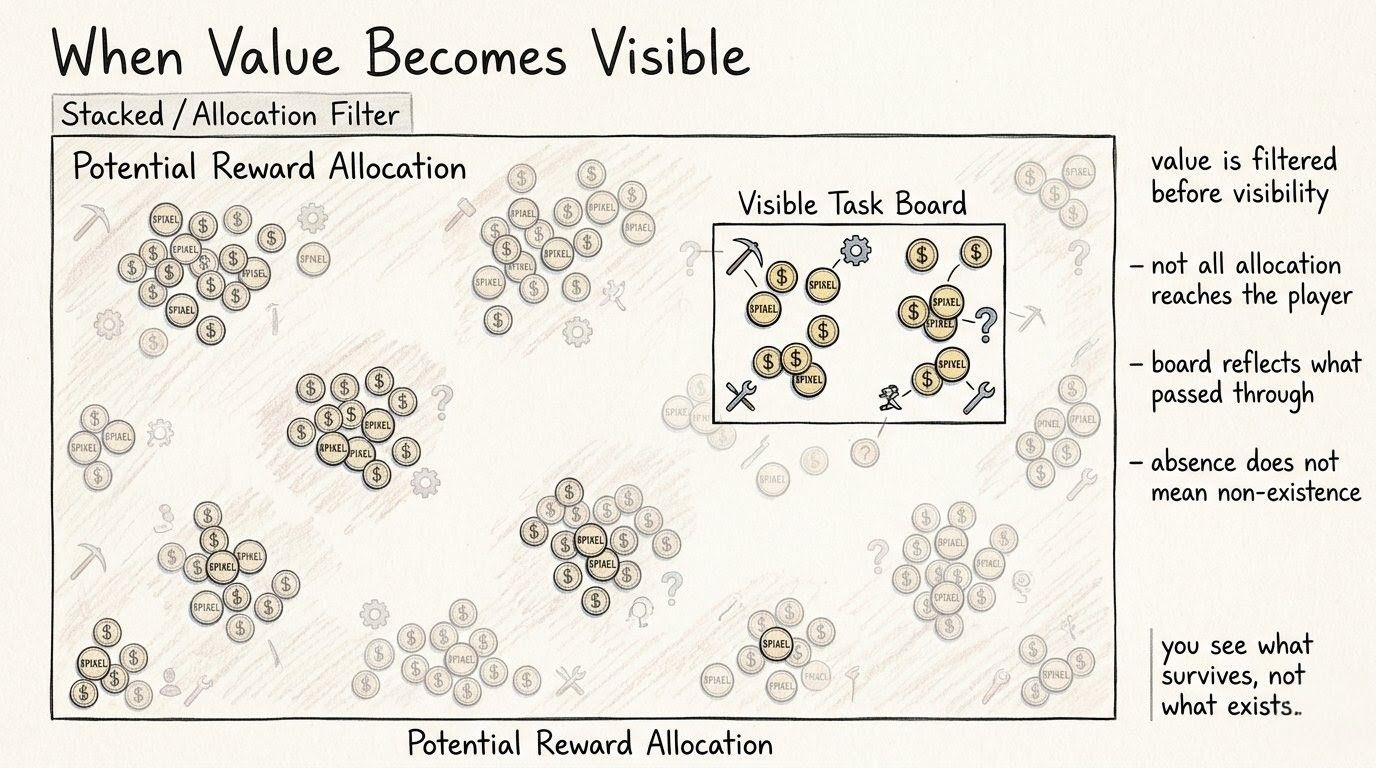
that is where the architecture has to matter. Realms without RORS becomes chaos. Factory contracts without staking direction become empty launch tools. Stacked without discipline becomes another rewards app. Pixels without selective use becomes farmable emissions wearing a better name. Ronin settlement without off-chain gameplay becomes too heavy for the kind of social farming loop Pixels needs.
everything has to stay split… fast activity here, scarce settlement there, soft Coins inside, hard Pixels outside, gameplay loose, withdrawals watched, new games allowed, but not allowed to poison the whole network.
that balance is the real machinery.
not the contracts alone, not the map, not the mini-games. the real system is the set of constraints that lets new loops appear without pretending every loop deserves value. and maybe that is why this direction feels more serious than just “Pixels is expanding.” expansion is easy to market. this is harder, because repeatable game creation also means repeatable pressure. it means the system has to keep asking the same brutal questions every time a new game plugs in.
does this loop hold players.
does this reward return more than it leaks.
does this validator lane deserve more fuel.
does this mini-game create demand or just another extraction surface.
does this belong inside pixels at all.
and if the answer is no, the game might still exist, but it should not get to eat the economy.
that is the part early P2E missed. everything got access to value too quickly. everything became earnable. everything looked alive until the treasury was empty and the players were gone. Pixels seems to be trying to build the opposite machine… a world where many things can be playable, but only some things become worth funding.
and if that machine works, then this whole direction gets uncomfortable because maybe Pixels is not trying to be one game that wins. maybe it is trying to become the place where games come to be judged… not by hype, not by trailer views, but by whether their loops survive real players, real rewards, real bot pressure, real retention, real spend.
that is a different kind of publishing.
and maybe that is why the “Steam of Web3” idea only makes sense if you stop imagining a storefront. Pixels’ version would not just list games. it would route value toward them, test them, measure them, let the community stake into them, let Stacked watch them, let RORS tighten around them, let Trust Score protect exits, let Ronin settle what actually survives.
that is not a store. that is a filter.
and filters are less friendly than stores, but maybe more useful, because Web3 gaming probably does not need more games pretending they deserve a token. it needs a way to find which game loops can touch value without collapsing under it.
and that is where Pixels starts feeling different to me. not because the farm is perfect, not because every loop feels clean, not because the system is easy to understand, but because the messy farm might already be the prototype for something larger… a system that builds games through constraint instead of hype.
i don’t know if that future feels exciting or uncomfortable. maybe both.
because if Pixels really becomes that kind of publishing layer, then every new Realm is not just content. every validator lane is not just staking. every Stacked campaign is not just rewards. every pixels path is not just earning. every imported NFT identity is not just cosmetic either. it is all part of the same question.
can this game survive being connected to value.
and maybe that is the only question that matters now, because maps can expand forever and still mean nothing. but a system that knows which loops deserve to live… that is where Pixels stops looking like a farm and starts looking like something that might keep manufacturing reasons for Pixels to matter beyond the first world it came from.