
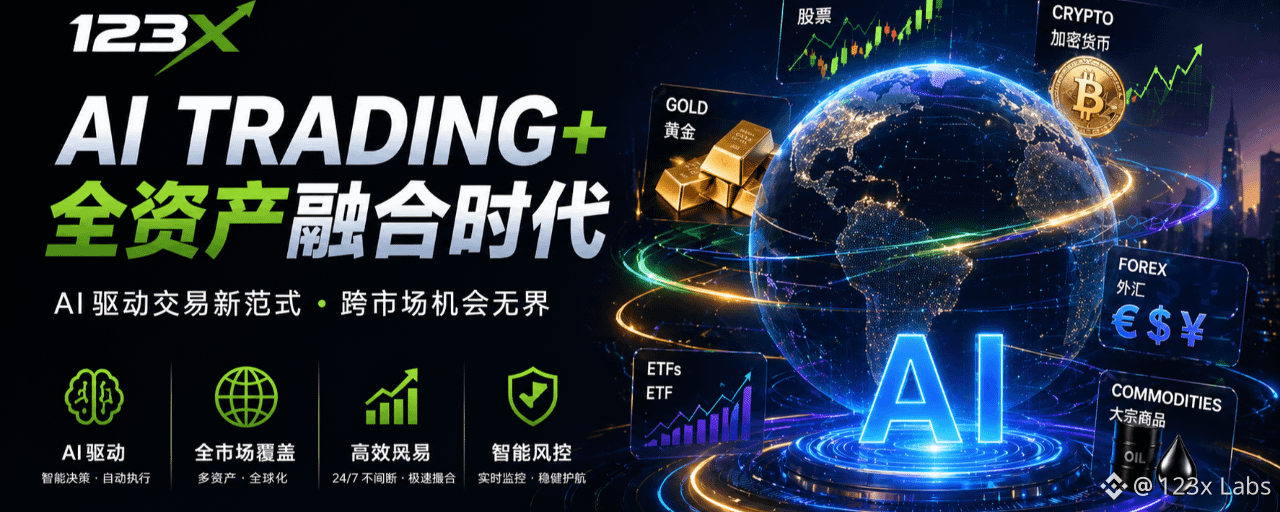
Recently, there have been a few insights from frontline practitioners that are definitely worth considering together:
From Lennix Lai (OKX):
"In the future, agent-driven trading and on-chain interactions will democratize professional investment risk management capabilities to everyone, and its scale will surpass human-led trading."
TMGM Founder’s circle:
"I checked the data from global retail trading platforms this year, and the structural changes among the top platforms are quite evident. Some platforms are no longer sticking to the traditional forex model but are clearly moving towards multi-asset + high-frequency trading. The number of clients may not be the highest, but trading activity and quality are the key indicators. The industry is quietly stratifying."
From He Yi (Binance):
"AI is like electricity, we are like the candle makers," and "Binance aims to build the financial infrastructure for 3 billion people."
Sounds reasonable, but is it still far from us?!
This isn't a trend; this is a reality that has already happened. The places closest to money are changing the fastest! The only difference is—are you participating?
| You think you’re trading, but you’re actually getting eliminated.
Let's start with a statistic: In the TMGM forex platform, forex trading might only account for 1%. On average, others don't exceed 50%.
What does this mean? You think you're in a 'forex market,' but in reality, the platform you’re on has long become a 'machine that trades whatever is profitable.'
Traders have changed, but many people are still unaware.
In the past, you would say: I'm trading crypto, I'm doing forex.
Now the trend has changed:
BTC is volatile → trade BTC.
US stocks have opportunities → switch to US stocks.
Gold has a trend → go for gold.
Wherever there’s volatility → go there.
They only have one identity: 'liquidity hunters.'
Platforms have already changed.
Platforms like eToro, Interactive Brokers are no longer 'a platform for a single market,'
But rather, one account = the entire financial market.
And on-chain, it's also: from the previous round's dYdX to this round's Hyperliquid and leading CEXs. From a singular crypto focus to an increase in gold, US stocks, oil, and other assets.
What they are doing is very simple and straightforward: 'Put all global assets into one system.'
What does this step mean?
In one sentence: the market is no longer decentralized; opportunities are starting to concentrate.
And once opportunities concentrate, the next thing that will happen is: more efficient people will eat up the inefficient.
| The real danger isn’t the market, but 'you are still trading manually.'
Many are still debating: Should I buy? Will it go up? Is it a bull market?
But the real question has turned into: 'Are you the one trading?'
You have to accept a reality.
Those who consistently make money in the long run are never ordinary people, but rather systems: Renaissance Technologies, Citadel.
They are not 'making more accurate judgments,' but rather: faster, more stable, and less error-prone.
The current question is:
These capabilities are starting to open up to everyone.
Agent, what is its essence?
You can think of it as: a trader who doesn’t sleep, isn’t emotional, and always executes discipline.
It can:
Watch multiple markets at the same time.
Analyze data + news.
Automatically make decisions.
Automatically execute.
Automatically cut losses.
And you: just need to decide whether to use it.
This brings a cruel but real change:
In the past: If you lost money, it's because you weren't good enough.
Now: If you’re losing money, it might be because you’re still 'doing it yourself.'
| What's really being eliminated is not retail, but 'inefficient people.'
Many will ask: With AI here, are retail traders worse off?
The answer is actually the opposite: it's not the retail traders being eliminated, but those who trade in the 'old-fashioned way.'
Why is this called 'trading equality'?
Because in the past, you lost on three things:
1) Information.
You: Look at the candlesticks.
Institutions: Look at the whole market data.
Now: AI + on-chain → information is almost synchronized.
2) Experience.
You: Rely on your instincts.
Institutions: Rely on models.
Now: Strategies can be copied.
3) Execution ability (the most fatal).
You must have experienced:
Know when to cut losses, but don’t.
Know when to hold, but can’t hold.
And agents:
Always execute.
Always stay calm.
So a crucial change has occurred:
For the first time, ordinary people have the chance to possess 'institution-grade' trading capabilities.
| In the future, what you buy may not just be gold or stocks or any single variety.
This is what most people haven't reacted to yet.
What were you buying in the past?
BTC/ETH/stocks/gold/forex…
What will you buy in the future?
A set of 'logic that helps you make money.'
For example:
Automatically hedge between BTC and gold.
Automatically rotate among tech stocks.
Automatically perform cross-market arbitrage.
In other words:
Assets are just the raw materials, strategies are the products. You don’t even need to understand the strategies; you just need to click once.
| Exchanges are 'disappearing,' replaced by 'trading operating systems.'
What were platforms like in the past?
Like a market:
You choose.
Buy on your own.
Take responsibility for the results.
What will platforms look like in the future?
Like the iPhone:
There are various 'trading apps (agents)' above.
You download, use, and switch.
So what are platforms competing on?
No longer just fees and depth, but:
Are there any good agents?
Is there a strategy market?
Is your data capability strong?
Exchanges are evolving into 'trading operating systems.' (Trading OS)
| A more brutal reality: Most people will be marginalized.
The market divides into three types of people:
1) Those using agents.
2) Semi-automated individuals.
3) Manual traders.
The platform only cares about the first type of person.
Because 80% of the income likely comes from 20% of the agent users.
| The real dividing line has already appeared.
In the future, it won't be about whether you can trade.
But rather: Are you using a system? What system are you using?
Three things determine your position:
1) Have you used an agent?
2) Are you connected to multiple markets?
3) What are your channels for acquiring strategies?
| You're not competing against people; you're competing against systems.
Putting everything together, there's really only one statement: the financial market is transitioning from a single product platform to an all-asset aggregation platform; it's shifting from 'human competition' to 'system competition.'
This means: Those who can analyze may not necessarily win, and those with insight may not necessarily win. What truly determines the outcome is how much stronger your tools are compared to others and whether your platform is a Trading OS.
This wave of change won't wait for anyone. Just like those who couldn't use the internet got eliminated, those who couldn't use smartphones got eliminated. The next step will likely be those who cannot use AI trading getting eliminated or becoming incredibly inefficient and high-risk.
—— END ——
We've also been talking to many frontline participants about this change—from trading platforms, strategy teams, to those who have been in the market long-term. Next, 123X Labs will do something: around 'AI + all-asset trading', we will hold 20 offline exchanges domestically and 5-10 overseas.
Let's discuss together:
As the market grows larger, and trading capabilities are fully amplified, who will truly make money in the next round?
If you’re also on this path, feel free to chat.