
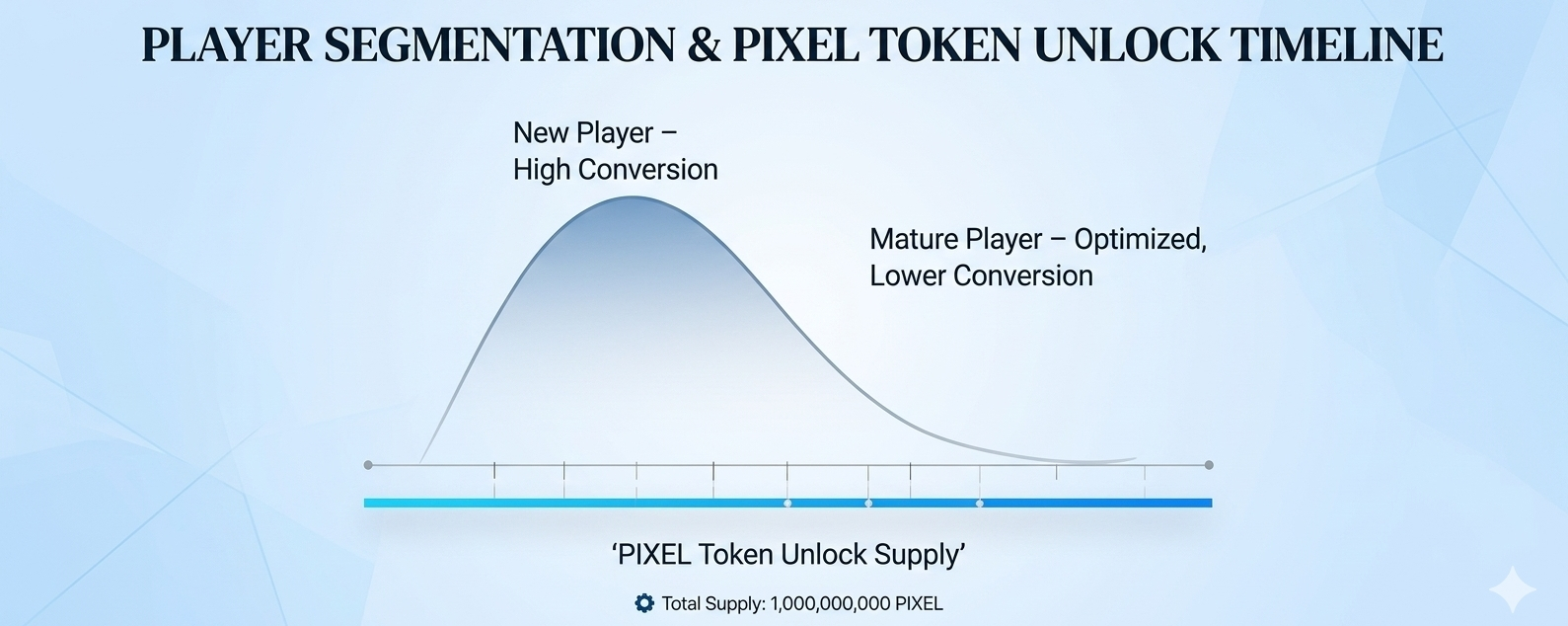
Early growth in game economies is usually loud. New players convert frequently. Progress feels meaningful. Tokens circulate through upgrades and positioning. Demand looks organic.
But early growth rarely defines durability.
In @Pixels , new entrants naturally interact with Pixel more often. They convert progress into durable assets, accelerate bottlenecks, or anchor themselves inside the ecosystem. Early‑stage engagement tends to be conversion‑heavy because progression is still frictional.
The real shift happens later.
As players mature, optimization compresses behavior. Efficient routes replace experimentation. Delays feel predictable. Some conversion steps become optional rather than necessary. Experienced players often reduce how frequently they cross into settlement-linked layers.
That lifecycle compression matters.
If demand for $PIXEL is strongest during onboarding but weakens as players stabilize, then the token’s growth curve depends on constant renewal — a steady flow of new participants replacing reduced conversion from older ones.
Now introduce supply.
Unlock schedules and emissions operate independently of player maturity. Tokens enter circulation regardless of where users sit in their lifecycle. If conversion intensity decreases while supply continues expanding, liquidity absorbs the difference.
This creates a structural tension between retention and release.
Retention needs to preserve conversion relevance.
Release continues regardless of conversion pace.
For $PIXEL to sustain demand, mature players must still encounter meaningful reasons to convert — not artificially, but structurally. Upgrades, competitive positioning, ecosystem expansion, or layered incentives must remain compelling even after efficiency sets in.
If progression becomes fully optimized without ongoing settlement interaction, token demand narrows to onboarding cycles alone.
That dynamic is subtle.
The game can appear active.
Player counts can remain stable.
Loops can function smoothly.
Yet token pressure can emerge quietly if lifecycle demand compresses faster than new demand forms.
Sustainable GameFi economies don’t just attract players. They maintain economic relevance across player lifespans. The token must remain integrated into long-term progression, not just early acceleration.
The durability of $PIXEL won’t depend solely on how many new players arrive.
It will depend on whether mature players still need to cross the boundary into settlement — even after they’ve mastered the loop.
Because growth brings attention.
Lifecycle depth brings stability.
And stability is what unlock schedules ultimately test.