

Pixels never really felt like it was trying too hard.
That was the thing I liked about it.
While a lot of Web3 games came in with huge promises, loud trailers, complicated economy talk, and the usual “next big thing” energy, Pixels felt much simpler. You had a farm. You had resources. You had small tasks. You crafted, upgraded, collected, and slowly built your place in the world.
Nothing about that sounds groundbreaking.
But honestly, that was part of the appeal.
A lot of crypto games make you feel like you need to understand the token before you can enjoy the game. Pixels did not feel that way at the start. You could just enter, do a few things, learn the rhythm, and come back later. It gave players a routine before asking them to care about the bigger economy.
That is rare in Web3 gaming.
The first version worked because it was easy to understand. You planted crops, gathered materials, made progress, and slowly improved your space. It was simple, but not empty. It had that calm daily feeling that can keep people around when everything else in crypto feels too noisy.
But simple loops have a limit.
After a while, farming can start to feel like a checklist. You plant because you can. You harvest because the timer is ready. You craft because the task is there. At first, that feels relaxing. Later, it can start to feel automatic.
And when a game becomes automatic, players start asking a quiet question:
Why am I still doing this?
That is why Bountyfall feels like an important step for Pixels.
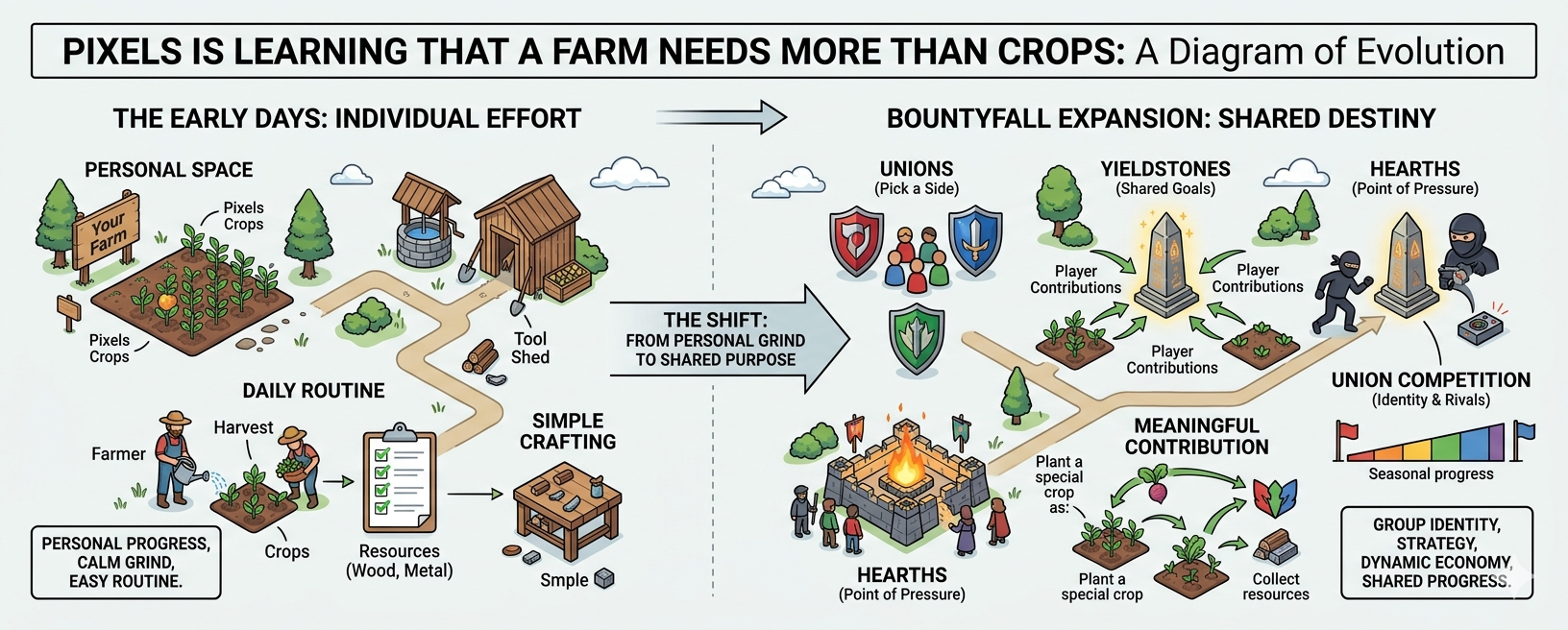
Not because it suddenly solves everything. It does not. But it gives the same daily actions a bigger reason. Before, a lot of the game felt personal. Your farm. Your progress. Your upgrades. Your rewards.
Now Pixels is trying to connect that personal grind to something shared.
Unions give players a side. Yieldstones give people something to work toward. Hearths create a point of pressure. Sabotage adds a little tension. The whole thing makes the world feel less like separate players farming in their own corners and more like people pushing against each other inside the same economy.
That changes the feeling of the grind.
A resource is not just a resource anymore. A task is not only a task. When you collect something and put it toward your Union, it feels like your action has a place. You are not just moving numbers for yourself. You are helping your side.
That kind of feeling matters.
Web3 games talk about community all the time, but a lot of that community only happens outside the game. People post, hype, repeat slogans, and try to keep attention alive. That can help for a while, but it is not the same as real attachment.
Real attachment happens when players feel connected inside the game.
Pixels seems to be moving in that direction.
It is trying to make contribution part of the actual play loop, not just something people talk about on social media. If players begin to care about their Union, then the game has something stronger than a reward system. It has identity.
And identity can be powerful.
People come back when they feel their absence matters. They compete harder when they feel responsible for a group. They remember close seasons, rival sides, and small moments where their effort felt useful.
That is the kind of thing a token alone cannot create.
Still, Pixels has to be careful.
The charm of the game was always its softness. It did not feel like a stressful economy simulator. It felt calm, approachable, and easy to return to. If Bountyfall adds meaning without making everything too heavy, it can make Pixels better.
But if the system becomes too complicated, it could push casual players away.
That is the danger.
New layers can make a game deeper, but they can also make it feel crowded. If players feel like they need to study every rule, join the right group, optimize every action, and keep up with stronger players, then the simple farm feeling could get lost.
Pixels should not become a place where new players feel late before they even begin.
The best version of this system would let everyone find their own level. A casual player can still enjoy the daily farm routine. A more active player can help their Union. A competitive player can chase the seasonal race. A landowner can feel useful without the whole game bending around land.
That balance will not be easy.
But it is the right problem to solve.
Because Pixels is no longer just trying to keep people farming. It is trying to make farming matter. It is trying to turn small daily actions into something that connects players to a bigger world.
That is a much better direction than simply adding more rewards.
Many Web3 games confuse activity with loyalty. They see players grinding and think the game is healthy. But sometimes people are not loyal at all. They are only waiting for the next payout. When the rewards slow down, they leave.
Pixels still has to prove that people are attached to the world, not just the numbers.
Bountyfall might help show that.
The first season will probably get attention because it is new. That part is easy. The real test comes later, when the feature is no longer fresh and players know exactly what the loop feels like. If they still care about their Union after the hype cools down, then Pixels may have something real.
If not, then it becomes another seasonal grind with better wording.
For now, though, the move makes sense.
Pixels already had the daily habit. People knew how to log in, farm, craft, collect, and slowly build. Now the game is trying to give that habit more direction. It is moving from personal progress to shared pressure. From quiet farming to group competition. From individual routine to something closer to a living economy.
That is interesting.
Not perfect.
Not guaranteed.
But interesting.
The project still has risks. One Union could become too strong. Rewards could feel weak. Sabotage could become annoying. The economy could become too serious. Casual players could lose interest if the rules feel too heavy.
All of that can happen.
But at least Pixels is asking the right question now.
Not just, “How do we make people farm more?”
But, “How do we make their farming mean something?”
That is the real shift.
Pixels started as a simple farming world. Now it is trying to become a place where daily effort connects to identity, competition, and shared progress.
The farm is still there.
But now it has more pressure around it.
More purpose.
More reason to care.
And that may be exactly what Pixels needed.