
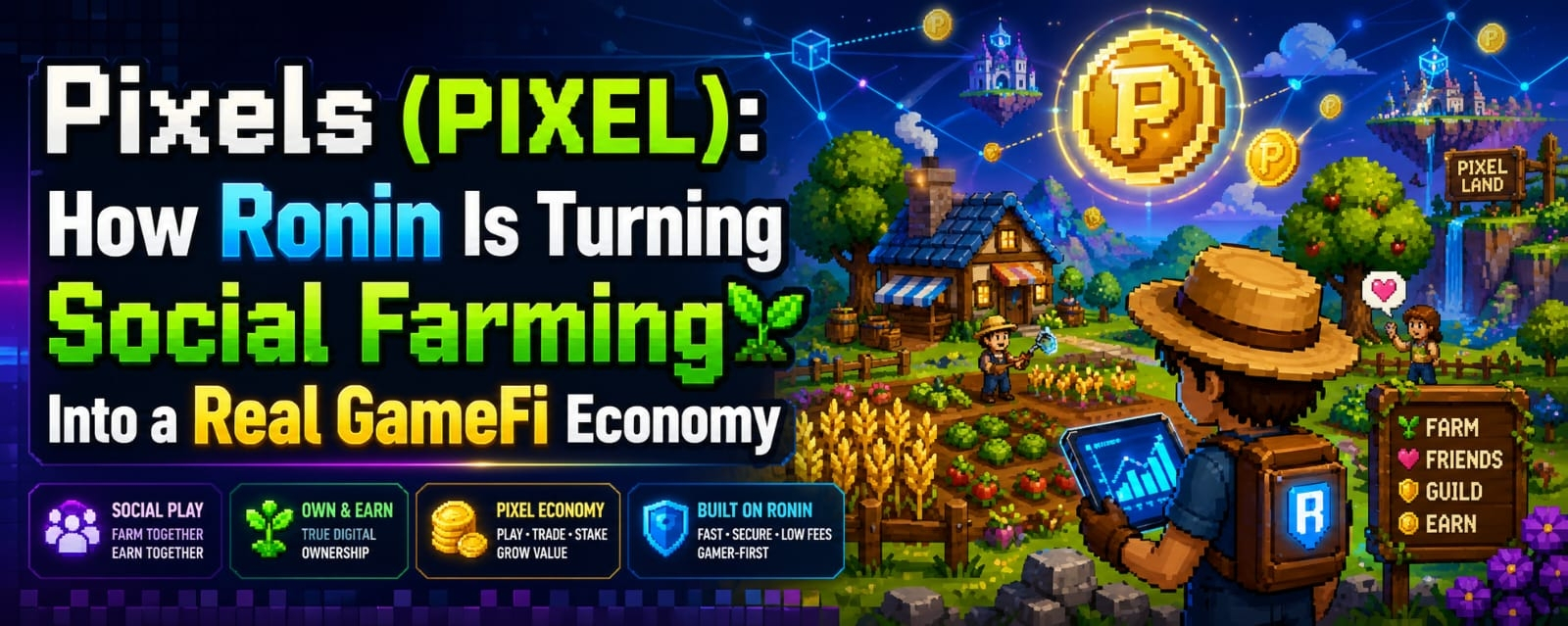
Most blockchain games lose people because they ask them to care about the token before they care about the experience. That is where Pixels feels different. It does not start by throwing complicated crypto terms at the player. It begins with something simple and easy to understand: farming, gathering, crafting, exploring, upgrading, and interacting with other players inside a colorful digital world. The Web3 part is still important, but it does not feel like the only reason the game exists.
Pixels is a social farming Web3 game built on the Ronin Network. At its core, it gives players a casual world where they can plant crops, collect resources, complete tasks, craft items, and build progress over time. This kind of gameplay already has a natural daily rhythm. You come back to check what has grown, what can be improved, what can be unlocked, and what new activity is waiting. That simple loop is powerful because it creates habit without forcing the player to think too much.
What makes Pixels more interesting is how it connects that familiar farming style with blockchain ownership. In a normal game, most items and progress stay locked inside the platform. Players spend time, energy, and sometimes money, but they do not truly own much beyond their account. Web3 changes that idea by allowing certain assets, rewards, and digital items to become part of a wider economy. This does not mean every player must become a trader. It simply means the game can give more value to the time people spend inside it.
Ronin Network plays a big role here. Gaming needs speed. It also needs low-cost transactions. If players have to wait too long or pay too much every time they interact with digital assets, the fun disappears quickly. Ronin was designed with blockchain gaming in mind, and that makes it a strong home for a project like Pixels. The game needs a network that can support active users, frequent actions, and an economy that does not feel heavy or confusing.
The PIXEL token is also part of the larger picture. It is not just a name attached to the project. PIXEL is connected to different in-game features, upgrades, memberships, pets, guild-style systems, and other premium experiences. This gives the token a practical role inside the ecosystem. A token becomes stronger when it has real use, not only market hype. That is an important difference because many GameFi projects have failed by building around speculation first and gameplay second.
Pixels also understands something many crypto games ignored: people stay longer when they feel connected to other people. Farming alone can be relaxing, but farming inside a social world can become much more engaging. Players can compare progress, join communities, take part in group activities, and feel like they are part of something bigger than a single account. That social layer may become one of the strongest parts of the game if it continues to grow properly.
Still, the project is not without risk.
GameFi economies are difficult to balance. If rewards are too easy, the economy can become inflated. If rewards are too hard, players may feel discouraged. If the token price becomes the main reason people play, the community can become unstable. This is one of the biggest challenges for Pixels and for every Web3 game trying to build a serious economy. The game has to reward players, but it also has to protect the long-term health of the system.
There is also a common misunderstanding around games like Pixels. Some people look at Web3 gaming and immediately think only about earning money. That mindset is too narrow. The better way to look at Pixels is as a game where ownership, community, and digital value are added on top of the playing experience. Profit may attract attention, but enjoyment is what keeps people coming back. Without fun, no GameFi economy can survive for long.
For players, Pixels offers a more relaxed entry into Web3. It does not feel as intimidating as many crypto projects. The farming style is easy to understand, the social world makes it more human, and Ronin helps support the technical side in the background. For the wider gaming market, it shows how blockchain can be used in a softer and more natural way. Not every Web3 game has to look like a financial product. Some can feel like a real game first.
The future of Pixels will depend on how well it keeps this balance. It needs fresh gameplay, useful token functions, strong community features, and a fair economy. If the team focuses too much on hype, the project could lose depth. But if it continues improving the player experience while using Ronin’s infrastructure wisely, Pixels could become one of the more important examples of social GameFi done right.
Pixels is not just about planting crops in a digital world. It is about testing whether blockchain gaming can become more casual, more social, and more enjoyable for everyday users. That is why the project matters. If it succeeds, the next chapter of GameFi may not be driven only by charts and speculation. It may be built around worlds that people actually want to visit, play in, and return to again.
