
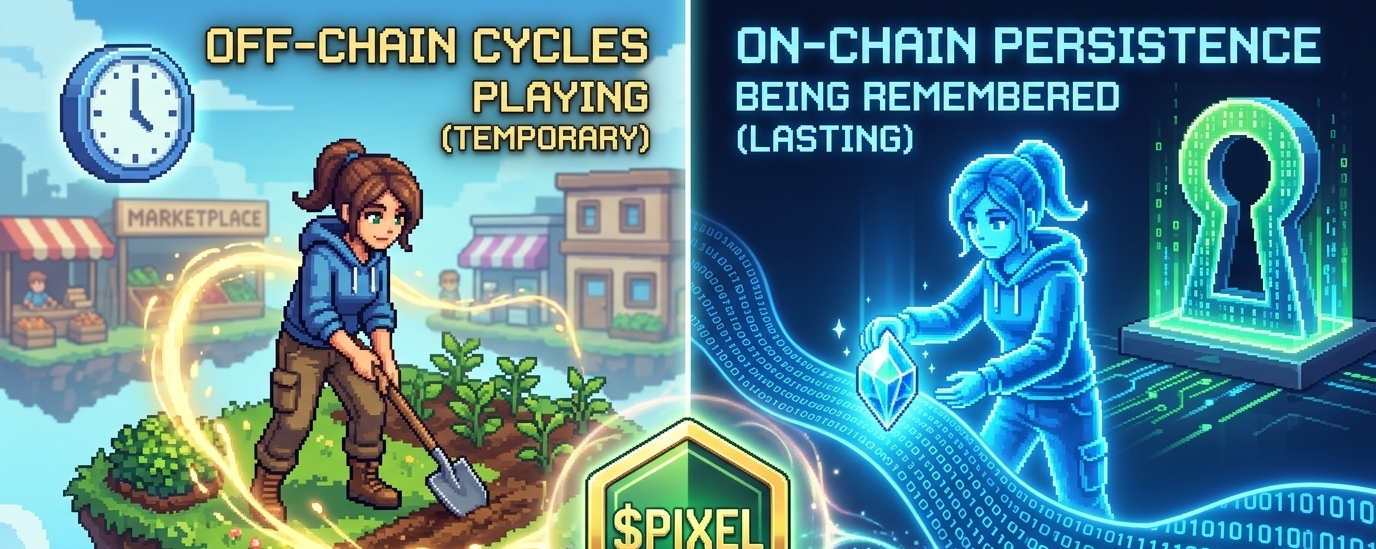
@Pixels There was a time when I thought “on-chain” was the point where everything finally became real. You do something, it gets recorded, and that’s it — it counts. Clean, simple, almost comforting in how clear it felt. But the more time I’ve spent inside systems like Pixels, the less that idea holds up on its own. Not because it’s wrong, but because it leaves too much out. Most of what players actually do never touches the chain at all, and still, somehow, the economy feels alive. Trades happen, progress builds, decisions carry weight. So if all of that exists without being recorded in the way we once thought mattered most, then the real question shifts. It’s no longer about what can go on-chain, but what actually gets chosen to.
Pixels sits in that tension in a way that’s easy to overlook if you’re just playing casually. On the surface, it feels open and almost neutral. You log in, you farm, you trade, you slowly refine how you move through the loop. Nothing aggressively pushes you in one direction. It doesn’t constantly demand that you spend or force you into decisions. It creates this impression that everything you do has equal weight, like the system is just there to support whatever path you choose. But after watching it more closely, especially how different players progress over time, that idea starts to crack a little. Because not everything echoes the same way. Some actions leave a trace that sticks. Others just blend back into the loop and quietly disappear.
You only really notice it when two players put in similar time and effort but end up in completely different positions. Not just in terms of rewards, but in how their progress feels. One path seems to build on itself, like each step creates something that can be used again later, something that exists beyond the immediate moment. The other feels active, even busy, but strangely temporary. It resets in ways that aren’t obvious at first, but become clearer the longer you stay. That difference doesn’t feel random. It feels shaped, but in a way that never announces itself.
And that’s where starts to look different the more you think about it. At first glance, it behaves like any other in-game token. Something that speeds things up, unlocks options, maybe smooths out friction. But over time, it begins to feel less like a simple utility and more like a kind of filter. Not a hard gate where you’re blocked without it, but a softer force that nudges certain actions into becoming more permanent. You can still play without it. You can grind, wait, repeat loops, and keep progressing in your own way. The system doesn’t break. But when $PIXEL enters the equation, something shifts quietly. It’s not just about efficiency anymore. It’s about whether what you’re doing has a chance to last beyond the immediate loop.
That idea of something being “recognized” starts to matter more than rewards or visibility. It becomes about persistence. Whether an action stays local, trapped inside a short-term cycle, or whether it gets lifted into a layer where it can matter later. Maybe that means being tied to something on-chain, maybe it just means being structured in a way that other parts of the system can build on. Either way, it stops being temporary. And that’s where the system reveals its real shape — not through restrictions, but through quiet selection.
What makes this more interesting is that it doesn’t feel forced. Pixels doesn’t aggressively signal which actions are more valuable in the long run. It lets players discover it over time, often without realizing it directly. That’s why it feels organic. The system isn’t telling you what matters — it’s letting your behavior slowly align with what does. And if $PIXEL is sitting at that boundary, influencing which actions cross into persistence, then its role is deeper than it first appears.
From a broader perspective, this changes how the economy should be read. It’s not just about activity or spending in the usual sense. It’s about how often players feel the need to turn temporary effort into something lasting. If that moment happens rarely, then the token remains peripheral. But if it becomes part of the natural rhythm of play — something players rely on without thinking too much about it — then it becomes embedded in the system itself. Not as an external layer, but as part of the loop that defines what progress even means.
There’s a version of this design that works incredibly well. It keeps the system efficient without overwhelming it, while still giving players a sense of freedom. Over time, it can even shape behavior in subtle ways, promoting actions that contribute more meaningfully to the ecosystem. But there’s also a fragile side to it. If players begin to feel like their efforts only matter when the token is involved, the openness can start to feel like an illusion. That shift doesn’t need to be obvious to have an impact. People sense it, even if they can’t fully explain it.
And then there’s the quieter possibility that doesn’t get talked about enough. What if most players are perfectly content staying inside the loop? Just playing, enjoying the system for what it is, without caring whether their actions persist beyond the moment. In that case, the whole idea of pushing things into a more permanent layer might never become central. The system would still function, still feel alive, but the deeper layer would remain underused.
So the way I see Pixels now isn’t as a game that simply mixes on-chain and off-chain activity. It feels more like a system that constantly decides what deserves to be remembered and what can fade without consequence. That’s a very different lens to look through. It’s not about how much gets recorded, but what gets selected. Not what’s possible, but what’s carried forward. And somewhere in that quiet decision-making process, $PIXEL seems to sit — not loudly controlling anything, but gently shaping the line between actions that pass through and those that stay.