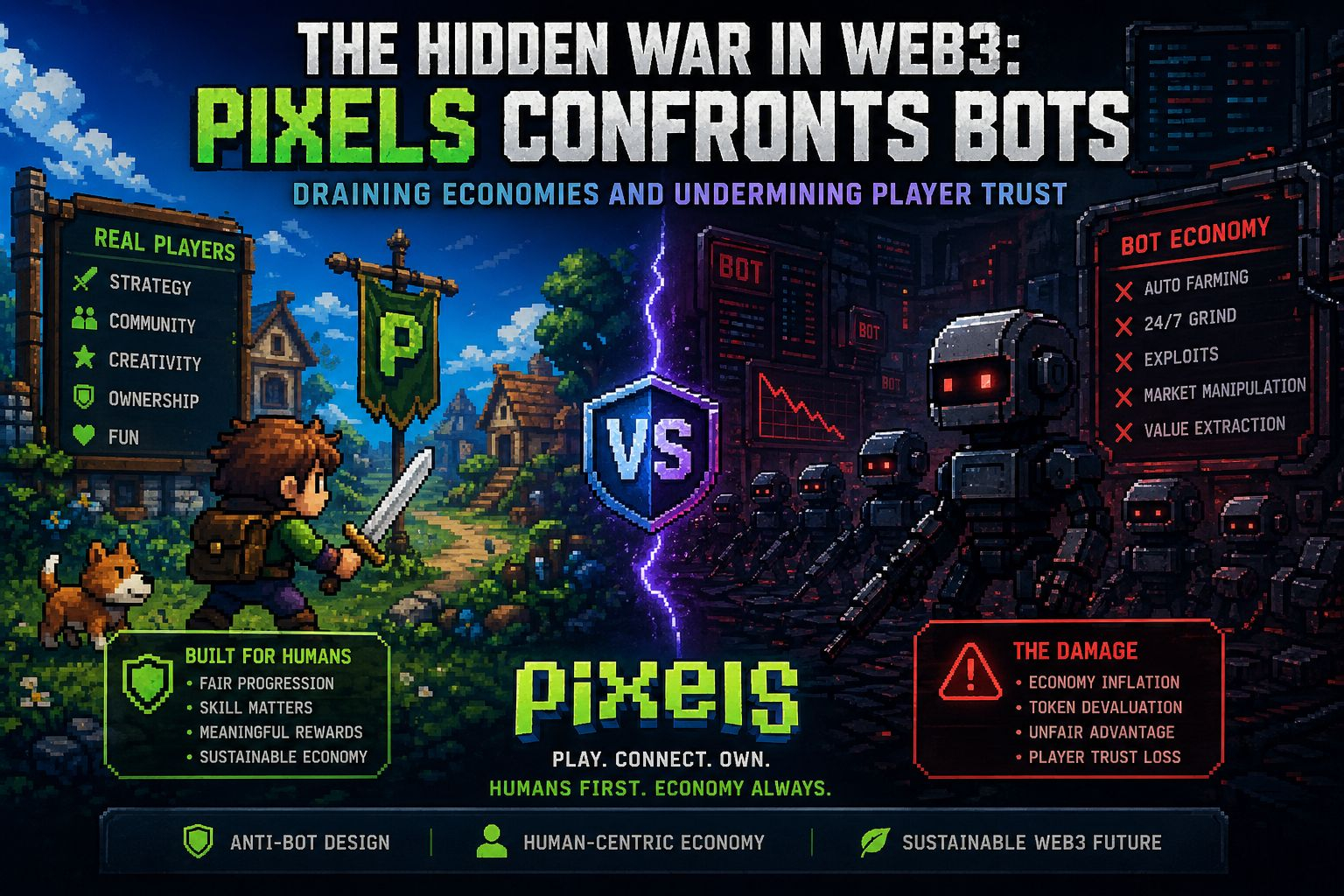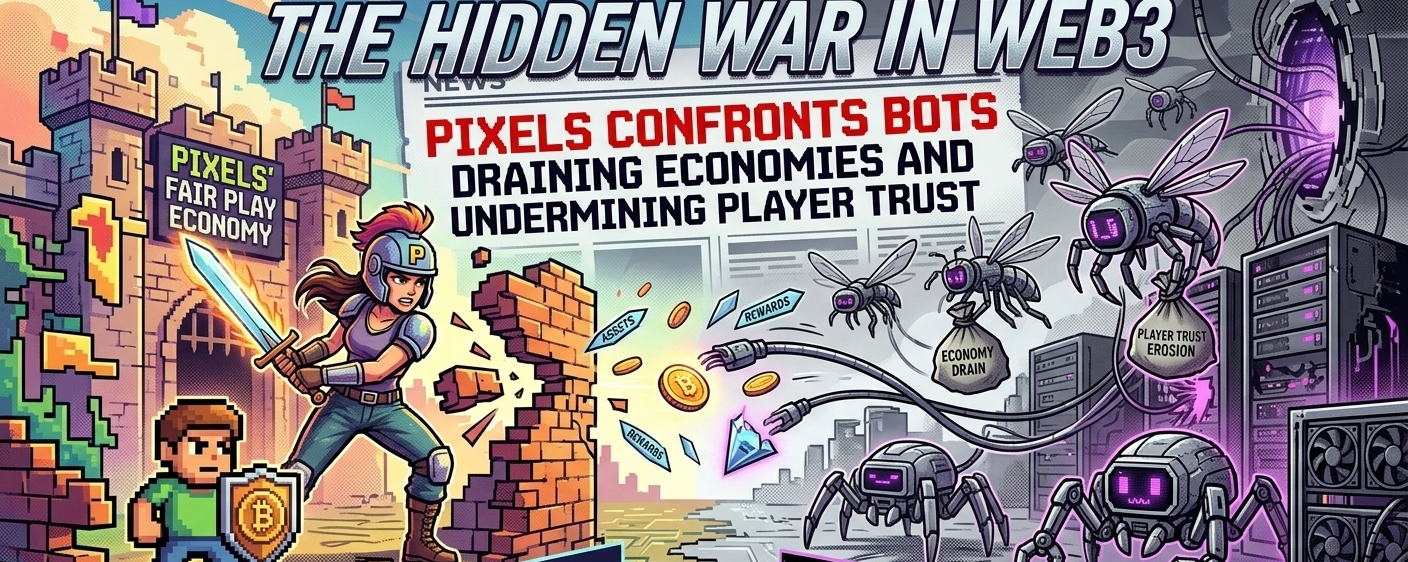
most people look at web3 gaming and see tokens, nfts, and reward loops. what they don’t see is the constant pressure from automated systems quietly extracting value in the background. bots don’t just “play” the game they optimize it. they farm faster, act 24/7, and remove the human element that gives these ecosystems meaning. over time, this creates an imbalance where real players feel like they’re always one step behind, not because they lack skill, but because they’re competing against machines designed for efficiency, not enjoyment.
in many projects, this problem is either ignored or treated as a minor inconvenience. but the reality is much bigger. when bots dominate resource generation, they dilute rewards, inflate supply, and destabilize in-game economies. tokens lose their perceived value, progression feels less rewarding, and genuine engagement starts to decline. what begins as a technical issue slowly turns into an economic one. the system no longer reflects player effort it reflects automation power. and once that shift happens, trust begins to erode.
this is where pixels starts to stand apart. instead of designing purely for extraction, it leans into friction, pacing, and participation. mechanics like time-gated actions, energy systems, and progression layers aren’t just gameplay choices they act as natural resistance against automation. bots thrive in predictable, repeatable loops, but struggle when systems require adaptability, timing, and decision-making. by subtly increasing the cost of mindless repetition, pixels creates an environment where human behavior becomes an advantage again, not a weakness.
but the deeper shift isn’t just mechanical it’s philosophical. pixels doesn’t try to eliminate bots entirely, which is nearly impossible in open systems. instead, it reduces their impact on the economy. it changes where value comes from. rather than rewarding pure output, it ties progression to engagement, ownership, and strategic play. this means that even if bots exist, they can’t easily dominate the most meaningful parts of the ecosystem. value begins to concentrate around participation quality instead of raw production volume.
this battle is still largely invisible to the average user, but it’s one of the most important challenges in web3 today. without addressing bot-driven extraction, no economy can remain sustainable for long. pixels highlights a different direction one where systems are designed with adversarial behavior in mind from the start. it’s not just about building a game or launching a token. it’s about defending an economy.
in the end, the real question isn’t whether bots can be removed. it’s whether real players can still matter. and in that sense, pixels isn’t just building a game it’s testing whether web3 economies can protect the very people they’re meant to serve.