
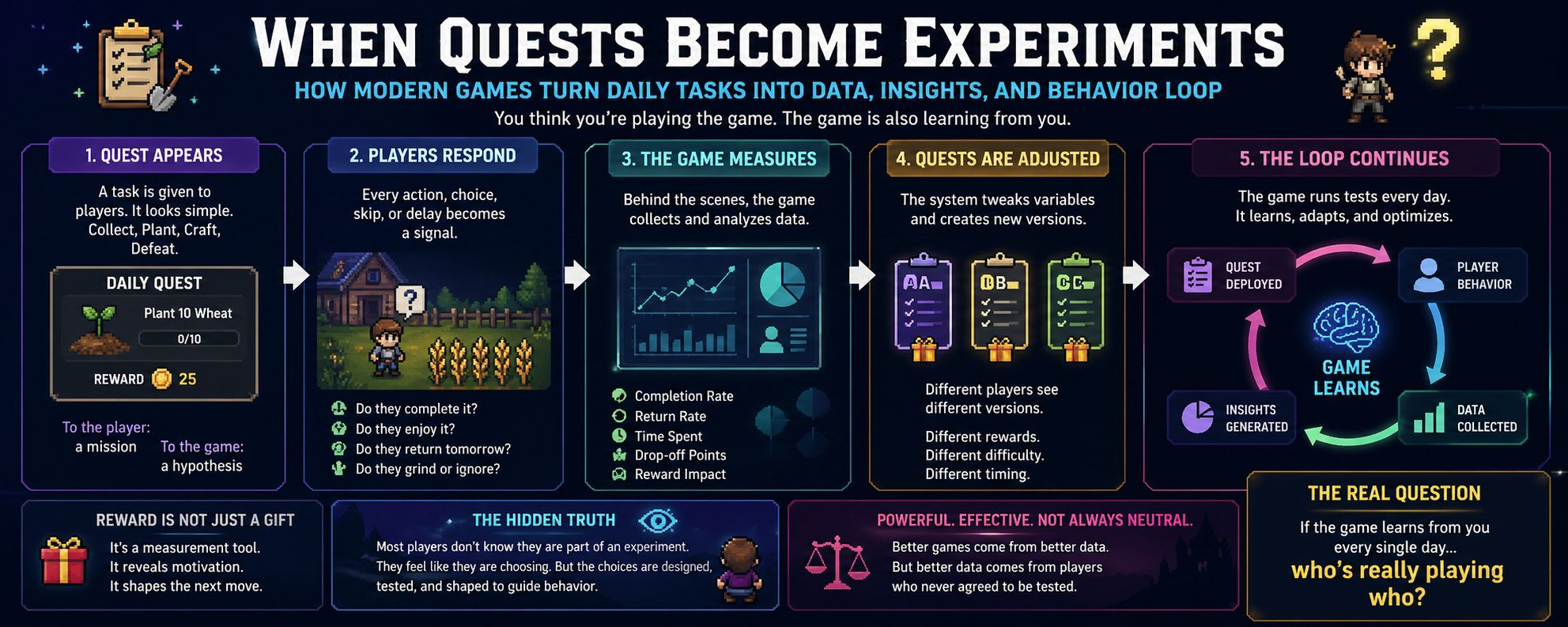
There is a quiet shift happening in the way games use quests.
On the surface, it still looks familiar. A player logs in. A task appears. Plant this. Collect that. Come back tomorrow. Claim the reward. It feels like the same loop games have been using for years.
But the more I look at it, the less it feels like simple content.
A quest is no longer just something placed in front of the player to keep them busy. It has started to behave more like a question the game is asking.
What happens if this reward changes?
What happens if only one group of players sees this task?
What happens if the same quest returns later with one small difference?
The player sees a mission. The system sees data.
That is the part that makes this interesting, and also a little uncomfortable.
For a long time, daily quests were easy to understand. They existed to bring people back. They gave structure to the day. They created a reason to open the game again. That explanation still works, but it no longer feels complete.
Because the real value of a quest is not always the task itself. Sometimes the value is in what the player does around it. How fast they respond. Whether they return the next day. Whether they ignore it. Whether they repeat the behavior even after the reward changes.
At that point, the quest becomes less like a piece of design and more like an instrument.
LiveOps makes this especially visible. A game can run one version of a quest today, adjust it tomorrow, bring it back later, and quietly compare the results. The changes may look small from the outside, but each one says something about player behavior.
Some players stay longer. Some only show up when the reward is worth it. Some turn the system into a farming route. Some disappear completely.
The game is watching all of that.
And not in some dramatic, evil way. It is simply how modern systems improve. They test, measure, adjust, and test again. That is the logic of live games now. Nothing has to remain fixed for long. Every feature can become a trial. Every response can become a signal.
Still, there is a difference between improving a game and quietly shaping a habit.
That difference is where the tension lives.
A player may think they are just choosing what to do next. But the choices being offered are not neutral. They are arranged, tested, timed, and rewarded in ways that guide behavior. The game does not need to force anything. It only needs to make one path feel slightly more natural than the others.
That is often enough.
And this is where rewards become more complicated than they first appear. A reward looks like a gift, but it can also function as a measurement tool. It tells the system what motivates you. It reveals what you will repeat. It shows where your attention bends.
You receive an item. The game receives information.
None of this automatically makes the system wrong. Games have always studied players in some way. Designers have always watched what people enjoy, where they get stuck, what keeps them engaged, and what makes them leave.
The difference now is speed and precision.
The feedback loop is tighter. The testing is more constant. The game can learn from yesterday’s behavior and reshape tomorrow’s experience. That makes LiveOps powerful, but it also makes the relationship between player and game less innocent than it appears.
Because if every quest is also an experiment, then every player is partly a participant in that experiment.
Most players will never think of it that way. They are not reading dashboards. They are not looking at retention curves. They are not thinking about cohorts or behavior patterns. They are just playing.
And maybe that is exactly what makes the whole thing feel strange.
The system does not have to announce itself as research. It can hide inside ordinary gameplay. It can look like a seasonal task, a limited event, a better reward, a small adjustment. Nothing feels serious enough to question. Yet over time, those small adjustments can teach the game how to keep pulling people back.
That is effective design.
It may also be a subtle kind of control.
The uncomfortable part is not that games are learning. The uncomfortable part is how normal it feels. We have become used to systems that observe us, predict us, and respond to us. When that happens inside a game, it feels lighter, almost harmless. But the mechanism is still there.
A quest asks for action.
The player responds.
The system learns.
The next quest arrives a little smarter.
That loop can make a game better. It can also make it harder to tell where play ends and behavioral engineering begins.
Maybe that is the real question now. Not whether quests are useful. Not whether experiments improve retention. Not whether LiveOps works.
It clearly does.
The better question is what kind of relationship a game creates when it learns from its players every day, quietly adjusts around them, and turns their habits into the next design decision.
At some point, the player is still playing the game.
But the game is also playing back.