
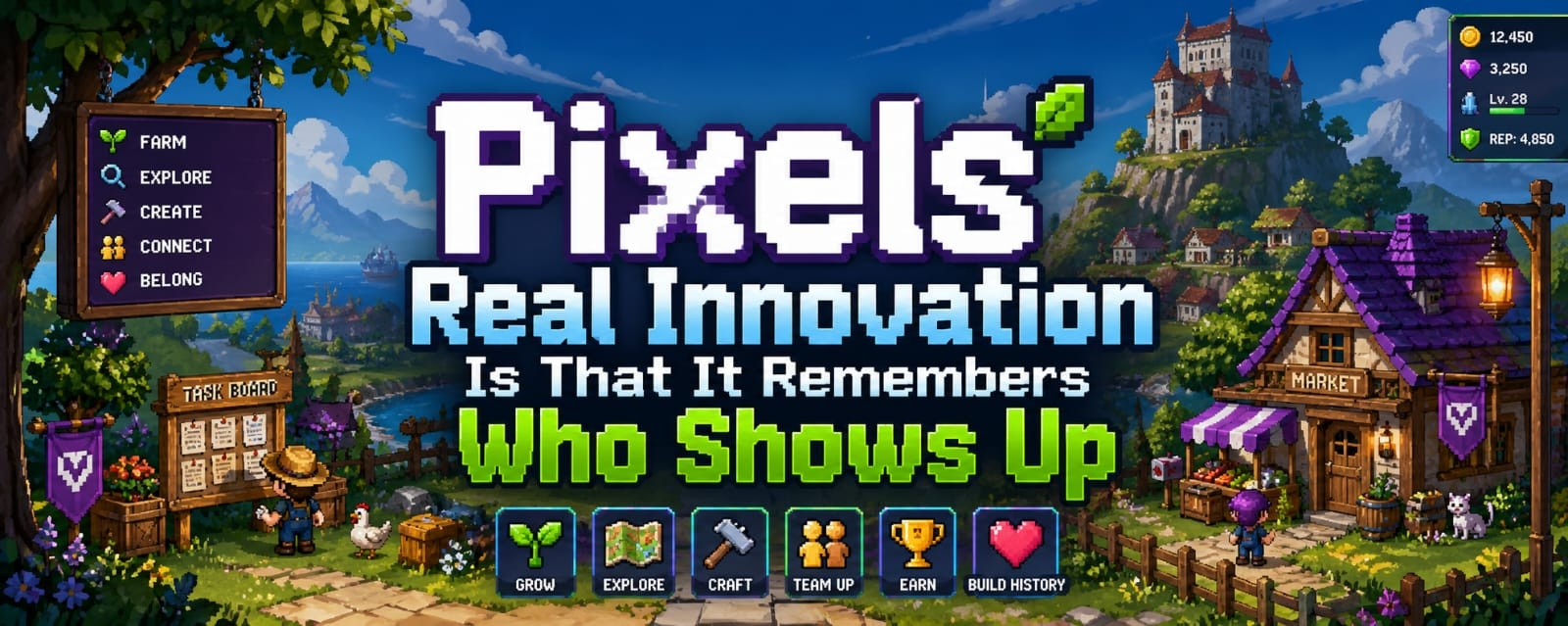

The easiest way to describe Pixels is to call it a farming game with a token attached. That description is not wrong, but it misses what actually makes the experience stick. When you spend time inside Pixels, it does not feel like a place that only wants your clicks. It feels like a place that is slowly learning how you behave.
At first, everything is simple. You plant crops, harvest them, craft a few items, maybe check the Task Board and complete a couple of jobs. It is calm, almost repetitive in a comforting way. But after a while, something subtle starts to change. The game begins to feel less like a loop you are running and more like a system that is quietly keeping track of how you show up.
That is what I think Pixels is really building. Not just an economy, but a kind of memory.
Most Web3 games never get this right. They attract wallets quickly, but they struggle to understand the people behind them. A player can jump in, farm rewards, move assets around, and leave before the system has any real sense of who they were. Everything becomes transactional. Ownership exists, but it feels shallow because nothing has time to mean anything.
Pixels is trying to slow that down.
The Task Board is a good example. On paper, it is just a place to earn coins, experience, and sometimes $PIXEL. But in practice, it shapes how you spend your time. You start planning your actions around it. You learn what resources matter, what routes are efficient, what tasks are worth your attention. Over time, your behavior becomes consistent, and that consistency becomes visible to the system.
The reputation system builds on that feeling. It is not loud or flashy, but it matters. The more you play, the more the game starts to treat you differently. Access changes. Limits change. Opportunities open up. It does not feel like you are buying your way forward. It feels like you are being recognized.
That difference is small, but it changes everything.
In most crypto environments, money is the fastest way to move ahead. In Pixels, time and behavior start to compete with capital. The player who keeps showing up, who understands the flow of the game, who contributes in small but consistent ways, slowly builds something that is hard to fake. Not just resources, but a kind of trust.
You can feel this shift more clearly in the newer systems. Chapter 3 did not just add more things to do. It changed the way players relate to each other. When you join a side, contribute to shared goals, and see rewards tied to participation, the game stops feeling like a solo grind. It starts to feel social in a deeper way. Your actions are not just yours anymore. They are part of something bigger, even if that “something” is still light and game-like.
That is where Pixels becomes interesting to me. It is not trying to force social behavior. It just makes it natural. You begin to care about what others are doing because it affects your own experience. You start to notice patterns. Who contributes. Who disappears. Who adapts. Without saying it directly, the game teaches you to read people.
Ronin strengthens this idea in a quiet way. When Pixels connects with other experiences in the ecosystem, it starts to feel less like a single game and more like a place you carry with you. If your actions in Pixels can influence how you are seen elsewhere, then what you build inside the game begins to matter beyond it.
That is a very different kind of value.
It also explains why Pixels leans toward activity even in things like staking. The system does not seem satisfied with passive presence. It nudges you to stay involved. To keep showing up. To remain part of the flow. That might feel restrictive at first, but it aligns with the bigger idea. This is not a world built for spectators. It is built for participants.
The part I find most compelling is how all of this feels human, even though it is running on game logic. In real life, people build reputations slowly. They gain trust by being consistent. They lose it by disappearing or acting opportunistically. Pixels mirrors that pattern in a soft, approachable way. It does not lecture you about it. It lets you feel it.
There is a risk here, of course. If everything becomes too optimized, the game could lose its charm. A world where every action is calculated can start to feel like work. Pixels still needs space for players to wander, experiment, decorate, and just exist without thinking about efficiency. That balance will matter more over time.
But right now, Pixels is doing something many Web3 games have not managed to do. It is making behavior matter.
Not in a rigid or punishing way, but in a gradual, almost invisible way. The longer you stay, the more the game reflects you back to yourself. Your habits, your choices, your consistency. And without realizing it, you start building something that goes beyond items or tokens.
You build a history.
That might be the real product of Pixels. Not just farming, not just exploration, not even just an economy. It is the feeling that your time leaves a trace, and that trace slowly turns into identity. In a space where everything moves fast and forgets even faster, that kind of memory feels surprisingly valuable.