There’s a quiet assumption most live-service games are built on:
The more often you show up, the more you deserve to earn.
It sounds fair.
It feels intuitive.
But it’s not neutral.
It rewards availability, not intelligence.
It favors time-rich players, not necessarily better players.
And for a long time, Pixels followed that same rule.
Then Chapter 2.5 broke it.
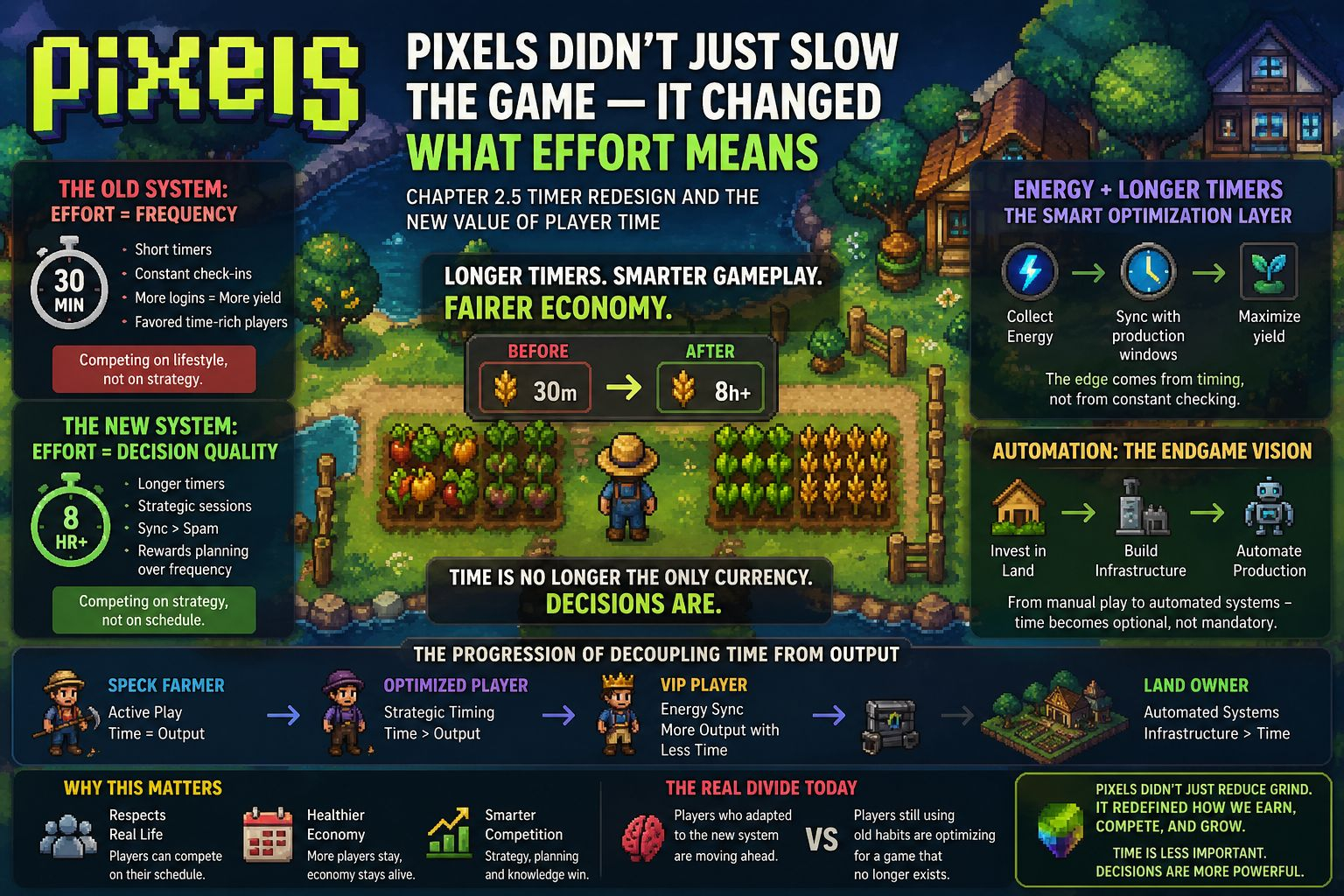
The Old System: Effort = Frequency
Before the redesign, the equation was simple:
More logins → more actions → more yield.
If you could check in every 30 minutes, you weren’t just active — you were economically advantaged. Progress wasn’t just about what you did, but how often you could interrupt your day to do it.
That created a silent divide: Players weren’t competing on strategy… they were competing on lifestyle.
The Shift: Time Stopped Being the Only Currency
When Pixels extended timers and adjusted XP, it didn’t just “reduce grind.”
It redefined effort.
Now, showing up constantly is no longer the dominant strategy.
What matters more is when you show up, not how often.
That’s a fundamental shift.
Because once frequency loses its dominance, something else takes its place: decision quality.
A Smarter Economy Emerges
Longer cycles compress the advantage gap between hyper-active players and structured players.
The edge now comes from:
syncing Energy with production windows
planning sessions instead of reacting constantly
understanding system interactions instead of brute-forcing them
In other words, the game starts rewarding thinking over checking.
And that’s a different kind of competitiveness entirely.
The Hidden Layer: Decoupling Time from Output
But the real design direction goes even further.
Automation and land systems hint at something bigger:
Pixels is gradually separating earning from presence.
At first: You had to be there constantly.
Then: You had to be there strategically.
Eventually: You may not need to be there at all.
That progression from manual play to optimized systems to automated production is not accidental.
It’s a shift from a time-driven economy to an infrastructure-driven economy.
Why This Matters
Games that demand constant attention eventually burn out their most committed players.
Games that respect time create players who stay longer, think deeper, and invest more meaningfully.
Pixels is moving toward the second model.
Not by adding more content…
but by changing the rules of participation.
The Real Divide Now
The biggest gap in Pixels today isn’t between grinders and casuals.
It’s between:
players who adapted to the new system
and players still playing like nothing changed
Because optimizing for a fast-cycle game inside a slow-cycle system is like sprinting on a marathon track.
Effort is still there.
But it’s pointed in the wrong direction.
Pixels didn’t just slow the game down.
It made time less important and decisions more valuable.
And in a game economy, that changes everything.