

I’ve been following blockchain games for a while now, and the pattern that always strikes me is how many of them started with big promises about ownership and freedom, only to end up feeling more like token farms than actual places to play. That’s what drew me to Pixels. It doesn’t try to sell you on the next big revolution. Instead, it feels like a quiet attempt to answer a tougher question: can you build a digital world where people genuinely enjoy spending time—farming, exploring, creating, chatting—and have the blockchain layer make that experience better rather than turning it into a second job?
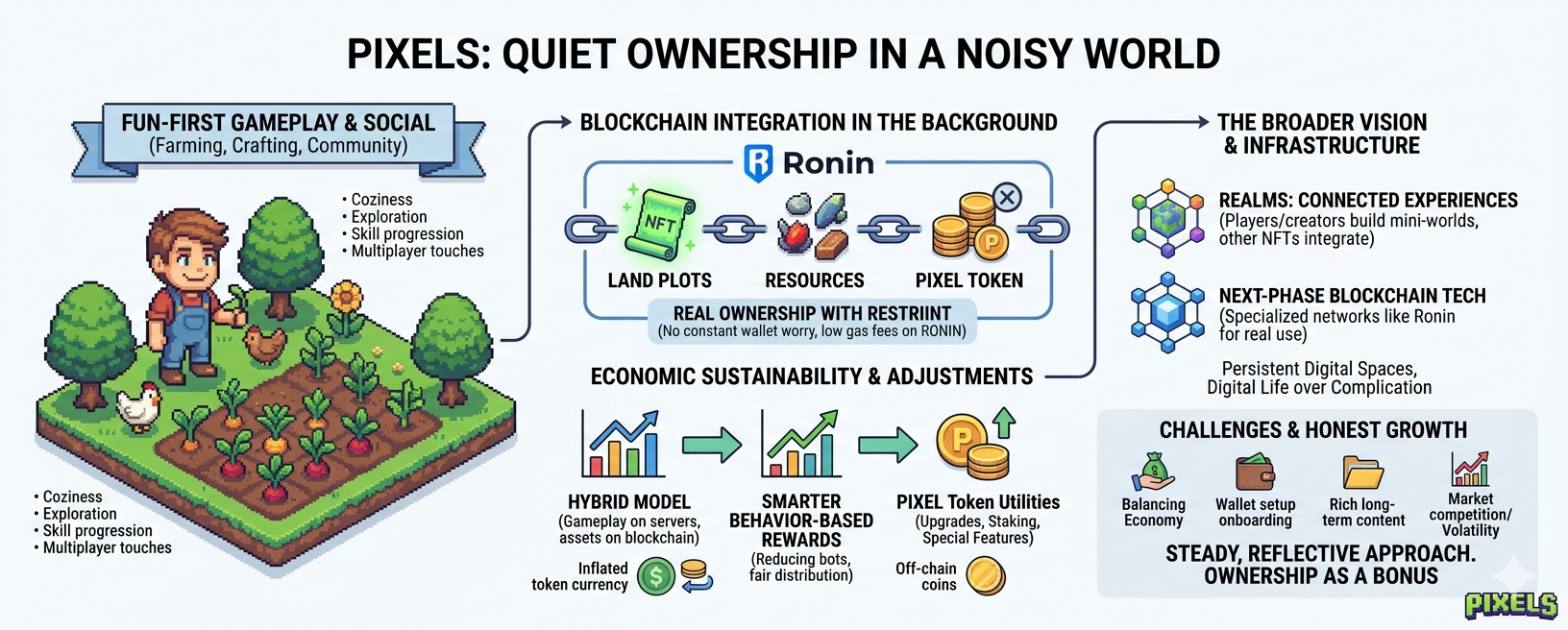
At its core, Pixels is a laid-back, pixel-art open world. You plant crops, tend to animals, gather resources, level up skills, and wander around with others in a cozy, social environment. It borrows that comforting vibe from classic farming games, but adds light multiplayer touches and progression that feels rewarding because you’re building something, not just grinding for tokens. The blockchain side is present but mostly stays in the background. Your land plots are NFTs, some items carry real ownership, and the PIXEL token ties things together, yet you can play for hours without constantly thinking about wallets or gas fees. That restraint is rare, and it’s probably why some players stick around longer than in flashier projects.
The tech behind it is practical more than cutting-edge. It runs on Ronin, the sidechain built by the Axie team specifically for games—fast transactions, almost zero fees, and designed to handle lots of players without slowing down. Pixels uses a hybrid setup: the actual gameplay (moving around, planting, crafting) happens on regular servers so everything feels smooth and responsive, while the important scarce stuff—land, special items, the token economy—lives on the blockchain. It’s not fully decentralized, but that compromise makes the game accessible. When they moved to Ronin a couple of years ago, the difference in player experience was noticeable. Suddenly it just worked better for normal people.
What I find interesting is how they’ve adjusted the economy over time. They learned from early mistakes with an easily inflated currency and shifted daily rewards to off-chain coins to keep things fair and reduce bots. PIXEL itself is the harder asset—capped supply, used for upgrades, staking across games, and special features. There’s this newer “Stacked” system that uses smarter, behavior-based rewards instead of blanket drops, trying to keep real players engaged without flooding the market. It feels like a team that’s actually studying what went wrong in previous cycles and quietly fixing it.
Beyond the main game, they’re slowly building something more open. Through their Realms feature, players and creators can spin up their own little worlds, bring in NFTs from other collections, and start connecting experiences. It’s not a grand metaverse yet, but it points to something useful: persistent digital spaces where your stuff and progress can travel with you. In a broader sense, that’s the quiet promise of this whole space—ownership that doesn’t get locked behind one company’s servers.
Looking at the bigger picture, projects like Pixels matter because they’re testing the next phase of blockchain infrastructure. We’ve moved past the era where everything had to run on slow, expensive general chains. Now we’re seeing specialized networks like Ronin that are built for real consumer use cases. If enough people can enjoy a game first and only later realize they actually own pieces of it, that’s when adoption starts feeling organic rather than forced.
Of course, it’s not all smooth sailing. Keeping the economy healthy while growing is tricky—reward too much and value leaks away, reward too little and people leave. Wallet setup still feels intimidating for true newcomers, and the game needs richer, longer-term content to hold attention beyond the initial charm. Competition is brutal, both from traditional games and other Web3 projects, and token prices can still swing in ways that affect player mood.
Still, there’s something honest about what Pixels is doing. It doesn’t pretend to have solved everything. It’s just patiently trying to make a fun world where ownership feels like a nice bonus instead of the whole point. In an industry that loves hype cycles, that kind of steady, reflective approach feels refreshing. Whether it grows into something bigger will depend on continued execution, but the direction it’s exploring—fun first, real stakes second—is one worth paying attention to. It makes me wonder what other quiet experiments are out there, slowly figuring out how blockchain can actually improve digital life instead of just complicating it.
