
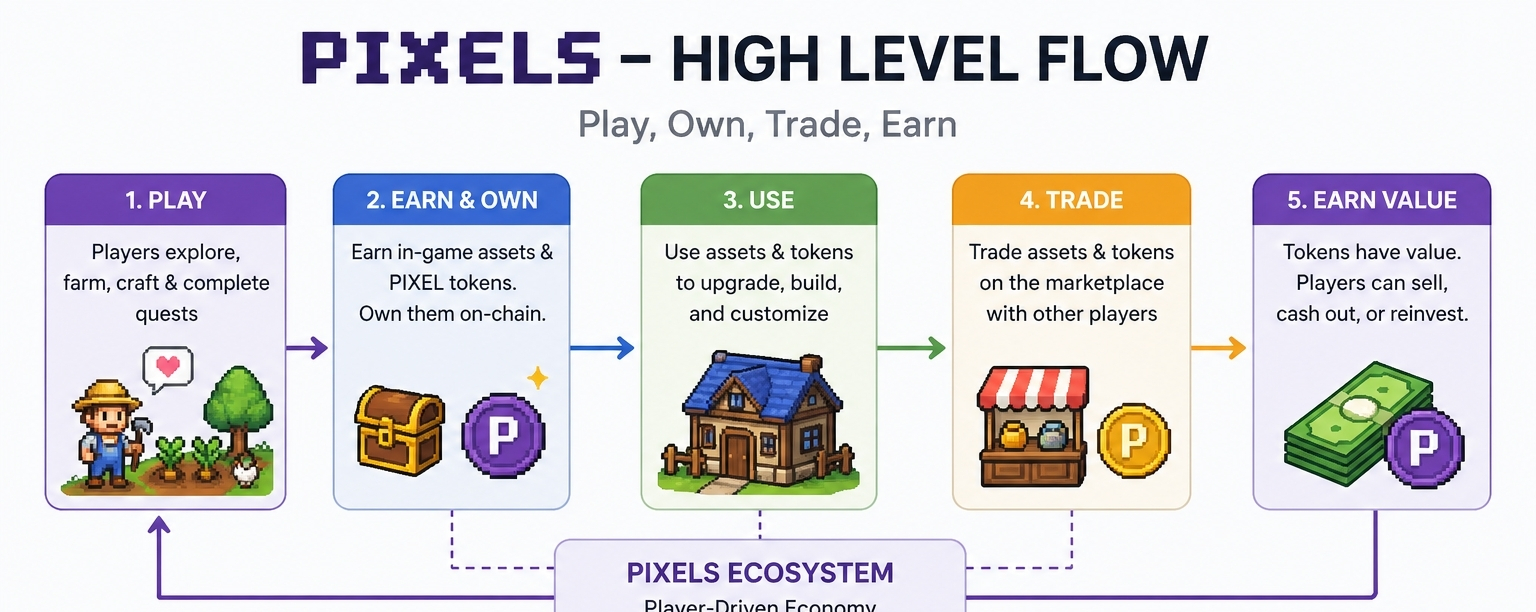
Look, I’ve seen this movie before.
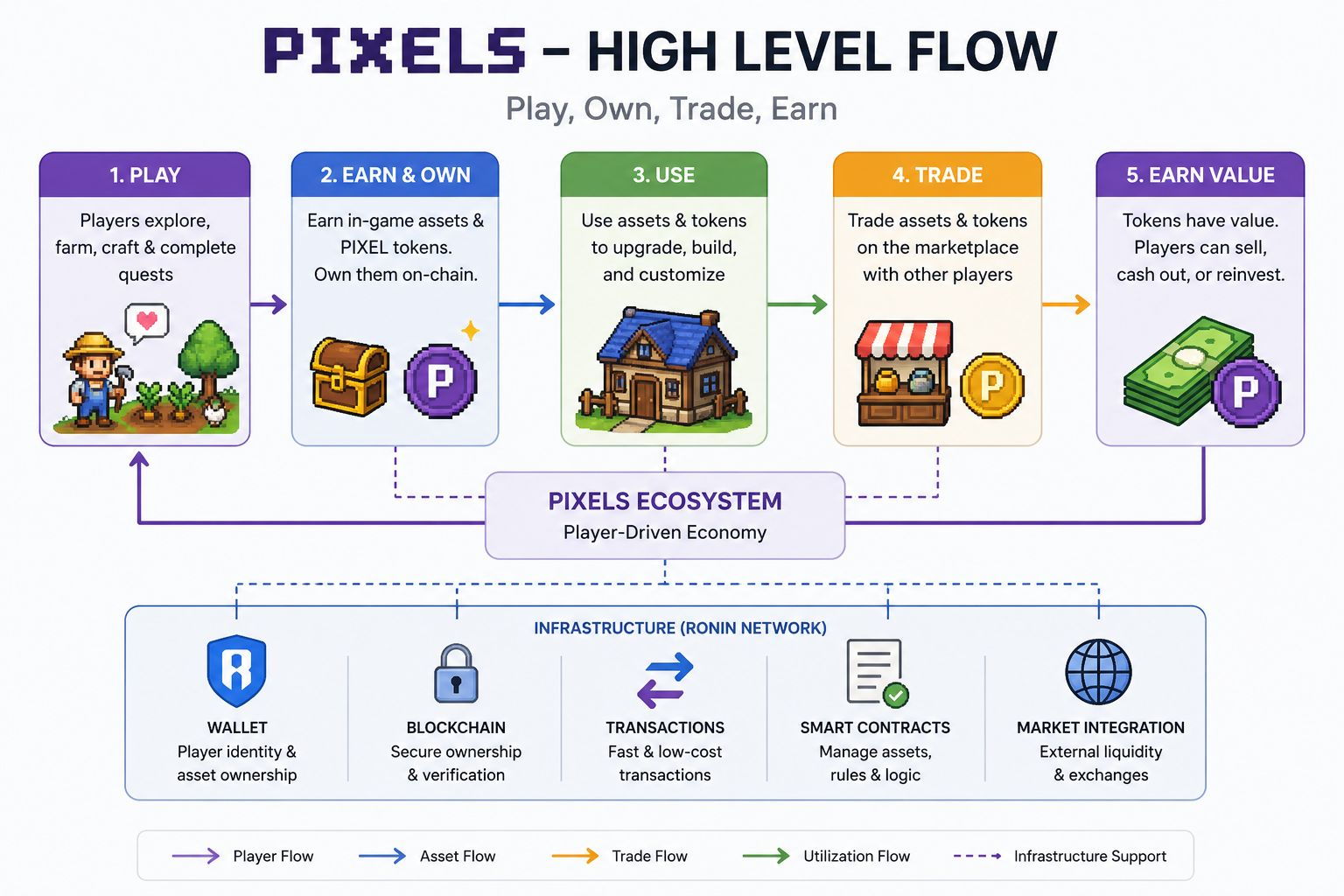
A simple game shows up. Friendly graphics. Low barrier to entry. Then someone says, “What if we added ownership, tokens, and real value?” Suddenly it’s not just a game anymore. It’s a system. That’s exactly where Pixels sits today, running on the Ronin Network and attracting just enough attention to make people wonder if this time is different.
Let’s be honest. That’s what they all say.
The pitch sounds clean. Players finally “own” their assets. Time spent in-game isn’t wasted. You can farm, trade, and maybe even earn something tangible. On paper, it fixes a real irritation in gaming. People sink hours into digital worlds and walk away with nothing when they leave. Pixels claims to correct that imbalance by turning effort into assets you control.
It sounds tidy. It really does.
But here’s the thing. The problem they’re “fixing” isn’t purely technical. It’s economic. Traditional games don’t give you ownership because control is the business model. Studios make money by keeping the system closed. Pixels flips that by opening the economy. Fine. But opening an economy doesn’t magically make it fair or sustainable. It just introduces a new set of problems.
And those problems are harder.
I’ve seen this pattern. You replace a closed system with a semi-open one, bolt on a token, and call it empowerment. What you actually get is a small financial market disguised as a game. Now every carrot you plant has a price. Every decision has an opportunity cost. You’re no longer just playing. You’re calculating.
That changes behavior. Quickly.
Players stop asking “Is this fun?” and start asking “Is this worth it?” That’s a very different mindset. It turns a casual loop into something closer to gig work, except the wages fluctuate with a token price you don’t control.
And that’s where the complexity creeps in.
The system underneath Pixels isn’t simple. It can’t be. You’ve got wallets, token flows, asset markets, and on-chain ownership stitched together with off-chain gameplay. The blockchain—Ronin in this case—handles who owns what. The game servers handle everything else. It’s a hybrid setup, which makes sense technically, but it also undercuts the whole “fully decentralized” narrative.
Because it’s not.
If the developers tweak reward rates, introduce new assets, or change the economy, your “ownership” adjusts with it. Quietly. The blockchain records what you have, sure. It doesn’t protect the value of it. That part is still controlled by design decisions and market sentiment.
So let’s talk incentives. This is where things get uncomfortable.
Who actually makes money here?
Early players. Token holders. The team, assuming they’ve allocated themselves a slice. That’s not unique to Pixels—it’s standard across these systems—but it matters. Because the entire structure depends on new participants coming in and assigning value to existing assets. If that flow slows down, the economics tighten. Rewards shrink. Activity drops.
I’ve watched this happen more than once.
The marketing won’t dwell on that. They’ll talk about “player-driven economies” and “community ownership.” What they won’t emphasize is how fragile those economies can be when they’re tied to speculative tokens. If the token dips, everything built on top of it feels the shock. Suddenly farming isn’t rewarding. Trading dries up. People leave.
And when people leave, liquidity goes with them.
That’s the catch. There’s always a catch.
Ownership only matters if there’s a market. A digital plot of land is valuable because someone else is willing to buy it. Take that away, and you’re left holding something that exists on a blockchain but doesn’t do much else. The system doesn’t break instantly. It just… thins out.
Then there’s the human side. This is the part people underestimate.
Games work because they’re escapism. They give you a space where effort doesn’t have to translate into money. Pixels blurs that line. It turns relaxation into optimization. For some people, that’s appealing. For most, it gets tiring. Fast.
I’ve seen players treat these systems like jobs. Logging in daily. Grinding tasks. Watching token prices. That’s not a game anymore. That’s a routine tied to a volatile income stream.
And when the returns drop?
They stop showing up.
Now zoom out. What Pixels is really trying to do is merge two worlds that don’t naturally fit together: gaming and finance. One is about engagement and enjoyment. The other is about efficiency and profit. You can overlap them, but the friction never fully goes away. One side always distorts the other.
Right now, Pixels is managing that tension better than some of the earlier attempts. The design is cleaner. The economy is a bit more thought-through. It doesn’t scream for attention in the same way those early play-to-earn projects did.
But I’ve been around long enough to know that early stability doesn’t guarantee long-term durability.
The real test isn’t growth. It’s what happens when growth slows.
Because it always does.
And when it does, you find out very quickly whether people were there for the game… or for the money.
