
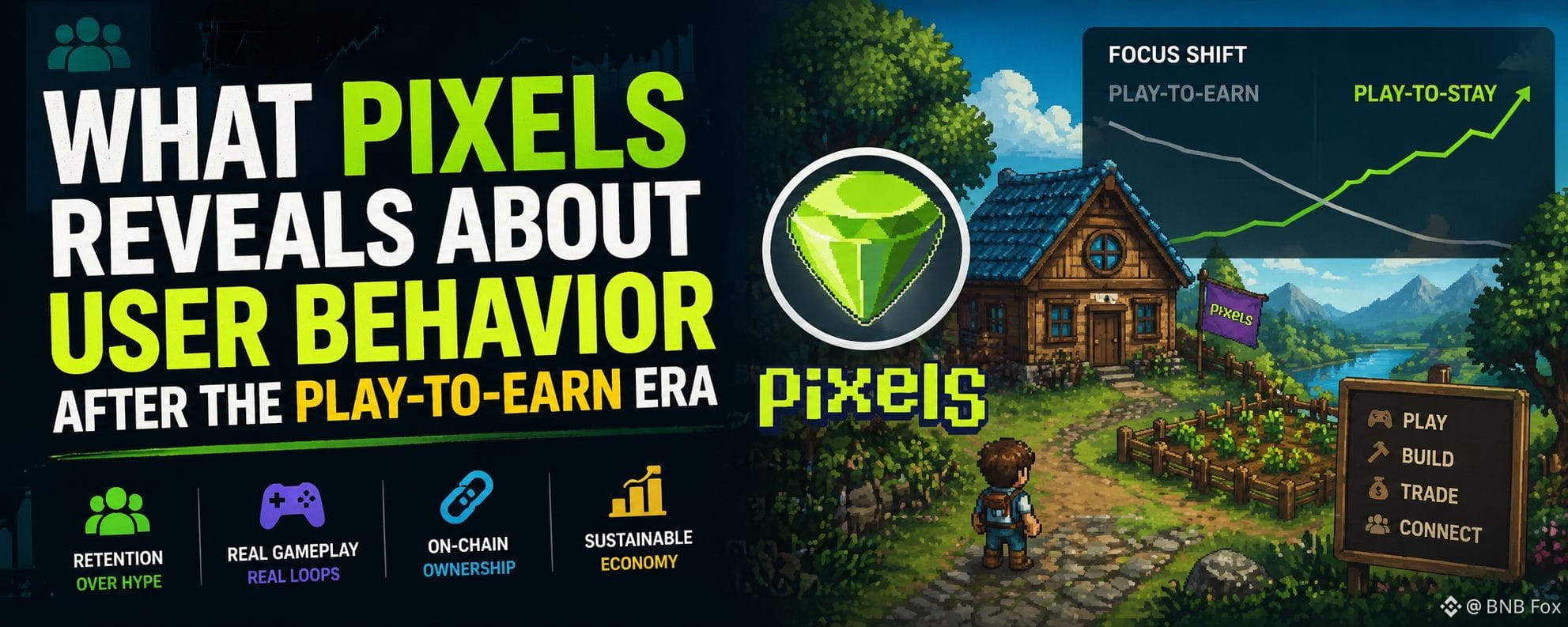
I’ve been watching the recent wave of on-chain gaming experiments closely, and what stands out to me about Pixels is not the surface-level narrative of “play-to-earn,” but the timing of its design choices. Pixels exists in a market that has already seen the rise and collapse of unsustainable reward loops. That context matters more than most people realize. We’re no longer in the phase where simply attaching a token to gameplay attracts durable users. What I notice instead is a shift toward retention-first design, where the token becomes secondary to behavior, not the other way around.
Pixels, built on the Ronin Network, quietly leans into this shift. When I look at it, I don’t see a game trying to financialize attention immediately. I see a system trying to normalize daily activity before extracting value from it. That might sound subtle, but it changes everything. Most earlier Web3 games pushed users to optimize for token extraction. Pixels, at least in its current structure, nudges users toward farming, crafting, and social interaction loops that feel closer to traditional browser or mobile games. The economic layer is there, but it doesn’t dominate the first interaction.
The problem it solves is not obvious unless you’ve spent time observing user churn across Web3 games. The majority of users don’t leave because rewards are too low; they leave because the experience feels transactional from the start. Pixels reduces that friction by making the game loop feel familiar before introducing economic depth. That onboarding difference is where I think most of its edge lies.
From a structural perspective, the architecture is relatively straightforward but effective. Assets, progression, and interactions are tied to on-chain elements, but the experience abstracts enough of the complexity so that users aren’t constantly reminded they are interacting with a blockchain. In real-world terms, it feels closer to logging into a persistent online world rather than managing a wallet-driven interface. That distinction matters because it lowers the cognitive load for new participants.
What I find more interesting is how users actually behave inside this system. The farming and resource loops create a natural rhythm. People log in, perform small tasks, interact with others, and log out. It’s not optimized for maximum extraction per session. It’s optimized for repeat sessions. That’s a very different behavioral pattern compared to earlier models where users tried to maximize yield in the shortest time possible. Here, time becomes the main input, not capital or strategy alone.
This is where $PIXEL comes into play. The token isn’t just a reward mechanism; it acts as a bridge between time spent and economic value. But unlike older models, the emission structure and reward distribution appear to be more controlled. The presence of large reward pools, like the millions of PIXEL allocated for campaigns, might look aggressive at first glance, but what I’m watching is how that distribution impacts retention rather than price spikes.
There’s an uncomfortable truth here that I don’t think enough people acknowledge. Even with better design, tokenized games still face the same fundamental tension: if too much value is extracted too quickly, the system weakens. If too little value is distributed, users lose interest. Pixels sits somewhere in the middle, trying to balance that tension, but it hasn’t fully escaped it. The long-term sustainability will depend on whether the in-game economy can generate demand that isn’t purely speculative.
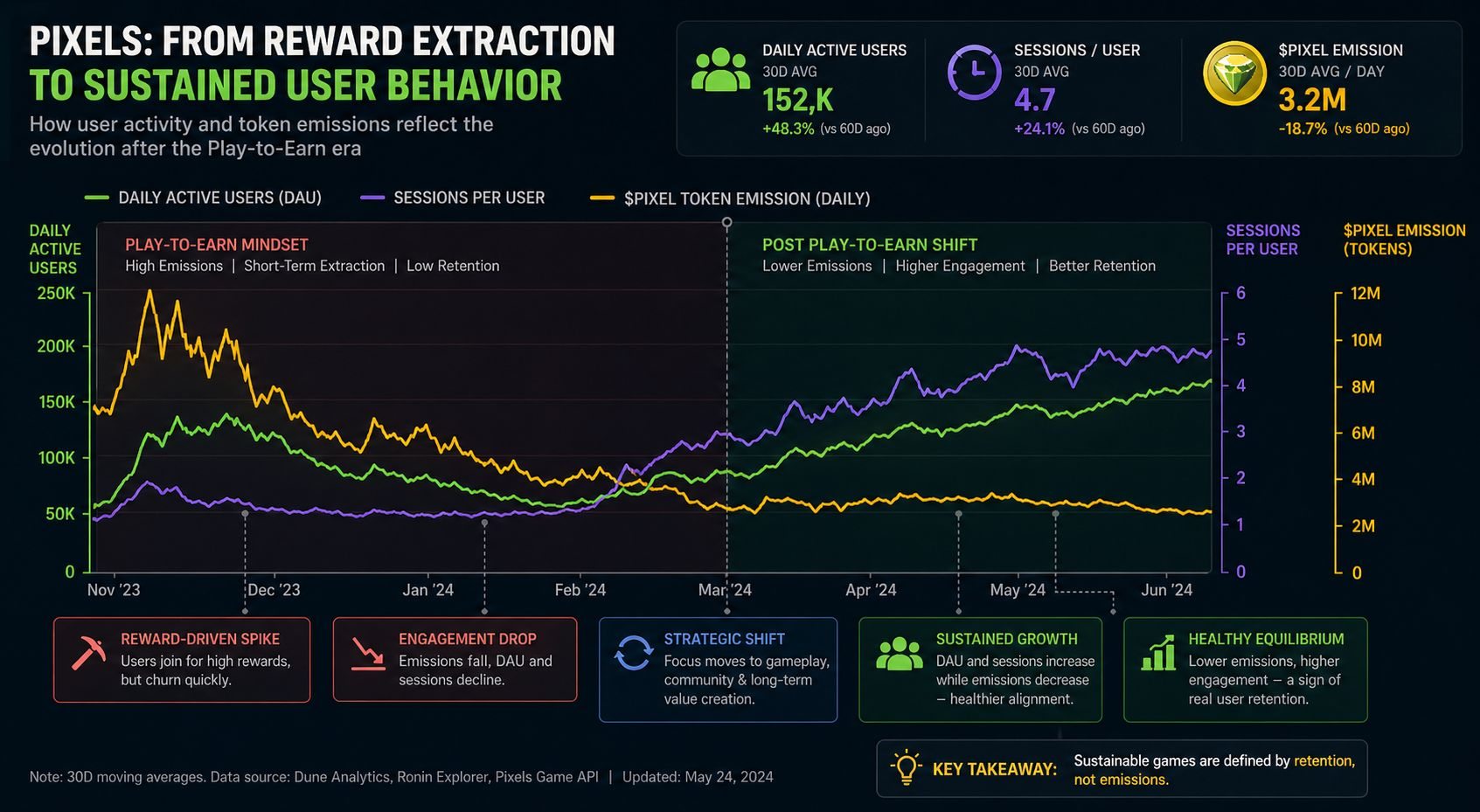
When I look at how this reflects in price behavior, I don’t focus on short-term volatility. Instead, I pay attention to participation metrics. If active users increase while token emissions remain stable, that’s usually a constructive signal. If rewards increase but engagement stagnates, that’s where problems begin. For $PIXEL, the more important data isn’t just price charts, but how many users are consistently interacting with the ecosystem and what they’re doing when they log in.
The recent push around social engagement, including campaigns that require posting and interaction on Binance Square, adds another layer. It’s not just about playing the game anymore. It’s about extending the ecosystem into content and attention markets. By requiring users to mention @Pixels, tag $PIXEL, and use #pixel, the system is effectively turning participants into distribution channels. This is not new in crypto, but in this case, it’s tightly integrated with the reward structure.
What I find interesting is how this affects perception. When users are both players and promoters, the line between organic growth and incentivized activity becomes blurred. That doesn’t necessarily invalidate the growth, but it does make it harder to measure genuine demand. I’ve seen similar patterns before, and they tend to create short-term visibility at the cost of long-term clarity.
In the broader market cycle, Pixels fits into what I’d call the “post-speculative utility phase” of Web3 gaming. The market has already priced in the idea that not all tokens can sustain value purely through hype. What’s being tested now is whether systems can retain users without constant external incentives. $PIXEL is one of the projects attempting to answer that question in real time.
I don’t think it’s a perfect model, and I’m not convinced it has fully solved the core issues of tokenized economies. But I do think it represents a more mature approach compared to earlier iterations. The focus on user behavior, the softer integration of the token, and the emphasis on repeat engagement all point in a direction that feels more grounded.
At the same time, I remain cautious. The history of this space suggests that early traction doesn’t always translate into long-term stability. What I’m watching now is not how fast @Pixels grows, but how it behaves under pressure. If rewards decrease, do users stay? If the token stabilizes instead of pumping, does engagement hold? Those are the questions that will define whether this model actually works.

For now, Pixels sits in an interesting position. It’s not trying to reinvent everything, but it’s clearly trying to correct past mistakes. Whether that’s enough is still uncertain. But in a market that has already seen extremes on both ends, sometimes incremental improvement is more meaningful than radical innovation. And that’s what keeps me paying attention to it.