
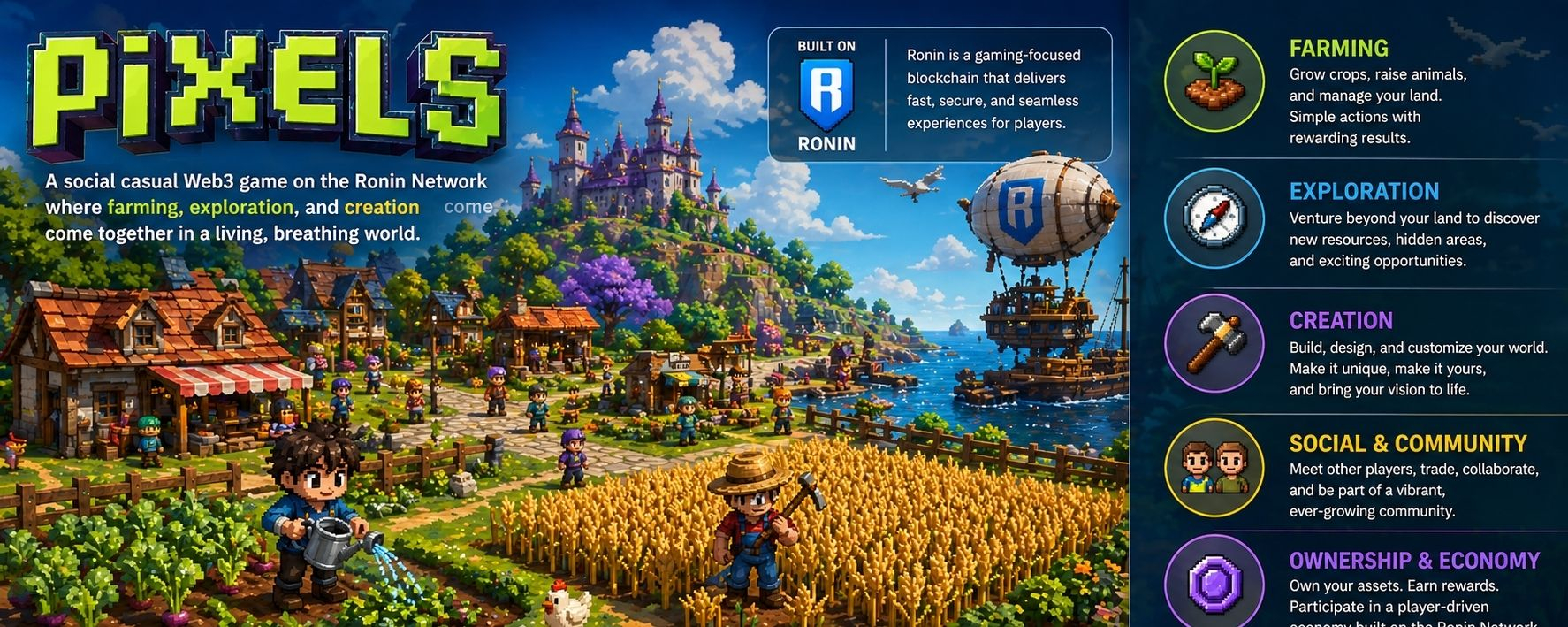
There is something quietly captivating about a game that does not rush you. In a digital age filled with fast-paced competition and constant stimulation, Pixels offers a different kind of experience—one that feels slower, more thoughtful, and surprisingly human. At first glance, it may seem like just another farming and exploration game, but spend a little time inside its world and it becomes clear that Pixels is trying to do something more meaningful. It blends familiar gameplay with the emerging ideas of Web3, not to impress with complexity, but to create a space where players can relax, connect, and build something that feels like their own.
Pixels is built on the idea that simple actions can be deeply satisfying. Farming, for instance, is not just a mechanic; it becomes a routine that players grow attached to. Planting seeds, waiting for crops to mature, and harvesting them creates a rhythm that mirrors real-life patience and reward. There is no urgency, no pressure to compete at every moment. Instead, the game invites players to return at their own pace, to check on their progress, and to enjoy the small but steady sense of growth. That quiet satisfaction is one of the reasons why farming games have always resonated with people, and Pixels captures that feeling well.
But Pixels does not stop at farming. It opens up into a world that encourages exploration, and that is where curiosity begins to take over. As players move through different areas, they encounter new resources, unfamiliar spaces, and sometimes other players going about their own routines. Exploration in Pixels is not about chasing danger or completing missions under pressure. It is about wandering, discovering, and occasionally stumbling upon something unexpected. That sense of discovery adds a layer of freshness to the game, ensuring that it never feels too repetitive, even when the core mechanics remain simple.
What truly sets Pixels apart, however, is its emphasis on creation. Many games allow players to interact with a world, but Pixels encourages them to shape it. Players can build, design, and customize their own spaces, turning a patch of land into something personal. This act of creation changes how people engage with the game. It is no longer just about completing tasks; it becomes about expressing identity. A player’s land reflects their choices, their priorities, and even their personality. Over time, these spaces begin to feel less like digital assets and more like extensions of the player themselves.
This sense of ownership is where Web3 quietly enters the picture. Unlike traditional games, where progress is often locked within the system, Pixels introduces the idea that players can truly own parts of their in-game experience. However, what makes Pixels stand out is how gently it presents this concept. It does not overwhelm players with technical details or complex processes. Instead, it allows them to naturally discover the benefits of ownership as they play. For someone unfamiliar with blockchain technology, the transition feels almost invisible, which is exactly what makes it effective.
The social aspect of Pixels adds another layer of depth to the experience. While it can be enjoyed alone, the game becomes richer when shared with others. Players cross paths, exchange ideas, and sometimes collaborate in ways that feel organic rather than forced. There is a sense that everyone is part of the same evolving world, even if they are pursuing different goals. This shared environment creates a feeling of connection that many games struggle to achieve. It is not about competition or dominance; it is about coexistence and contribution.
At the heart of this social world is a living economy. Like many Web3 games, Pixels includes tokens and rewards, but it approaches them with care. Rather than making profit the central focus, the game treats rewards as a natural extension of gameplay. Players earn through participation, through effort, and through engagement with the world. This approach helps maintain balance, ensuring that the game remains enjoyable rather than purely transactional. It reflects a broader understanding that people stay for the experience, not just the rewards.
Of course, creating this balance is not without its challenges. Any system that involves rewards must constantly adjust to remain fair and sustainable. Too much incentive can disrupt the experience, while too little can reduce motivation. Pixels navigates this by evolving over time, refining its systems and responding to how players interact with the game. This willingness to adapt is a positive sign, as it ցույցs a commitment to long-term stability rather than short-term excitement.
Another strength of Pixels lies in its flexibility. It respects the fact that players have different lifestyles and preferences. Some may log in for just a few minutes to tend to their crops, while others may spend hours exploring and building. The game does not force a particular style of play. Instead, it provides a framework that supports both casual and more engaged experiences. This flexibility makes it accessible to a wider audience, including those who may not consider themselves traditional gamers.
A typical day in Pixels might begin with a quick visit to check on crops, followed by a short exploration of nearby areas. Later, a player might decide to expand their land, experiment with new designs, or interact with others in the community. There is no fixed path, no single “right” way to play. Each session feels like a continuation of a personal journey, shaped by individual choices and interests. That freedom is one of the game’s most appealing qualities.
What makes Pixels particularly interesting is how it reflects a shift in gaming culture. More players are seeking experiences that feel meaningful without being overwhelming. They want games that fit into their lives rather than dominate them. Pixels aligns with this mindset by offering a space that feels welcoming, flexible, and rewarding in subtle ways. It shows that a game does not need intense action or complex systems to be engaging. Sometimes, all it takes is a well-designed world and the freedom to explore it.
Looking ahead, the future of Pixels will depend on its ability to maintain this balance. As the game grows, it will need to continue evolving without losing the qualities that make it special. New features, updates, and expansions must enhance the experience rather than complicate it. At the same time, the community will play a crucial role in shaping the world. A strong, engaged player base can turn a good game into a lasting one.
In many ways, Pixels feels like a quiet experiment in what Web3 gaming can become. It does not rely on hype or complexity. Instead, it focuses on creating a space that people genuinely enjoy spending time in. By combining farming, exploration, and creation with a thoughtful approach to technology, it offers a glimpse of a future where digital worlds feel more personal and connected.
In the end, Pixels is not just about what you do in the game; it is about how it makes you feel while you are there. It invites you to slow down, to build, to explore, and to be part of something that grows over time. In a landscape often defined by speed and competition, that simple invitation is what makes Pixels truly stand out.
