
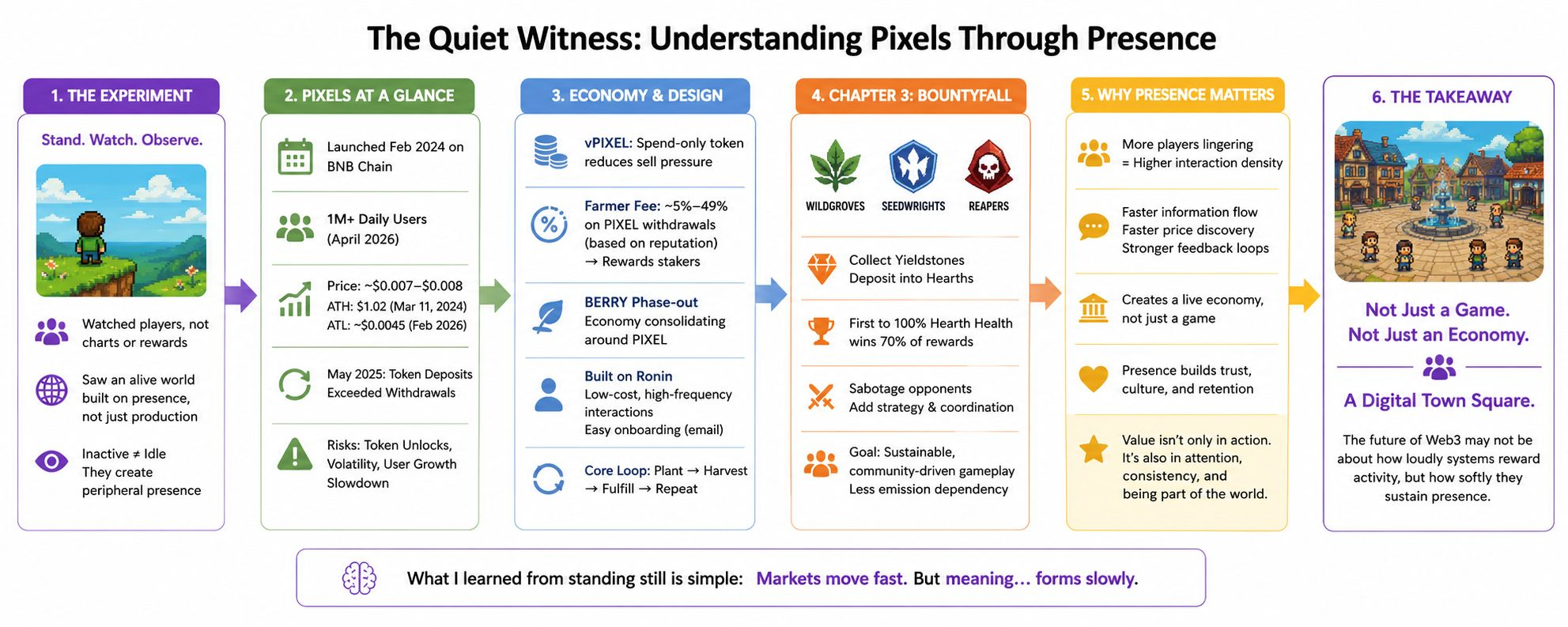
One morning in April 2026, I logged into and didn’t do anything. No farming. No crafting. No checking charts. I just walked to the edge of the map and stood there. Watching.
At first, it felt pointless. Then… something shifted.
Players kept moving. Crops harvested. Orders filled. Small trades happened quietly. No one cared that I was there. But the world didn’t feel empty. It felt alive. Not because of rewards but because of presence.
As a trader, I got curious. So I turned it into an experiment.
Different days. Different hours. Same spot.
I watched behavior instead of price.
And honestly… what I saw matters more than most dashboards.
Most of us entered GameFi through numbers. APY. emissions. unlock schedules. Pixels was no different when it launched as the 46th project on in February 2024. Stake BNB, farm , exit early that was the mindset.
But by April 2026, the story looks different.
The token trades around $0.007–$0.008 range. Far below its $1.02 ATH from March 11, 2024. It even touched an ATL near $0.0045 in February 2026. That volatility tells you something clearly—this is not a hype-driven up-only asset.
And yet… the game still pulls over a million daily users.
Why?
It’s not emissions. It’s not speculation.
It’s behavior.
The more I watched, the more I noticed something subtle. The players who stayed the longest weren’t always the most productive. Some just stood near hubs. Some walked slowly across farms. Some gathered without speaking.
At first, I thought they were inactive.
Then I realized… they were contributing in a different way.
They were creating what I call peripheral presence.
It’s not measured in token volume. Not visible on-chain. But it changes everything.
In traditional GameFi models, idle users are considered churn risk. In Pixels, they feel like infrastructure. Like background liquidity but social instead of financial.
This is where the design starts to make sense.
Pixels runs on , built for low-cost, high-frequency interaction. The onboarding is simple email login, no wallet friction. The core loop is intentionally soft: plant, harvest, fulfill, repeat.
But underneath that simplicity is a structured economy.
The team introduced $vPIXEL a spend-only version of the token to reduce sell pressure. If you withdraw real PIXEL, you pay a “Farmer Fee” that can range roughly from ~5% to ~49%, depending on your in-game reputation. That fee gets redistributed to stakers.
It’s a subtle system.
It doesn’t force holding. It nudges behavior.
At the same time, the older inflation-heavy $BERRY is being phased out. The economy is consolidating around PIXEL. Fewer moving parts. Cleaner incentives.
Then came Chapter 3 -Bountyfall, launched October 30, 2025.
Three Unions. Wildgroves. Seedwrights. Reapers.
Players collect Yieldstones and deposit them into Hearths. First to 100% health wins 70% of the seasonal rewards. You can even sabotage other teams.
It’s not just farming anymore.
It’s coordination.
described it as a push toward sustainable, community-driven gameplay. Less emission dependency. More interaction density.
And that’s where my “standing still” experiment connects.
Because when players linger… they increase density.
More density means faster information flow. Faster price adjustments. Faster behavioral feedback loops.
It starts to resemble a live economy not a game.
Let’s be honest. We’ve seen this before in reverse.
grew fast, then collapsed when incentives dried up. The economy was strong, but the world was empty without rewards.
Pixels seems to be testing the opposite hypothesis.
What if the world stays alive… even when rewards shrink?
There are signs pointing that way.
In May 2025, Pixels reached a key milestone token deposits exceeded withdrawals. That’s rare in GameFi. It suggests users are not just extracting value, but recycling it.
Still, risks are real.
Token unlocks continue. The next one, May 19, 2026, will release about 91 million PIXEL around 1.8% of total supply. Circulating supply sits near 771 million out of a 5 billion max. That’s a long emission tail.
If user growth slows, sell pressure can return quickly.
And yes… sentiment in crypto flips fast.
But here’s what I can’t ignore.
Even on slow days, when the market feels quiet, the map in Pixels doesn’t fully empty.
There’s always someone… standing.
Watching.
Existing.
That changes how I think about value.
Maybe not all value comes from action. Maybe some of it comes from attention.
From being there consistently.
From contributing to a shared space without extracting immediately.
As traders, we’re trained to look at charts. Volume. Liquidity. Unlocks.
All important.
But sometimes… the real signal sits outside the chart.
At the edge of the map.
Pixels might not be perfect. The token is volatile. The roadmap is still evolving. Chapter 4 is expected sometime in 2026, likely pushing mobile and ecosystem expansion but nothing is guaranteed.
Still… there’s something quietly forming here.
Not just a game.
Not just an economy.
Something closer to a digital town square.
And maybe… just maybe… the future of Web3 won’t be defined by how loudly systems reward activity.
But by how softly they sustain presence.
Because what I learned from standing still is simple.
Markets move fast.
But meaning… forms slowly.
