
China has stepped in to block Meta’s roughly $2 billion purchase of AI startup Manus, ordering the U.S. social-media giant to unwind a deal that was announced and closed months ago. The National Development and Reform Commission (NDRC) issued the cancellation on Monday, saying it aimed to prevent sensitive AI assets from being transferred to a foreign company amid rising tensions with Washington. Meta completed the acquisition of Manus in December for just over $2 billion, pursuing the company’s advanced work on AI agents — systems built to carry out complex digital tasks with minimal human supervision. Regulatory pressure first surfaced in March when Manus CEO Xiao Hong and chief scientist Ji Yichao were reportedly stopped from leaving China while authorities reviewed the transaction. Although Manus later relocated its headquarters to Singapore, Beijing’s move makes clear that such maneuvers don’t necessarily shield firms from Chinese oversight. Analysts say the intervention signals a shift in Beijing’s posture: AI is now being treated as strategically sensitive the way semiconductors once were. “China is saying we will prevent foreign acquisition of assets we consider important for national security — and AI is now clearly one of them,” said Alfredo Montufar-Helu, managing director at Ankura China Advisors. State media had earlier framed Manus as a potential challenger to DeepSeek after the startup unveiled what it called the first general AI agent capable of handling a broad range of tasks. The decision is likely to add friction to U.S.-China relations ahead of a planned mid-May meeting between Presidents Donald Trump and Xi Jinping, where technology and trade are expected to be high on the agenda. Inside Meta, the company has been aggressively expanding its AI efforts. Internal documents reported by crypto.news show Meta has deployed tracking tools under a “Model Ability Initiative” to collect employee interaction data — including keystrokes, mouse movements and periodic screenshots — to help train AI systems on real-world computer usage. CTO Andrew Bosworth has described a future where “our agents primarily do the work and our role is to direct, review and help them improve.” Meta spokesman Andy Stone said the data are used for model training, not employee evaluation. Meta is also reorganizing engineering teams and creating roles focused on building autonomous systems that can write and deploy code. The company is experimenting with a digital avatar of CEO Mark Zuckerberg trained to mimic his communication style and interact with employees in real time. On the consumer side, Meta is pushing AI deeper into social commerce, integrating tools that aim to shorten the path from discovery to purchase across Instagram and Reels. The Manus episode underscores how AI has become a geopolitical flashpoint. For startups, investors and tech platforms — including projects at the intersection of crypto, AI and decentralized infrastructure — the ruling is a reminder that national security concerns and regulatory boundaries can quickly reshape global deals and talent flows. Read more AI-generated news on: undefined/news

Article
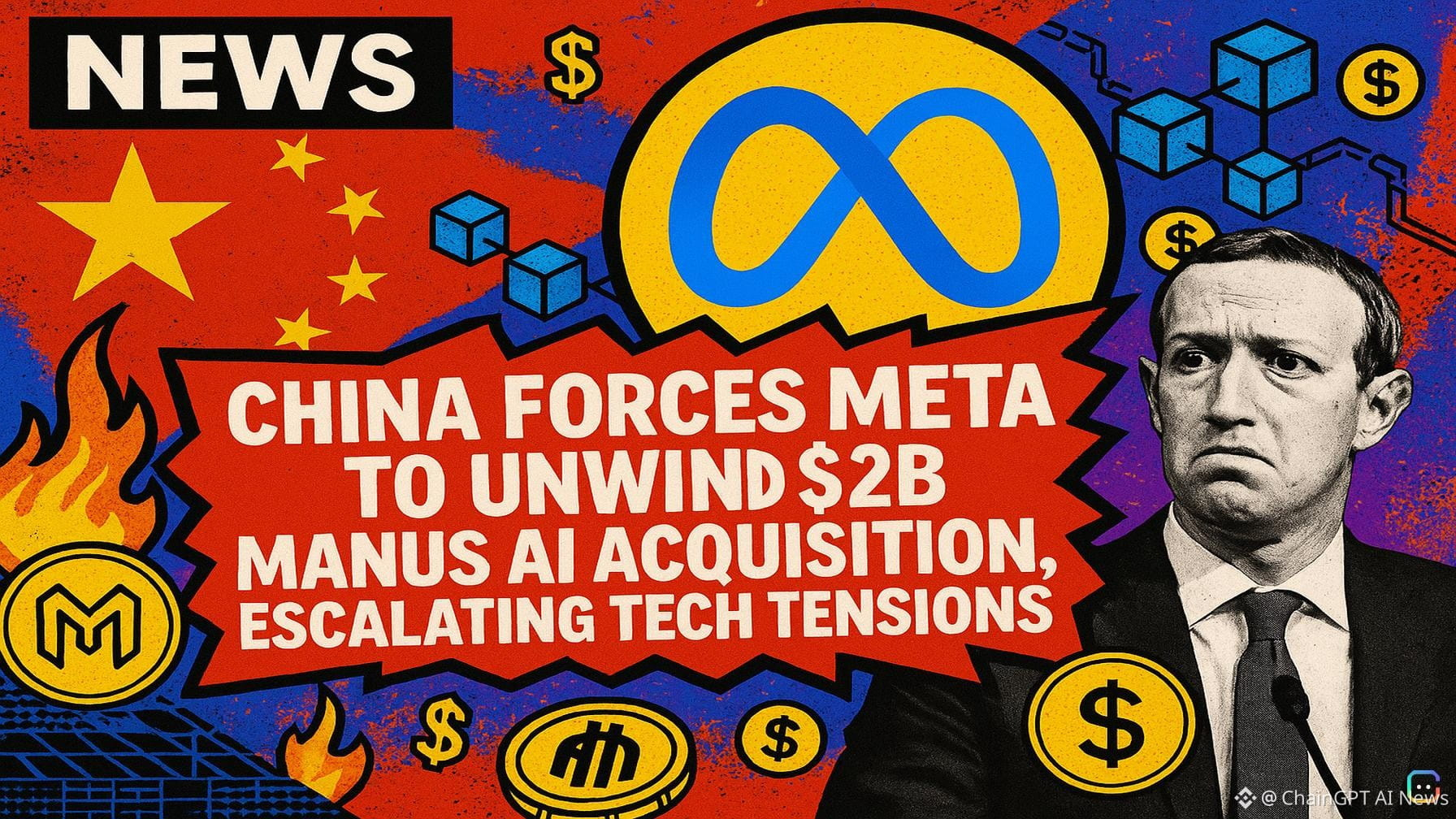
China Forces Meta to Unwind $2B Manus AI Acquisition, Escalating Tech Tensions
Disclaimer: Includes third-party opinions. No financial advice. May include sponsored content. See T&Cs.