
I noticed it on a Tuesday morning about two months into playing Pixel seriously. I logged in, opened the task board, and for a brief moment couldn't tell whether I was looking at the same nine tasks from my first week or something that had evolved with me. I checked. It hadn't. Nine tasks. Coins as rewards. Reset in 24 hours. Exactly what a player who created their account yesterday would open to. I closed the board, completed the tasks anyway, and didn't think about it again until a few weeks later when I noticed something specific about how I was talking about the game to people who asked. I was describing it in past tense without realizing it.
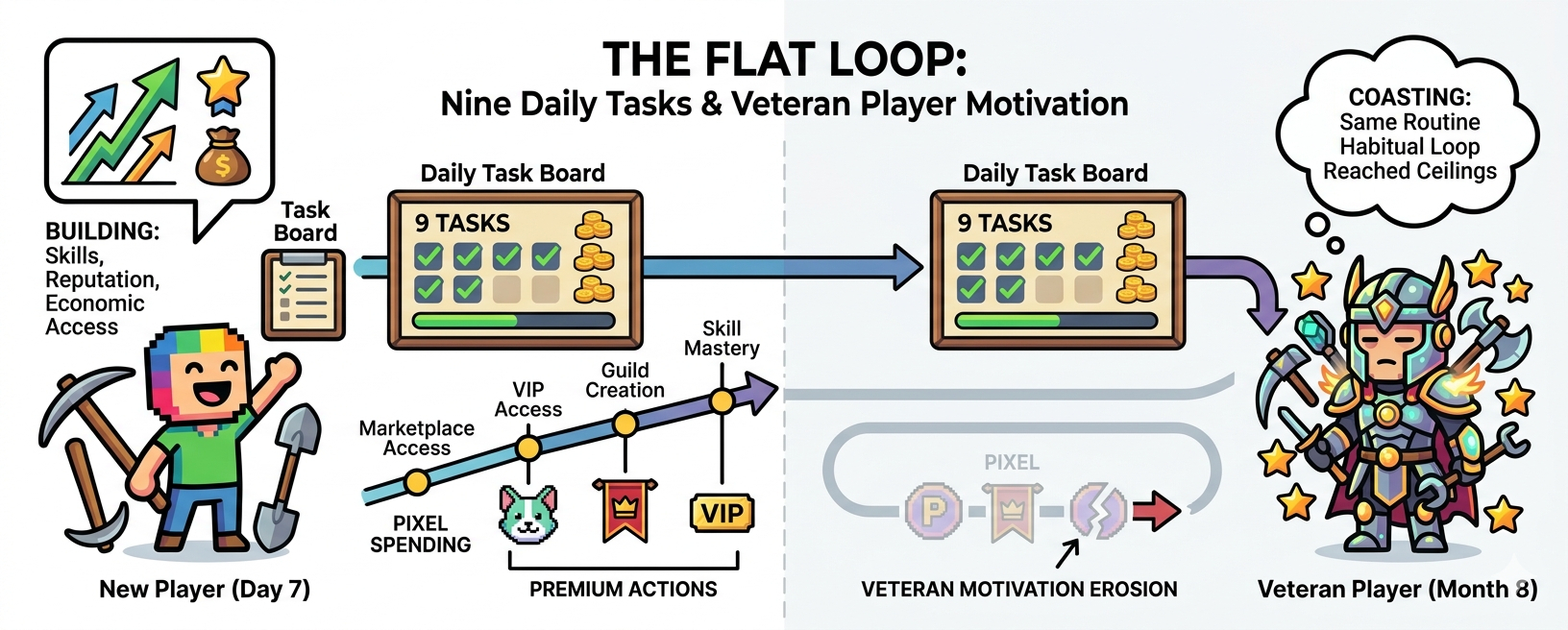
The task board is Pixel's primary daily retention mechanism. Not land. Not guilds. Not the marketplace. The thing that pulls the majority of the active player base back every single day is nine resetting tasks that reward Coins for completing basic in-game activities. That system works genuinely well as an onboarding loop. New players need a structured daily reason to return while they are still learning the game's systems, building reputation, developing skills, finding their footing inside the economy. The task board gives them that reason cleanly and consistently. What it doesn't do and what I keep coming back to as the more important structural question is change meaningfully as the player develops. The veteran player who has spent eight months building skills, accumulating reputation, navigating the marketplace, and investing real time into understanding Pixel's economy opens the same task board as the player on day seven. Nine tasks. Coins. Reset tomorrow.
What feels more important here than the token price or the unlock schedule is what this structural flatness does to veteran player motivation over time. In almost every live game that successfully retains a long-term player base the daily engagement loop deepens as the player progresses. The veteran's daily experience diverges from the new player's daily experience in ways that make the veteran feel their months of investment produced something that changes how the game meets them each session. Harder content. More complex systems. Rewards that reflect progression depth rather than just daily presence. Pixel's task board doesn't do this. It treats eight months of committed play and eight days of casual play as equivalent inputs deserving equivalent daily structure. The veteran has better skills. They have reputation. They may have land or guild access. But the primary rhythm pulling them back every morning is identical to what pulled them back when they knew nothing about how the game worked.
I'm not fully convinced the player data surfaces this distinction cleanly. A veteran completing nine daily tasks and a new player completing nine daily tasks look identical in the engagement metrics. Both logged in. Both completed the loop. Both counted as daily active users. What the data doesn't capture is the quality of that engagement or the trajectory of the motivation behind it. A new player completing tasks is building toward something reputation, marketplace access, skill progression, economic participation. A veteran completing tasks may have already reached the ceilings that originally motivated their investment and is now completing the same loop out of habit rather than genuine forward momentum. Those two behaviors produce identical signals in the activity data while representing completely different retention conditions. One is compounding. The other is coasting. And coasting has a specific endpoint that doesn't announce itself before it arrives.
The PIXEL demand consequence of this is the part that matters to me most and that I haven't seen examined directly anywhere. Veteran players are the most likely segment of Pixel's player base to spend PIXEL on premium actions pet minting, guild creation, VIP access, land-related functions. They have the reputation required to participate in the economy's most active layers. They have the game knowledge to understand what premium spending buys them. They have the commitment history that suggests they care enough about the game to invest beyond the free loop. If that segment is quietly experiencing motivational erosion while their daily login behavior remains superficially unchanged the PIXEL demand signal from veterans looks stable right up until it doesn't. The task board's structural flatness doesn't cause veteran exit directly or immediately. It produces a slow motivational drift that precedes exit by weeks or months and shows up in premium spending behavior before it shows up in login frequency. Whether veteran PIXEL spending data over the next two quarters reflects that drift or contradicts it is the specific reading that future behavior will either confirm or break entirely.
