

I’ve been around crypto long enough to notice a pattern before it fully plays out.
A new project appears. The messaging feels strong, the community grows quickly, and for a brief moment it feels like something important is happening again. People talk with certainty, as if the outcome is already decided.
Then time passes.
The excitement fades. Attention moves elsewhere. Most of those projects slowly disappear into silence, even the ones that once felt unavoidable.
After enough cycles, you stop reacting to noise. You start paying attention to what still makes sense when everything goes quiet.
That mindset is what led me to look more closely at privacy focused blockchain systems like Aleo.
At first I honestly did not give it much weight.
What always stayed with me in this industry is a simple tension. Blockchain solved trust in a very clean way, but it did so by making everything visible. Every transaction, every interaction, every movement of value is permanently recorded and traceable.
At the beginning that transparency felt like a breakthrough. It removed uncertainty. It made verification possible without asking anyone to trust a central authority.
But over time I started noticing what that design quietly leaves out.
In real life, not everything is meant to be fully exposed. People do not broadcast their entire financial history. Companies do not reveal every internal decision. Even systems that depend on openness still rely on some level of controlled privacy.
Blockchain, in its current form, often removes that layer completely.
When I first looked into Aleo, I expected it to be another variation of the same privacy narrative I had seen before. But the approach felt different enough to make me slow down and actually pay attention.
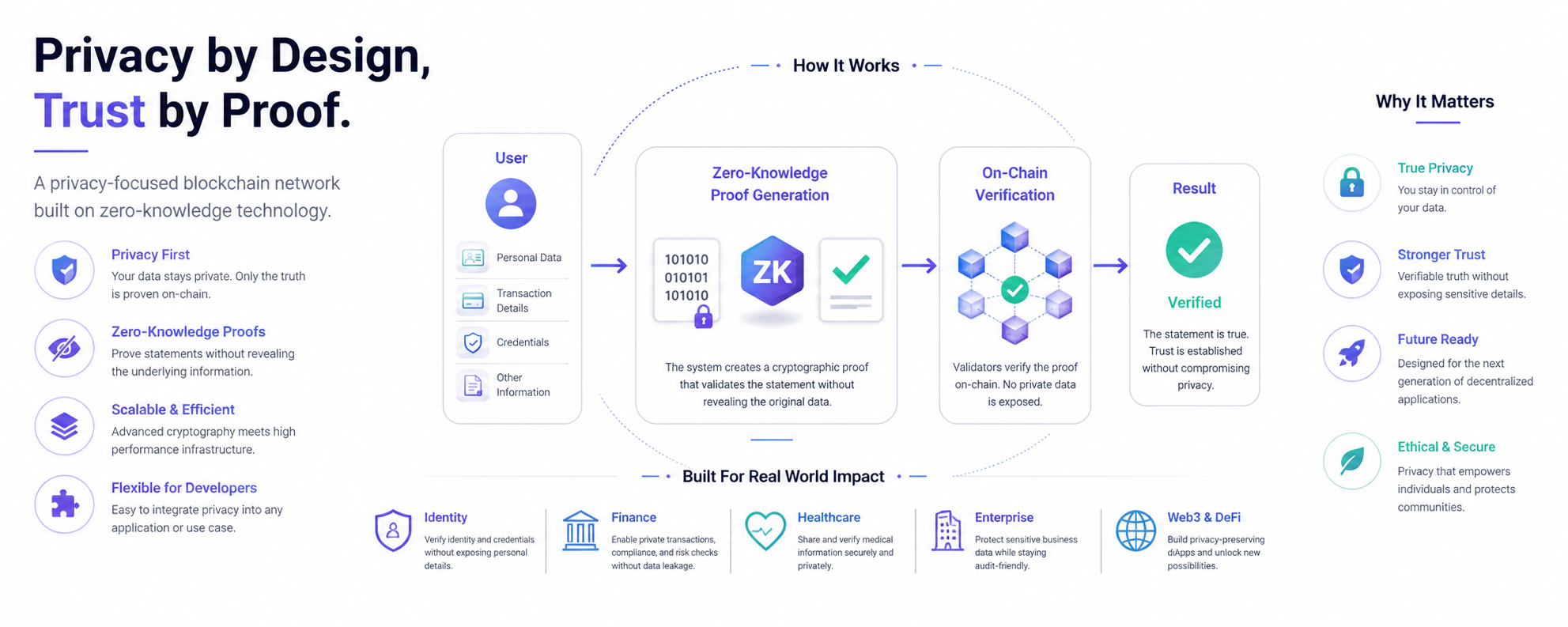
Instead of treating privacy as something added on top of an existing system, it is built around zero knowledge computation from the ground up.
In simple terms, the idea is this. You can prove that something is true without revealing the information behind it. You are not exposing the inputs, not exposing the process, and sometimes not even exposing the result in a readable form. You are only proving validity.
That might sound subtle at first, but it changes the way systems can be designed.
Because it separates verification from visibility.
Most blockchain systems today assume that trust requires full transparency. If you want to verify something, you also see everything behind it. That model works, but it comes with limitations. It restricts what kind of applications can exist in public environments.
Privacy focused computation changes that assumption. It suggests that you can still have verifiable systems without exposing everything inside them.
When I started thinking about that more practically, a few use cases stood out.
Financial systems are an obvious one. Today, most blockchain activity is completely transparent. That is fine for basic transfers, but it becomes a problem when strategies, positions, or sensitive activity are involved. A system where actions can be verified without exposing details changes how serious participants might interact with it.
Identity is another area. Right now, proving something about yourself often means giving away more information than necessary. Age, credentials, eligibility, all of it usually comes with extra data exposure. A system that allows selective proof without full disclosure feels like a more natural evolution.
Even digital environments and games start to look different under this lens. In open worlds like Pixels, everything is visible, including player activity and asset movement. That transparency shapes behavior. A model that allows hidden strategies while still maintaining fairness through verification could create entirely different dynamics.
Business use cases might be the most important. Companies do not operate in full transparency internally. They rely on confidentiality to function. If blockchain is ever going to move deeper into enterprise systems, it has to support that reality instead of ignoring it.
Still, I do not treat any of this as guaranteed success.
I have seen enough cycles to know that strong ideas do not always become widely used systems. There are real challenges here. The technology is complex, developer experience is still evolving, and performance trade offs exist. On top of that, privacy in blockchain always sits in a sensitive regulatory space that is not fully settled.
So I do not look at this with excitement or certainty.
I look at it with attention.
Because most projects fade with hype, but a few quietly work on problems that do not go away.
Privacy is one of those problems. It was never really solved in blockchain. It was just set aside because transparency was easier to build and explain.
What interests me now is not whether this becomes popular in the next cycle, but whether the underlying idea continues to hold up over time.
That is usually where the real shifts happen in this space.
Not in the loud moments, but in the quiet ones that keep making sense even when nobody is talking about them.