
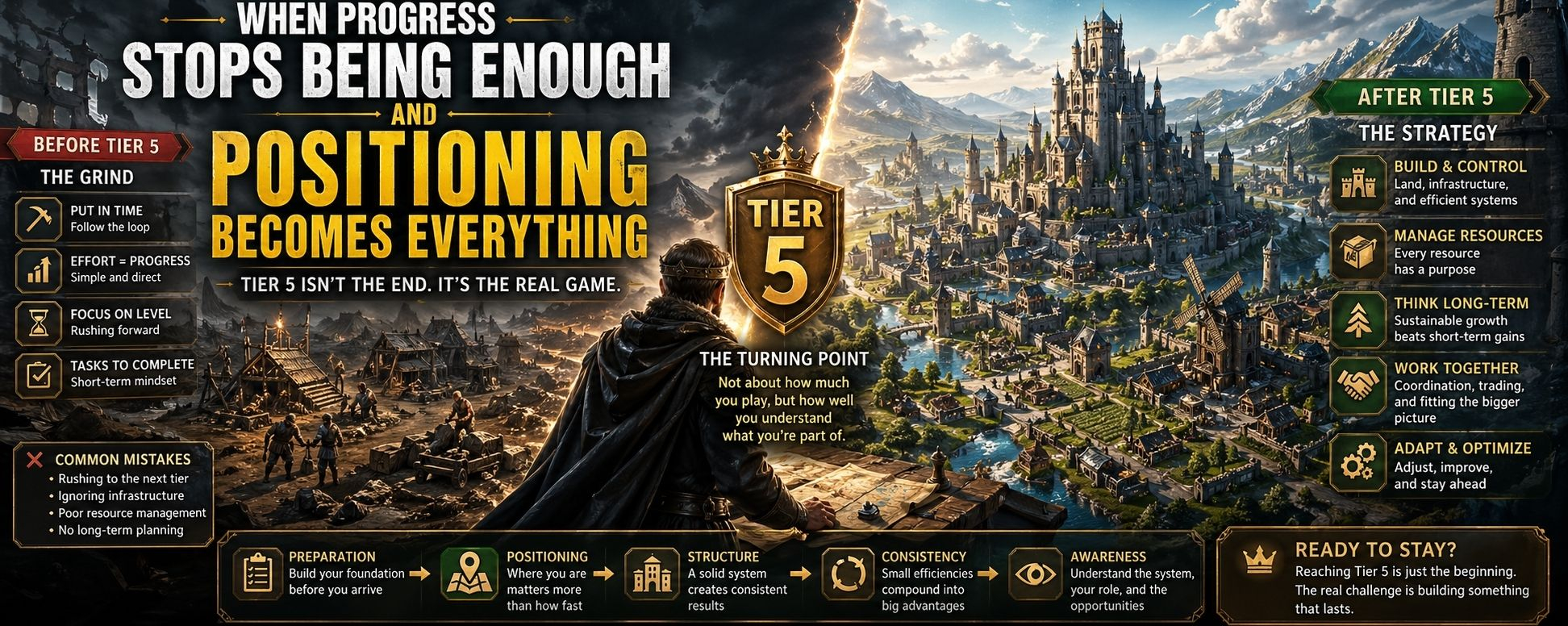
I used to look at Tier 5 like it was the moment everything finally settles. The grind pays off, the pressure drops, and you step into that comfortable phase where rewards start flowing a little easier. It felt like an ending in the best way possible. But the closer I’ve gotten to understanding it, the more that idea starts to fall apart. Tier 5 doesn’t feel like a place where you slow down. It feels like the point where the game quietly shifts its expectations and starts asking a different kind of question. Not how much you can play, but how well you actually understand what you’re part of.
Up until that stage, everything feels familiar and almost predictable. You put in time, you follow the loop, and you move forward. There’s a rhythm to it that makes sense. Effort leads to progress, and progress feels earned in a very direct way. But once you hit Tier 5, that rhythm changes. It’s no longer just about how much you’re doing. It becomes about what you’ve built, what you control, and how efficiently everything connects. Suddenly, the small details you could ignore before start becoming the things that define your experience. Land is no longer just something nice to have. It becomes central. Resource management stops being optional. Even crafting starts to feel less like a feature and more like a responsibility you can’t avoid.
What really stands out is how differently players experience the same tier. Two people can arrive at Tier 5 around the same time, but what happens next can look completely different for each of them. One might feel stuck, constantly trying to keep things running without falling behind. The other starts to build momentum, stacking gains in a way that feels almost effortless. The difference isn’t luck or even just time spent. It comes down to preparation. To whether they built something sustainable before they got there or simply rushed toward the level itself. That’s when it becomes clear that Tier 5 isn’t rewarding effort in the same straightforward way anymore. It’s rewarding positioning.
There’s also a noticeable shift in how pressure works at this stage. Everything starts to feel a bit tighter. Resources don’t stretch as far, mistakes cost more, and inefficiency becomes harder to hide. Before, you could compensate for gaps just by putting in more time. Now, that doesn’t work the same way. If your system isn’t solid, it shows quickly. If your setup isn’t balanced, it becomes a constant struggle. It’s almost like the game stops carrying you forward and starts expecting you to carry yourself. That’s where planning, structure, and consistency start to matter more than pure effort.
In a strange way, it begins to feel less like playing a game and more like managing something real. You’re not just reacting anymore. You’re thinking ahead, making decisions that affect your output over time, and adjusting based on how the system responds. Sometimes that even means relying on other players, whether through coordination, trading, or just understanding where you fit within the bigger picture. The solo mindset starts to feel limited because the environment itself becomes more interconnected. It’s not just about what you do, but how it aligns with everything else happening around you.
A lot of players, though, still approach Tier 5 like it’s a reward waiting at the end of the road. Something to unlock and enjoy. But it feels more accurate to see it as a responsibility instead. Reaching it without having a system in place is like stepping into something you’re not fully ready to manage. The moment you arrive, the gaps become visible. Without structure, there’s no consistency. And without consistency, it becomes difficult to maintain any real progress. The game doesn’t punish you directly, but it definitely exposes whether you were prepared or not.
That’s why the whole idea of “rushing” to Tier 5 feels a bit misleading now. Getting there quickly doesn’t guarantee anything once you arrive. What actually matters is what you built along the way. Did you understand how your production works? Did you think about long-term output instead of short-term gains? Did you treat the game like an evolving system, or just a series of tasks to complete? Those questions seem to matter a lot more than how fast you reached the tier itself.
The more I think about it, the more Tier 5 feels like a turning point rather than a destination. It’s where the simplicity fades and the deeper layer of the game starts to show itself. Everything becomes more intentional. Every choice has weight. And progress starts depending less on how much you do and more on how well you understand what you’re doing. It’s a shift that can feel overwhelming at first, but it’s also what makes it interesting. Because now, it’s not just about time anymore. It’s about awareness, planning, and the ability to adapt.
So instead of seeing Tier 5 as the end of the journey, it makes more sense to see it as the beginning of a different kind of challenge. One that tests whether you were simply playing through the game or actually preparing for what comes after. And if you were to reach it right now, with everything you’ve built so far, the real question isn’t whether you made it there. It’s whether you’re actually ready to stay there and make it work.
