I’ve spent enough time watching crypto cycles to know how these stories usually unfold.
A new project appears with the usual promises—player ownership, sustainable rewards, digital economies, a new era for gaming. The community gathers fast, the token gets attention, the early momentum feels real, and for a moment everyone starts talking like the future has arrived. Then, almost always, the same old problems surface. The incentives begin to outweigh the experience, the users who came for rewards start looking for exits, and the “ecosystem” that once looked alive starts to feel like another temporary economy built on speculation.
I’ve watched that cycle repeat enough times that most Web3 games blur together now.
The names change. The visuals improve. The language becomes more polished. But underneath, the same pattern keeps showing up. A token economy gets designed first, the reward systems get optimized second, and the actual game is expected to carry whatever is left. There’s always an assumption that if players can earn, they will stay. But I’ve seen enough failed projects to know that earning and engagement are not the same thing.
That’s what makes Pixels interesting to me.
Not because it feels revolutionary. Not because the market says it has potential. And definitely not because it carries the usual “this changes everything” energy that crypto loves so much. What stands out is something much simpler: it feels like one of the few projects that understands players need a reason to stay that goes beyond extraction.
That may sound obvious, but in crypto gaming it’s surprisingly rare.
For years, Web3 gaming has been obsessed with ownership, as if putting assets on-chain automatically creates emotional investment. It doesn’t. Ownership only matters if the world behind it feels meaningful. A player does not care about owning digital land, tools, or items if the experience attached to them feels empty. Most people are not looking for “decentralized assets.” They are looking for a world that feels worth returning to.
That’s the mistake so many projects keep making. They confuse financial incentives with genuine engagement.
I’ve seen beautifully designed token economies fail because the actual game felt like work. The rewards looked attractive, the marketplace was active, the numbers looked healthy for a while—but the experience itself lacked something human. It lacked comfort. It lacked rhythm. It lacked the kind of simple satisfaction that makes people come back even when nobody is paying them to.
That’s why Pixels caught my attention.
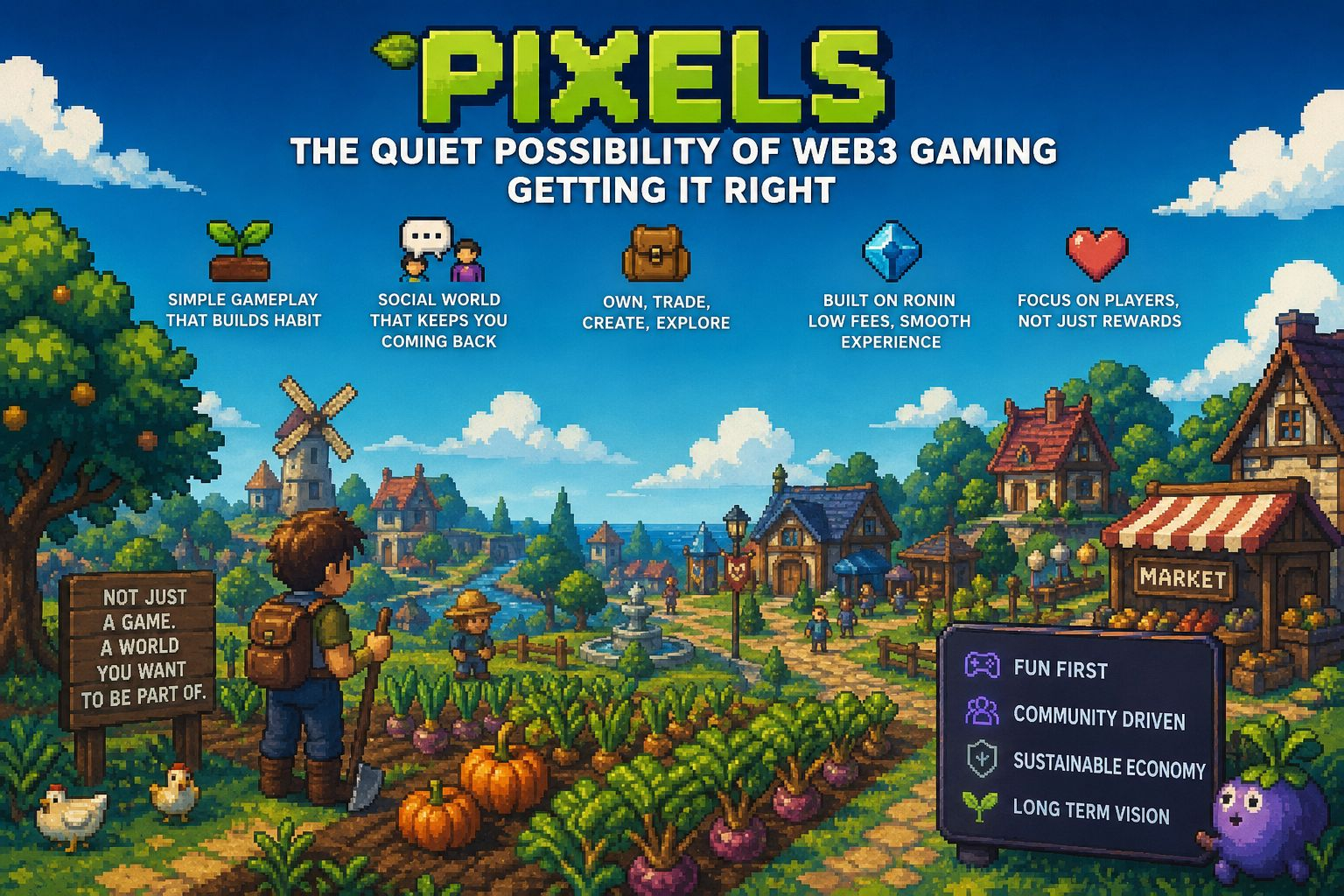
At its core, it doesn’t try to overwhelm the player. The gameplay loop is familiar—farming, crafting, gathering, exploring, interacting. On paper, none of that sounds groundbreaking. In fact, if you described it without the Web3 layer, it might sound almost ordinary.
But after watching years of crypto projects chase novelty for the sake of headlines, ordinary starts to feel refreshing.
There’s something quietly intelligent about not trying to reinvent everything.
Pixels seems to understand that sustainable engagement doesn’t come from constant excitement—it comes from familiarity. It comes from small loops that feel natural. It comes from giving players an environment they can settle into rather than a system they need to constantly optimize.
That difference matters.
Crypto often tries to force engagement through rewards, but games create engagement through habit. That’s an important distinction. Players don’t stay because the rewards are high. They stay because the routine feels satisfying, because progress feels tangible, because the world feels like somewhere they belong.
That kind of retention is much harder to build than token incentives.
And to be honest, that’s why I’m paying attention to Pixels. It feels like one of the few Web3 games that may actually understand this.
But I’m still cautious.
Years in this market teach you that early impressions mean very little. A game can feel balanced at first and still break once financial incentives begin shaping user behavior. In fact, that’s exactly what happens to most crypto games. They attract players through rewards, then the rewards become the main point of the experience, and eventually everything bends around extraction.
I’ve seen this too many times.
At first, people log in because the game feels fresh. Then they realize assets have value. Then efficiency becomes the goal. Players stop exploring and start optimizing. Communities become less social and more transactional. Every mechanic gets stress-tested by users trying to maximize yield. Bots enter the ecosystem, reward loops get abused, and the economy starts carrying pressure it was never meant to handle.
That’s when the real problems begin.
Because designing a game is difficult enough on its own. Designing a game with an open economy where every reward has financial value is something else entirely.
The moment real money enters the loop, every balancing decision becomes painful. Reduce rewards, and the community reacts. Increase rewards, and the token weakens. Restrict extraction, and growth slows. Expand incentives, and sustainability suffers.
There is no easy balance.
That’s why I don’t fully trust any claims that Web3 gaming has “solved” its economic challenges. Nobody has. The problem is bigger than any one project.
But Pixels may be doing something smarter than most—it may be building an experience strong enough that the economy is not the only reason people stay.
That doesn’t sound dramatic, but it matters more than all the dramatic promises.
Because for years, crypto games have treated gameplay like decoration around the economy. Pixels, at least from what I can see, feels like it is trying to make the gameplay matter first.
That’s a subtle but important shift.
Its move onto the Ronin ecosystem also reflects that practical mindset. Lower fees, easier transactions, smoother onboarding—these are not the flashy things that attract headlines, but they are the details that shape user behavior. People stay where friction is low. People return where participation feels easy.
The projects that survive are usually the ones solving practical problems quietly while everyone else is making noise.
That’s part of why Pixels feels different. It doesn’t feel obsessed with sounding revolutionary. It feels more focused on creating a smoother loop.
And honestly, after years of watching this industry overpromise, that kind of restraint feels refreshing.
Still, the biggest question remains unanswered.
Can any tokenized game avoid becoming an extraction economy?
That question sits underneath every optimistic Web3 gaming narrative. Once assets hold value, users arrive with financial motives. That changes behavior. It changes expectations. It changes how every system is used.
No matter how enjoyable the game is, the economy creates pressure.
Pixels is not immune to that pressure.
In fact, because it has gained traction, that pressure may become even stronger. Growth in crypto often creates problems before it creates stability. The more valuable the ecosystem becomes, the more aggressively users optimize it. What begins as a community-driven game can quickly become an economy under strain.
That’s why I’m not ready to celebrate anything yet.
The real test for Pixels won’t be in its growth phase. It will be in the moment when incentives cool down and players decide whether the experience itself is enough.
That moment reveals the truth.
If people stay when rewards normalize, then the game has substance. If they leave when profitability drops, then it was just another economic cycle disguised as entertainment.
I don’t know which direction Pixels will go.
And after years in crypto, I’ve learned to be suspicious of certainty.
Still, something about this project feels more grounded than the usual noise. It feels less like financial engineering trying to imitate a game, and more like a game trying to responsibly integrate an economy.
That difference may not sound huge, but in this industry it’s meaningful.
Because most projects chase attention first and solve problems later. Pixels feels like it may be doing the opposite.
Maybe it still fails. Maybe the same economic pressure that damaged other Web3 games eventually damages this one too. That would not surprise me.
But even then, I think there is something worth noticing here.
For once, I’m looking at a crypto game that doesn’t seem entirely built around the assumption that rewards alone can create loyalty. It seems to recognize that players need more than incentives—they need rhythm, familiarity, and a reason to care.
That’s not a breakthrough. It’s not a revolution. It’s just a more honest understanding of what games actually are.
And after watching so many projects ignore that truth, seeing one move in the right direction stands out.
I’m not calling Pixels the future of Web3 gaming.
I’m not saying it has solved the impossible balance between fun and financialization.
I’m not even saying it will succeed.
I’ve seen too many promising systems collapse under the weight of their own economics to believe in early narratives.
But I am saying this: in a market full of loud promises and fragile models, Pixels feels unusually grounded.
And right now, that quiet sense of realism is more convincing than any hype ever could be.
Maybe that’s enough.
Maybe it isn’t.
I’m still watching.
And after everything I’ve seen in this market, the fact that I’m still watching means more than optimism ever would.