I used to think that if I followed a clean and efficient loop, the system would respond in predictable ways. There’s usually a point in any game where effort feels aligned with outcome — where doing things “right” starts to feel consistent. But here, that alignment never felt fully stable.
Some sessions felt smooth. Others felt slightly off, even when I was doing the exact same things. Nothing was clearly wrong, but the results didn’t match the effort in a way I could explain. It wasn’t failure — it was inconsistency that didn’t explain itself.
At first, I assumed it was on me. That’s the default mindset. If something doesn’t work, you optimize. So I refined everything — cleaner routes, less wasted motion, more structured play. For a while, it felt like I had figured it out. The system started responding the way I expected.
But then the same disconnect appeared again.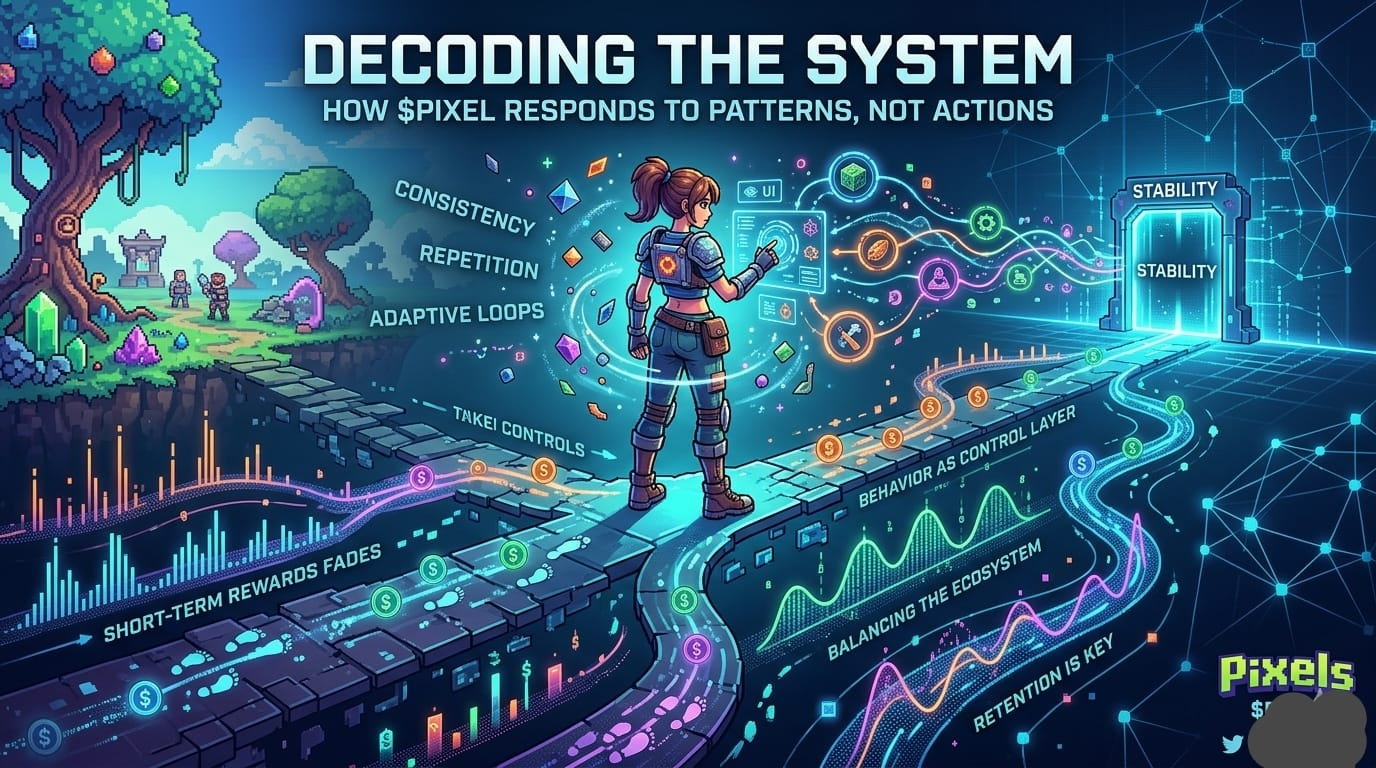
That’s when I started noticing something else. Not everyone playing “efficiently” was getting similar results. Some players moved with less structure, but still progressed smoothly. Not faster — just smoother. And that made efficiency feel incomplete, like it was only part of what the system responds to.
That’s when the perspective started shifting.
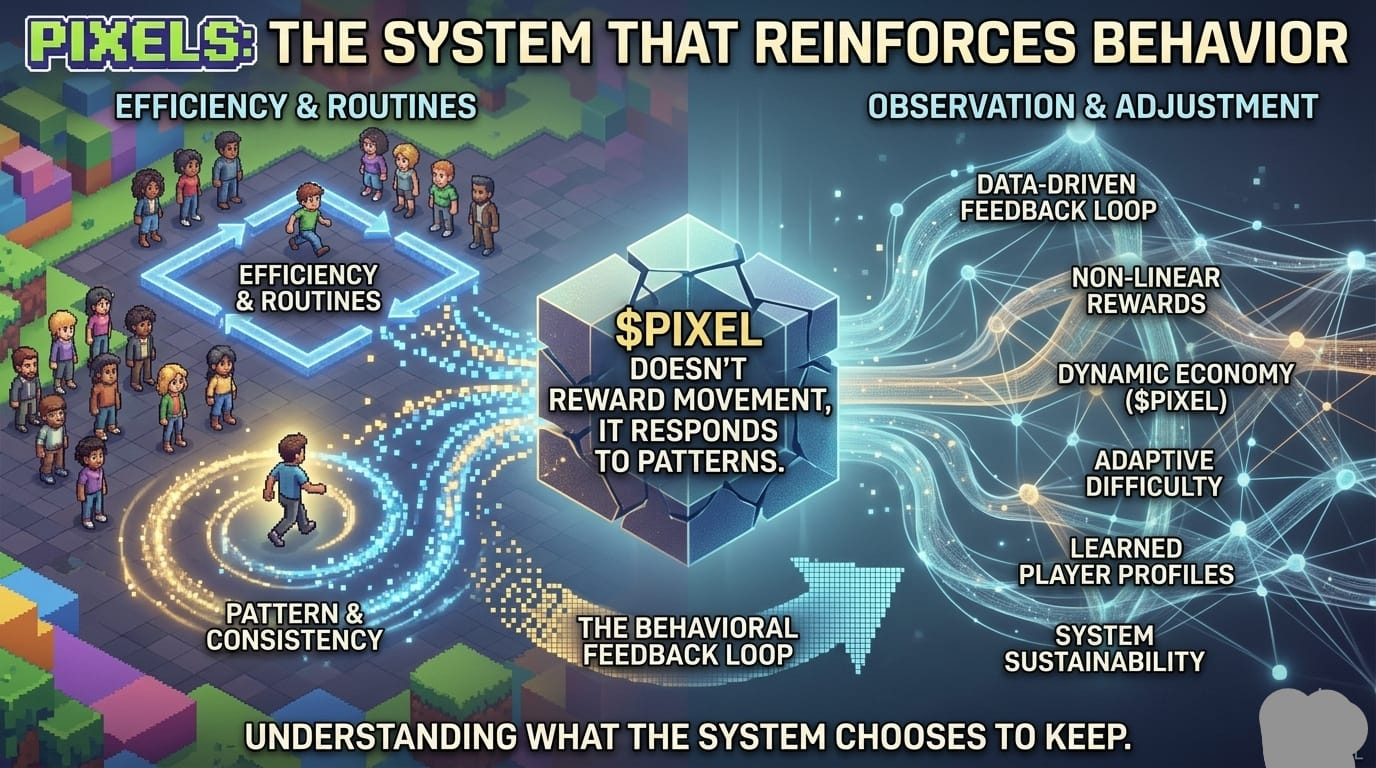
Inside Pixels, it stops feeling like a game of actions and starts feeling like a system reacting to behavior. Not what you do once, but what you repeat. Not just how optimized you are, but how your patterns settle over time.
Rewards don’t scale in a straight line. Sometimes they compress, sometimes they stretch, and sometimes they disconnect from expectation entirely. It doesn’t feel random — it feels adaptive.
Inside Pixels, consistency matters more than intensity.
At the same time, nothing is completely free. Progression has friction. Crafting, upgrades, participation — everything slowly pulls value back out of circulation. You don’t notice it immediately, but you feel it in how carefully you start making decisions.
The system isn’t just distributing value.
It’s balancing it continuously.
With $PIXEL evolving through its broader supply and activity cycles, the economy naturally becomes sensitive to behavior patterns. If everything were linear, it would be easy to drain or distort. So instead, behavior itself becomes part of the control layer — not just how much is happening, but what kind of participation keeps the system stable.
$PIXEL doesn’t reward movement — it responds to patterns.
What stands out most is how subtle this feels from the outside. There’s no clear moment where you’re told something changed. But over time, outcomes begin to separate players who look identical on paper.
The system doesn’t announce differences — it produces them.
And the longer you stay, the clearer it becomes.
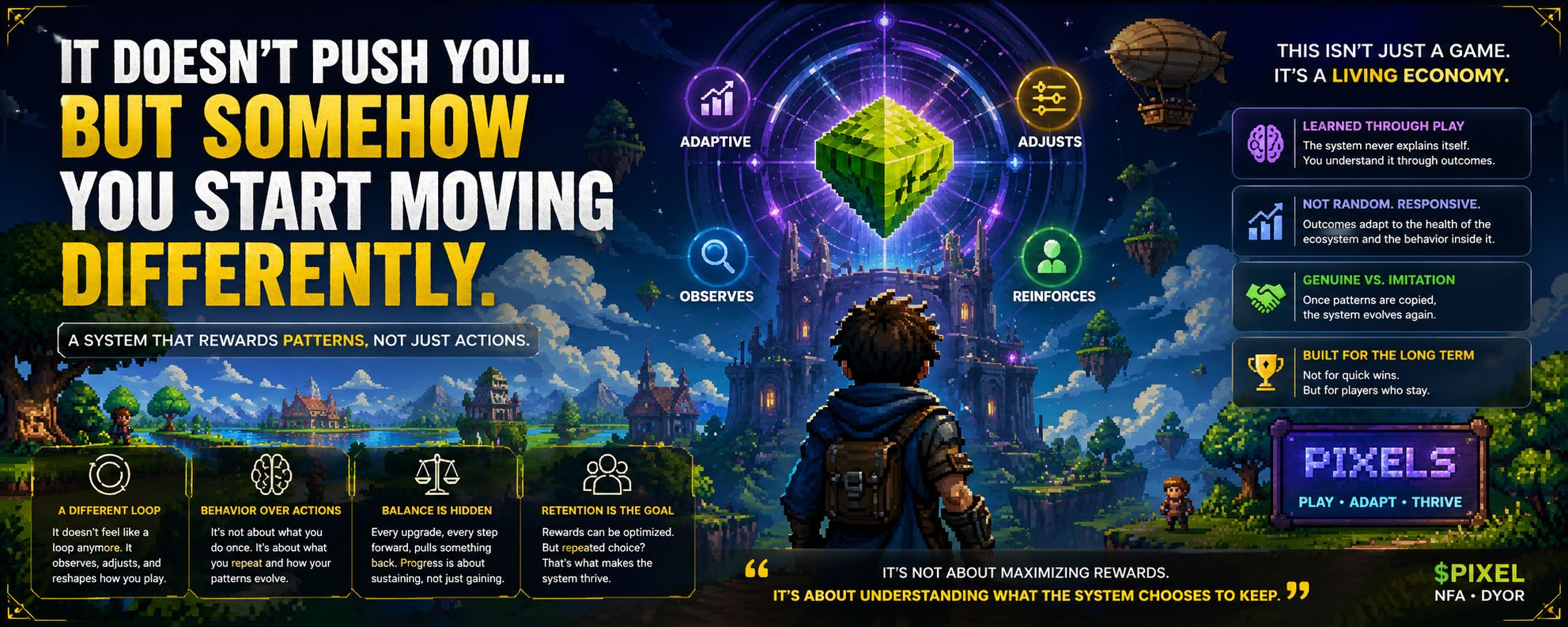
Once behavior is readable, it becomes replicable. Once it’s replicable, it changes the system again. That creates tension between genuine participation and optimized imitation.
At some point, rewards stop being the main focus.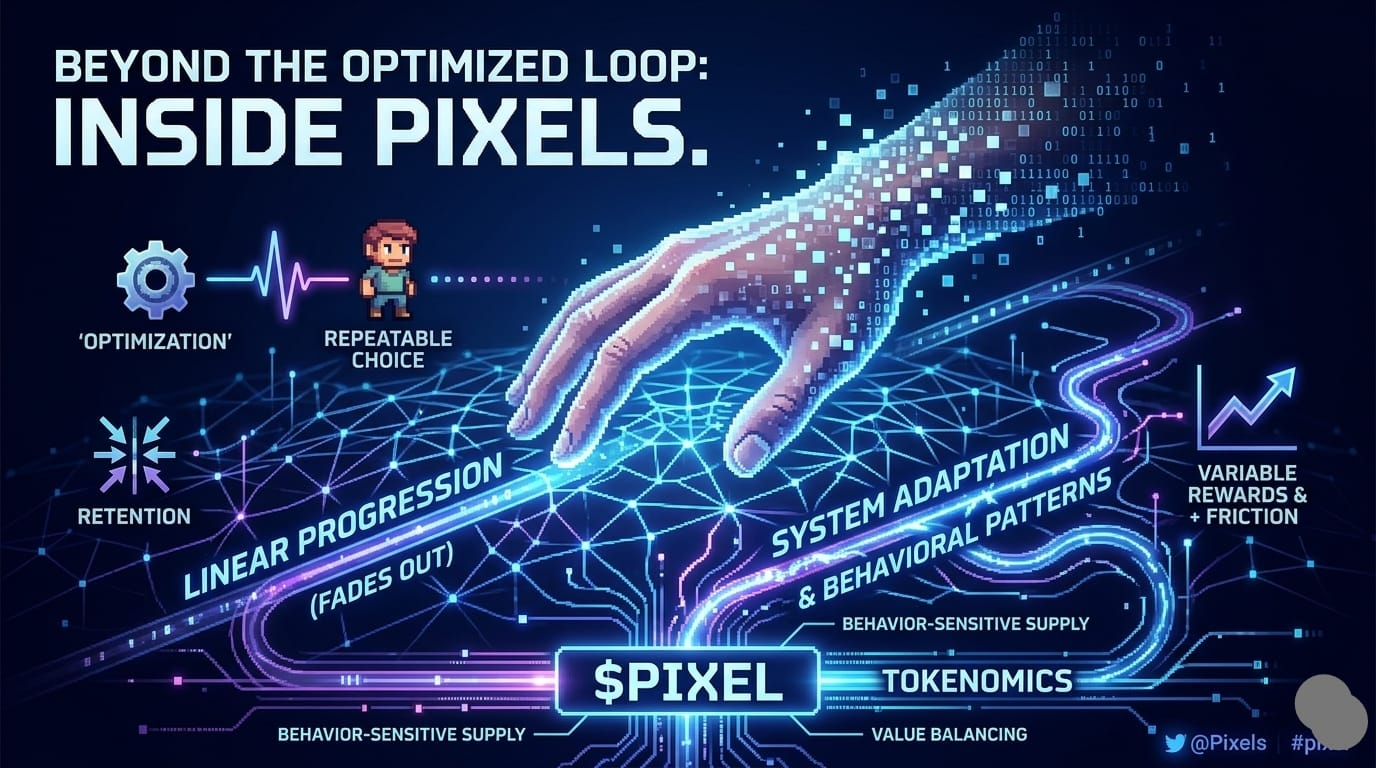
It becomes about retention.
Because no system survives on one-time actions. It survives on repeated choice — on return behavior. That’s where everything eventually converges.
So the loop doesn’t feel like a loop anymore. It feels like something that observes, adjusts, and gradually reshapes how you move through it.
Not through instructions — but through outcomes.
I don’t really see Pixels as just a game or a token system anymore. It feels more like an environment that learns what kind of behavior it wants to sustain, and then reinforces it quietly through results.
Whether that holds at scale is still uncertain. Systems evolve. Players evolve. And neither side stays fixed.
For now, the design still feels ahead of certainty.
And maybe that uncertainty is the point.
Because in the end, it’s not about maximizing rewards.
It’s about understanding what the system chooses to keep.