

You don’t decide to play.
You just open it.
Check the game while waiting for something else.
While a video buffers, while a meeting drags, while you’re just… there.
You don’t think about it.
You just do it.
Open the app. Harvest one crop. Start another. Close it.
No reward spike. No pop‑up.
And yet you open it again.
A carrot has a timer.
You check near the end, harvest, replant, close.
Notifications sit unopened.
You open the app anyway.
You harvest blueberries.
12 berries. Next time, same action, 8 berries.
No explanation.
You open the app, stare at a grown carrot, close it without harvesting.
You didn’t want the carrot.
You just wanted to see if it was ready.
That’s where $PIXEL enters.
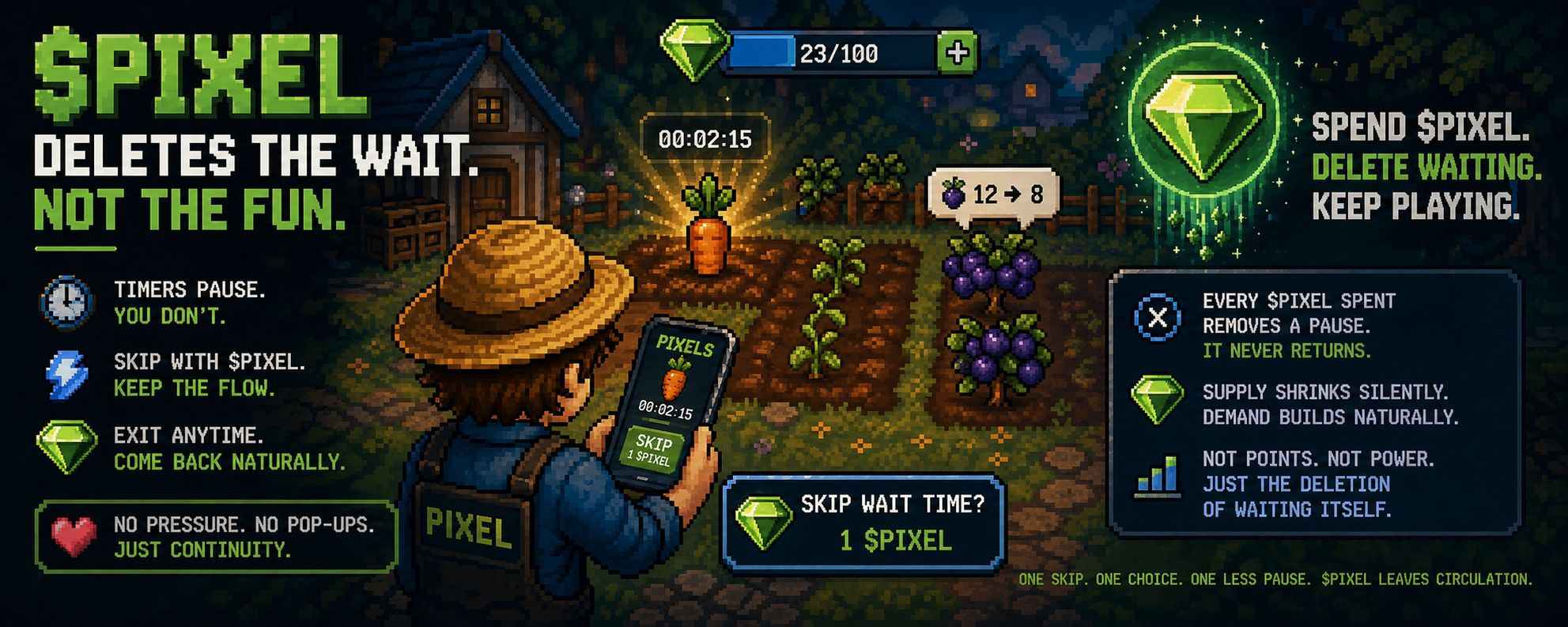
You use $PIXEL. Skip the timer. Refill the energy bar.
You spend $PIXEL to cut the pause.
And every time, the token disappears with the pause.
It doesn’t return.
The delay vanishes, and somewhere out of sight the available pool shrinks a little.
You never feel it. You never need to.
The same delay comes back.
You use PIXEL again. And again.
Twenty skips. Two hundred.
A dozen sessions. A hundred returns.
The count never announces itself.
You’re not buying power. You’re not chasing a reward.
You’re spending $PIXEL for the only thing it sells: the deletion of waiting itself.
Not points. Not status.
Just continuity.
The loop doesn’t ask permission.
No pop‑up suggests it. No notification pushes it.
Nothing tells you to return which is exactly why you do.
The option simply sits there, waiting for the exact second the wait starts to feel like a wall.
You reach for it not because you were told to, but because the pause feels slightly longer than your willingness to wait.
After a while, some actions feel easier.
The game flows better with certain rhythms.
Doing the same thing doesn’t always feel the same.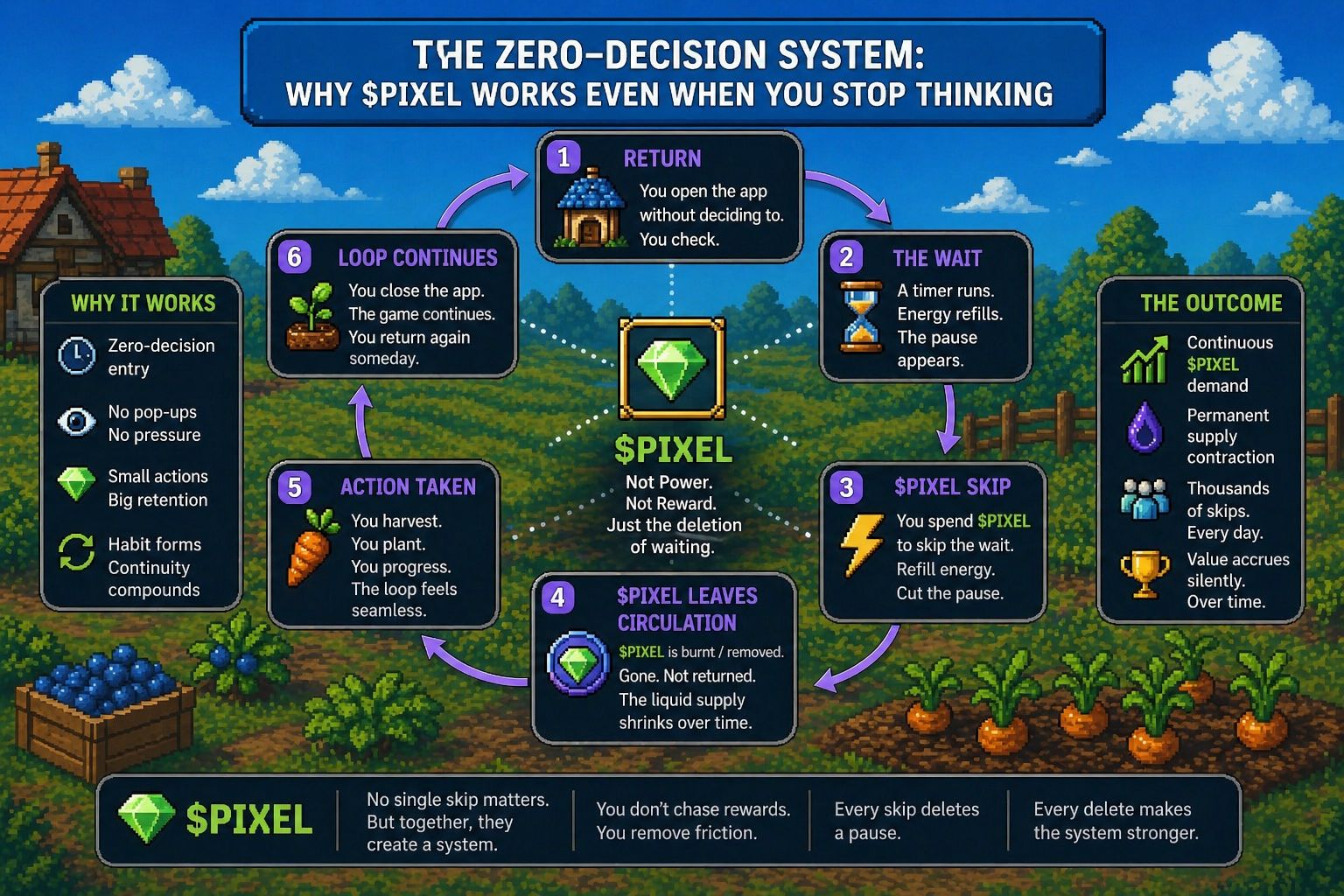
You don’t know why. You just see it.
It doesn’t feel like playing anymore.
It feels like checking.
Click, harvest, close.
Open again. Delete the wait with $PIXEL.
The loop compresses until the space between intention and outcome disappears.
You stop noticing the token. You only notice the flow.
And then the flow becomes expectation.
The delay becomes interruption.
The $PIXEL skip becomes reflex.
$PIXEL doesn’t ask. It doesn’t remind.
It only appears at the exact moment you feel the wait, and that moment arrives every time you return.
Some days you skip nothing. Other days you skip five timers in an hour without feeling the weight.
You never noticed when the decision stopped being yours. You just know that it did.
You’re not counting days. The pattern counts something else: how many times you chose to delete a pause with $PIXEL.
Twenty skips. Two hundred.
Over weeks, that number builds, not just in your habits, but in the token itself.
Each $PIXEL you spend leaves a permanent dent somewhere you can’t see, the liquid supply tightening one micro‑transaction at a time.
No single skip matters. But the design doesn’t depend on single skips.
It depends on how often you return and reach for $PIXEL, and you return a lot.
You never felt pressured. You never felt rewarded in the way other games reward.
You just kept coming back. That’s when it quietly settles in: leaving was designed to cost nothing.
Nothing breaks. Nothing punishes you. Crops grow.
Absence doesn’t feel like absence. It just feels like a small pause between two identical moments.
And $PIXEL is the only thing that ever asks you to notice.
It lives exactly where the waiting would be.
You use it, and the waiting is gone.
It doesn’t feel like a purchase. It feels like the game just speeds up for a moment.
Like it’s letting you slip through a door you didn’t see.
You hear people talk about user numbers, growth, charts.
But every time you skip a timer with $PIXEL, you’re part of something that doesn’t show up anywhere.
You’re just one person, returning again and again, quietly making the same small choice to compress time with the token.
That choice, repeated across thousands of people, dozens of times a week, adds up into a demand base no dashboard can hold and a supply contraction no emission schedule can offset.
And then you notice something else, something you almost dismiss.
Some days the timers feel different. A little longer than you remember.
You’re not sure. It could just be your mood.
But if it ever felt like the game was slowing you down on purpose, you’d stop.
You wouldn’t complain. You wouldn’t announce it.
You’d just close the app and not come back.
That’s the thin thread $PIXEL hangs on.
If the pause ever feels artificial, the entire rhythm of micro‑spends collapses silently.
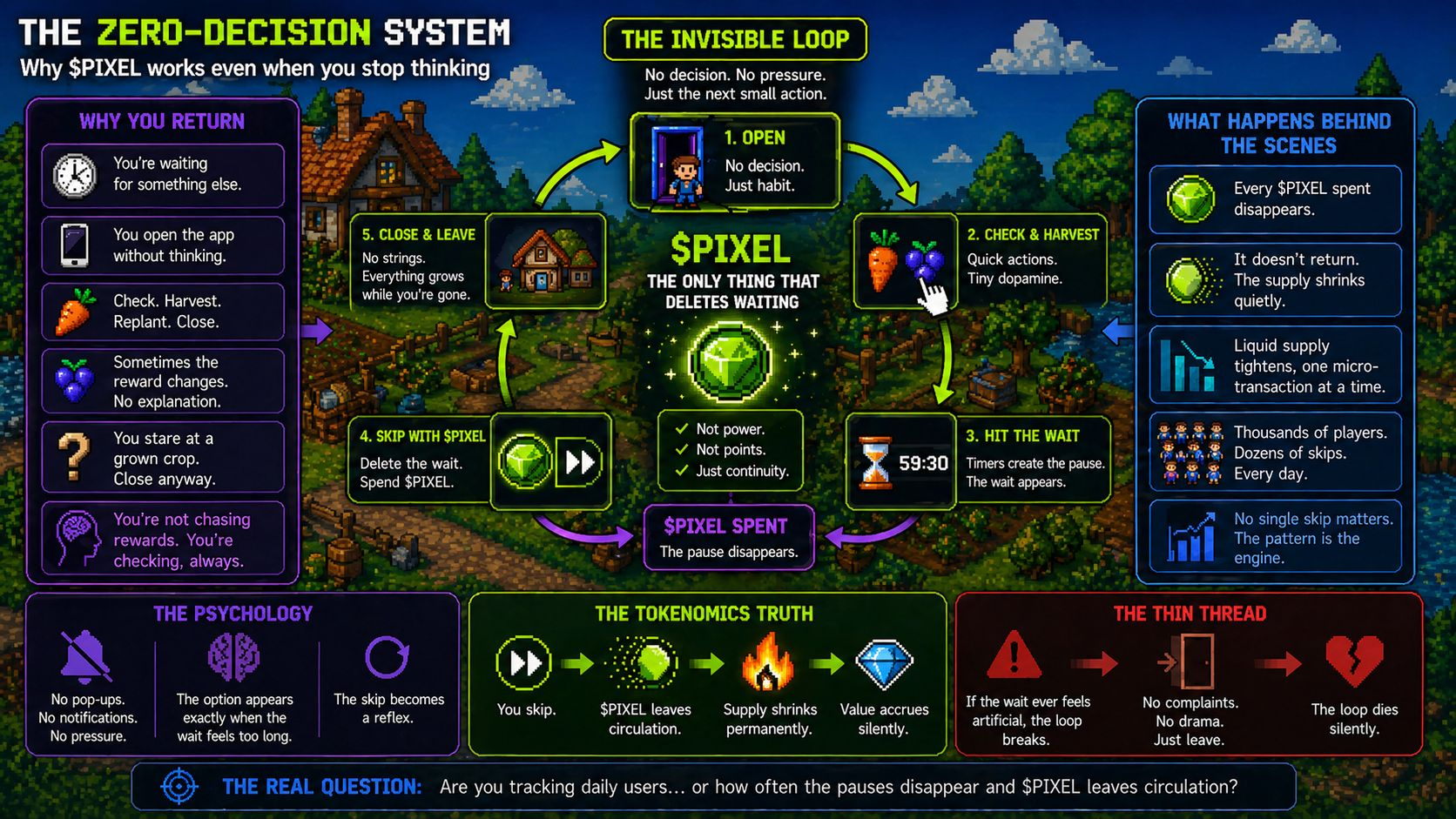
You check the game while waiting for something else.
You open the app without deciding to.
You skip a timer with $PIXEL without evaluating the cost.
That’s the whole thing.
Everything after that the spending, the supply tightening, the pattern occurs just outside the frame of the session.
So the real question isn’t about the token.
Not about the game. Not about the charts.
When did opening the app stop being a decision?
Because if you have to pause to remember,
if that question lands somewhere slightly uncomfortable,
you’re not observing the loop anymore.
You’re already in it.
It’s been running.
And $PIXEL has been quietly accumulating value every single time you returned without deciding to one deleted pause, one micro‑transaction, one permanently removed token at a time.
Are you tracking daily users…
or how often the pauses disappear and $PIXEL leaves circulation?