
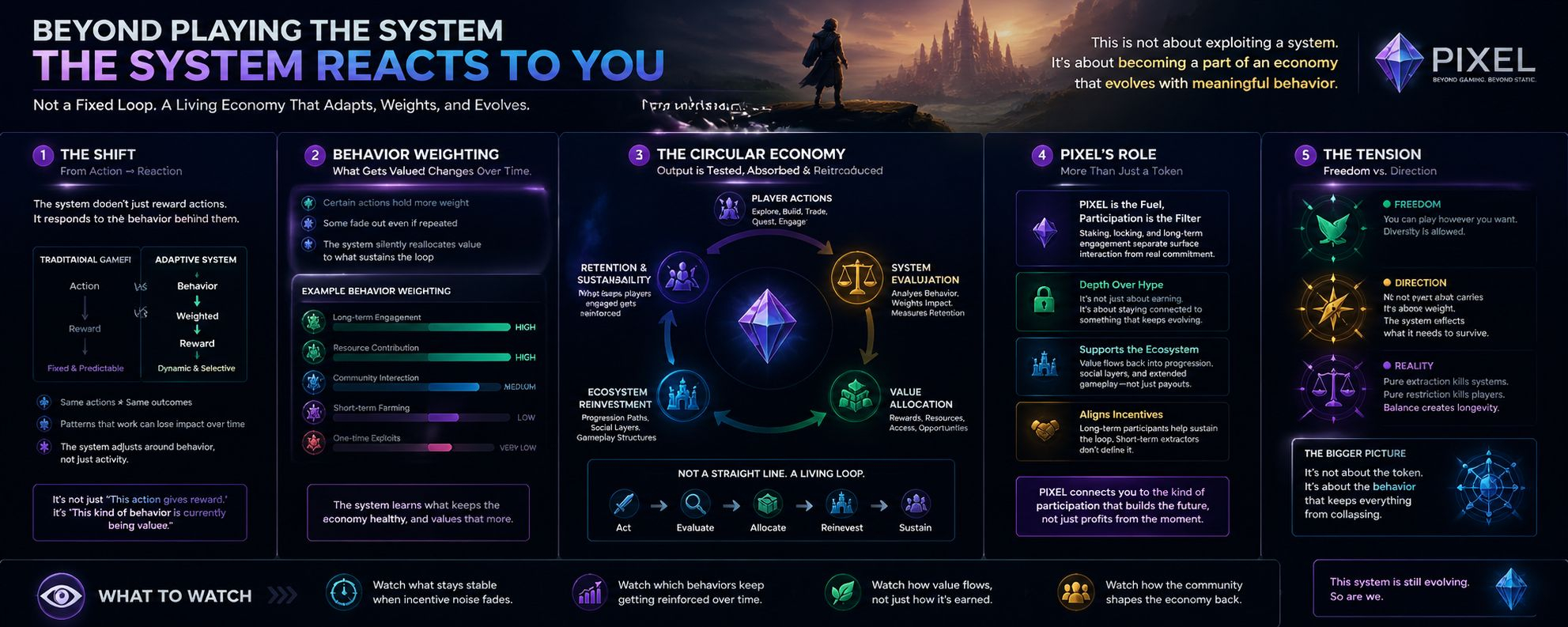

What I’ve come to realize is that it’s no longer about me playing the system; it’s about the system reacting to me. This shift wasn’t a single, dramatic moment but rather a gradual accumulation of small inconsistencies that made me realize something deeper was happening. The same actions didn’t always yield the same results. Some moments felt more impactful, while others seemed almost muted. It wasn’t "broken," per se, but it made repetition feel less automatic, less predictable.
And that’s where things started to get interesting. Unlike the typical GameFi cycles where you can quickly learn the pattern, optimize your actions, and extract rewards—here, it felt like the cycle wasn’t fixed. It was evolving, adjusting in response to player behavior, not just doling out rewards based on a predefined structure.
This shift fundamentally changes how you view the system. It stops being about "this action gives reward" and starts becoming more about "this kind of behavior is currently being valued." And that subtle distinction is huge. One is mechanical and repeatable, the other is adaptive and selective.
Over time, I noticed that consistency alone wasn’t the full story. Repetition no longer guaranteed the same outcome. Some actions seemed to hold value longer, while others began to lose relevance—even when I was doing the same thing. This is where I started to understand the concept of behavior weighting—not as a formal, explicit system, but as something that becomes evident in the way output is distributed. Certain actions seem to stay alive in the economy longer than others, while others fade away, not because they’re removed, but because they stop being reinforced.
Once you recognize this, it becomes clear that rewards aren’t static—they’re dynamic, they move. Not randomly, but with an evolving sense of allocation, designed to sustain what the system values at that given moment. And that changes the entire way you approach the game. It’s no longer about optimizing for static rewards; it’s about understanding what behaviors keep the system alive, what patterns feed into the system’s ongoing development.
At first glance, the system may appear to behave like a typical GameFi token, responding to sentiment cycles and speculation. But the deeper layer is something much more interesting: the type of participation it fosters. Staking, locking, and long-term engagement loops stop feeling like simple yield mechanics. They become filters for depth—ways to separate surface-level interactions from repeated, meaningful presence.
This distinction is crucial, because it changes the very concept of value within the system. It’s no longer just about earning tokens; it’s about whether your actions contribute to a larger, ongoing cycle that sustains the game itself. Value isn't just something you extract; it’s something that’s constantly recycled, reabsorbed, and repurposed for progression, social layers, and extended gameplay that exist to keep players engaged, not just to pay them.
This gives the whole system a sense of circular economy—where output isn’t just rewarded in a linear fashion but is constantly being tested, absorbed, and reintroduced into new layers of the game. The value of a player’s actions is based on how useful those actions are for retention and long-term engagement.
But there’s an underlying tension that’s hard to ignore. The more the system learns and adapts to player behavior, the more it starts shaping that behavior. Over time, certain playstyles get more support, while others fade into irrelevance—not because they’re explicitly removed, but because they’re no longer reinforced. The system doesn’t need to tell you which behaviors to follow; it simply reflects them in the outcomes.
This is where the subtle tension sits: you still have the freedom to play however you want, but not every direction holds the same weight over time. The system doesn’t need to force you in one direction—it just reflects the consequences of your choices in the results you get. It’s a delicate balance between free choice and the system’s subtle control.
This dynamic also highlights a key truth: open, unfiltered extraction doesn’t last. Without some form of filtering, any reward system will eventually be drained. That’s why long-term participation is prioritized over short-term activity. It’s not about how much you do, but about how consistently your behavior aligns with the system’s evolving needs.
And that’s the biggest change I’ve noticed. The focus has shifted from tokens themselves to the type of behavior that sustains the system. The more I stay engaged, the more I understand that this isn’t a finished system—it’s something that’s still adjusting, figuring out what kind of participation is truly sustainable in the long run.
I’m not passing judgment just yet. I’m watching how the system evolves when the noise of incentives starts to fade, because that’s when the true structure of the system will reveal itself. And it’s in that quiet shift that I think the game will either stand the test of time or collapse under its own weight