
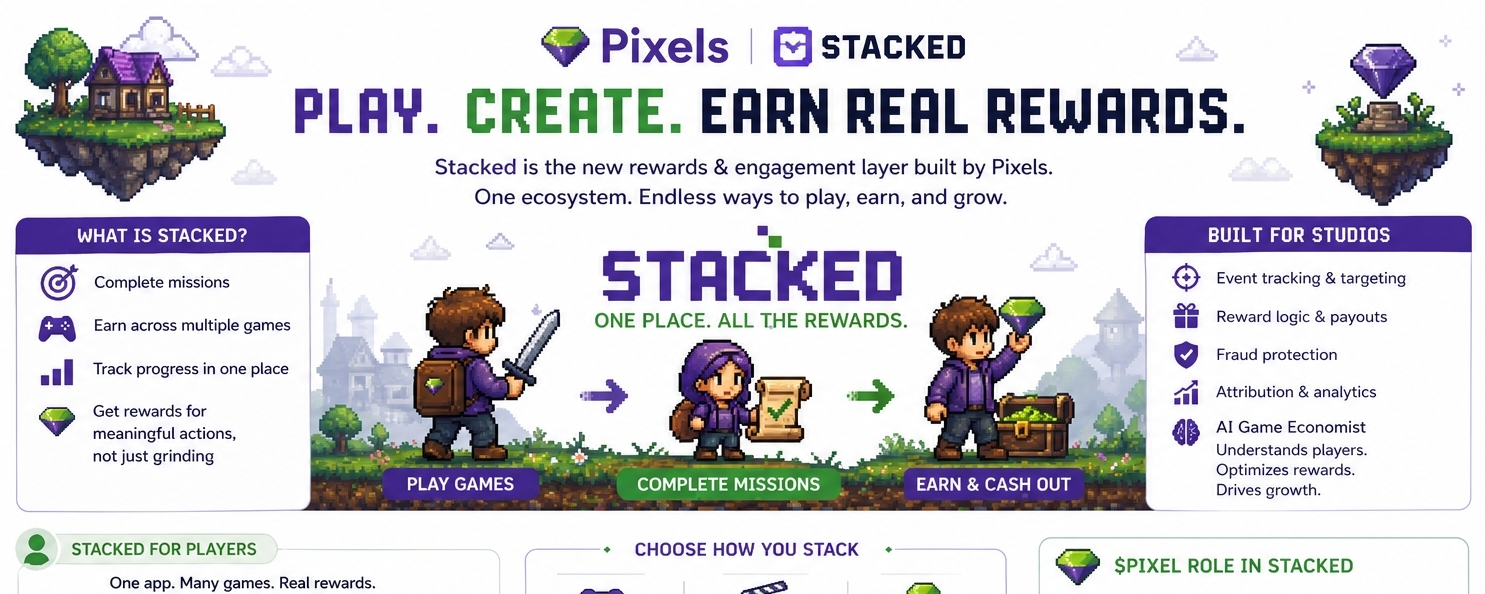
Pixels initially gained traction as one of the most recognizable farming games in Web3, reaching significant daily active user numbers. But the more important development isn’t just the game itself it’s what comes next. That next layer is Stacked, a system designed to expand Pixels beyond a single title into a broader engagement and rewards infrastructure.
What Stacked Actually Is
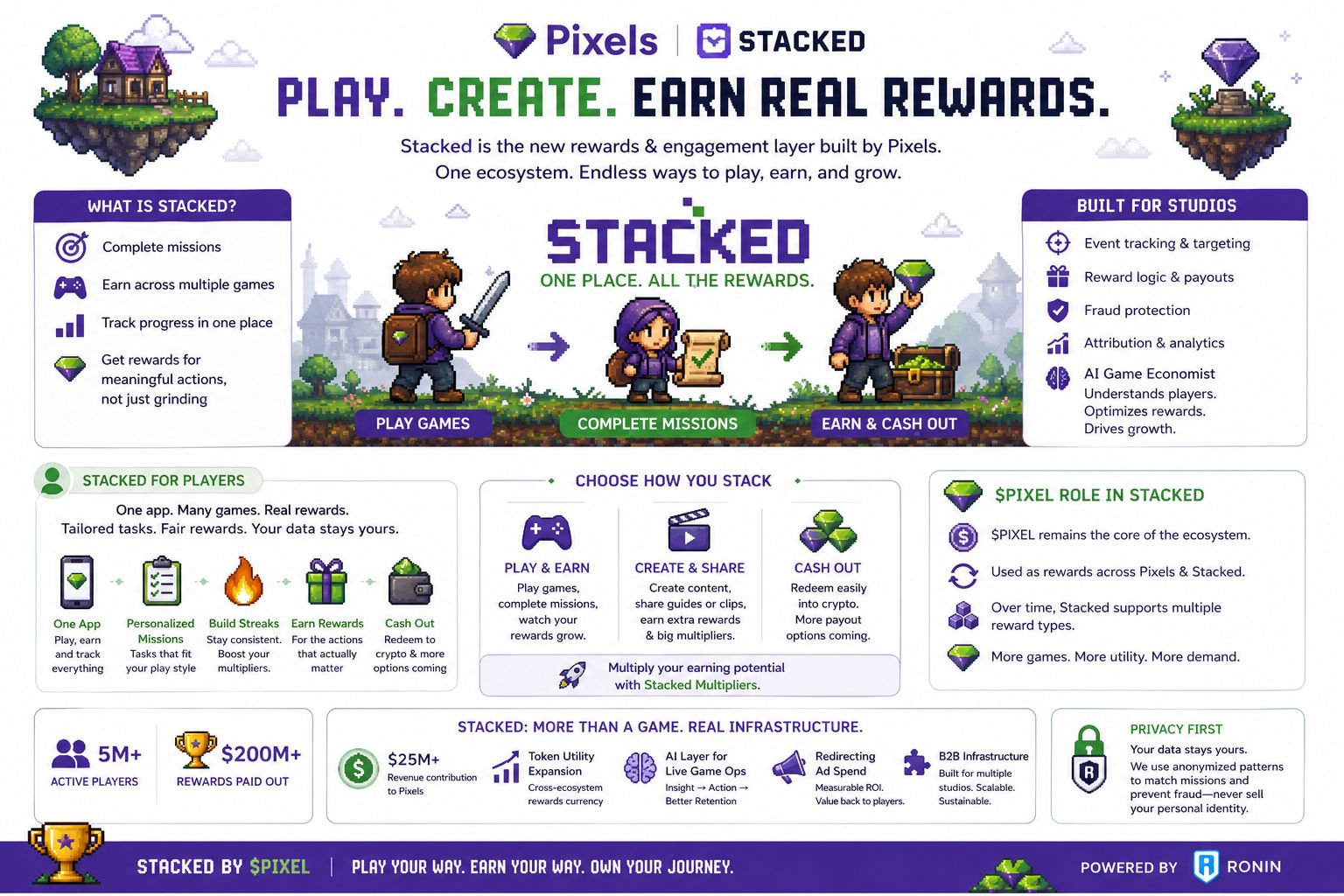
Stacked is not just a feature it’s a framework. Instead of limiting users to one game loop, it creates an environment where players can:
Complete missions across different experiences
Earn rewards tied to real activity
Track progress in a unified system
Get compensated based on meaningful participation rather than repetitive grinding
In practical terms, it becomes a central hub where gameplay, progression, and rewards converge.
From a Player’s Perspective
For users, the interface is intentionally simplified. One entry point gives access to:
Multiple games
Personalized missions
Ongoing streak systems
Aggregated rewards
You play, complete tasks aligned with your behavior, and accumulate value in one place. The complexity is abstracted away.
What differentiates it is the personalization layer. Tasks are not uniformly distributed. Rewards are not static. The system adjusts based on how you actually engage. Two players can spend similar time but receive different pathways depending on behavior patterns.
Equally important, gameplay data remains internal. It’s used to refine matching and reward logic rather than being monetized externally. That constraint matters in a system increasingly driven by behavioral signals.
From a Studio’s Perspective
Underneath the user-facing simplicity sits a full operational stack. Stacked provides:
Event tracking and behavioral analytics
Reward distribution logic
Fraud detection systems
Attribution and performance measurement
Continuous testing and optimization tools
More critically, it introduces an AI-driven economic layer. Studios are no longer guessing what works. They can evaluate:
Where users disengage
Which actions correlate with retention
How reward structures influence behavior
This reduces iteration cycles and allows real-time adjustment of in-game economies.
The Role of AI
The AI component is not cosmetic. It functions as an adaptive layer that interprets player behavior and refines reward systems accordingly. Instead of static incentives, the system evolves:
Identifying churn triggers
Reinforcing high-retention behaviors
Optimizing reward allocation efficiency
In effect, it turns game economies into responsive systems rather than fixed designs.
Multiple Paths to Earn
Stacked expands participation beyond traditional gameplay:
Play and Earn: Complete missions and accumulate rewards through gameplay
Create and Share: Produce content, guides, or highlights and receive additional incentives
Cash Out: Convert accumulated rewards into crypto or other assets
There’s also a multiplier mechanism that increases earning potential based on engagement depth.
Scale and Current Position
The system is already operating at scale:
Over 5 million active users
More than $200 million in distributed rewards
This indicates that Stacked is not theoretical infrastructure it’s already being utilized in live environments.
Where Pixel Fits
The Pixel token remains central but its role is evolving. Initially tied closely to the core game, it is now transitioning toward a broader function:
Acting as a cross-ecosystem reward layer
Supporting multiple games rather than a single loop
Expanding utility as more integrations are added
Over time, the system is expected to support multiple reward types, making the economy more flexible and less dependent on a single asset.
Privacy and Data Handling
The system relies on behavioral signals but avoids direct identity exposure. Matching and optimization are based on anonymized patterns, not personal data resale. This design reduces friction while maintaining functional targeting.
Business Model and Strategic Positioning
Stacked introduces a shift in how game economies are funded and optimized:
Revenue validation: Systems powered by Stacked have already contributed tens of millions in revenue within the Pixels ecosystem
Token demand expansion: As more games integrate, the demand for reward infrastructure including $PIXEL increases organically
AI-driven operations: Studios can move from delayed analytics to immediate decision-making
Ad spend reallocation: Instead of inefficient user acquisition spending, budgets are redirected into measurable player incentives
Infrastructure model: Stacked is not tied to a single game’s success. It operates as a service layer for multiple studios, increasing scalability and reducing dependency risk
Final Positioning
Stacked shifts @Pixels from being just a game into something closer to infrastructure. It connects gameplay, behavior, and rewards into a unified system that can scale beyond a single title.
The key difference is this: instead of building a game around a token, it’s building a system where participation itself becomes the foundation of value.
That distinction is what makes it worth watching.