
The evolution of Web3 gaming is becoming more tangible with projects like @Pixels Pixels, which is steadily building a dynamic and sustainable ecosystem through its Stacked model. Unlike traditional games where players invest time without real ownership, @Pixels introduces a refreshing shift—where effort, strategy, and consistency can translate into actual value. The integration of $PIXEL as a core utility token plays a major role in tying the entire experience together, creating a loop where gameplay, rewards, and economy interact seamlessly.
What stands out most about @Pixels is how it doesn’t rely solely on hype or short-term incentives. Instead, it focuses on creating a balanced in-game economy that encourages long-term participation. The farming mechanics, for example, are not just repetitive tasks—they require planning, resource management, and timing. This adds depth to the gameplay and ensures that players remain engaged rather than feeling like they are simply grinding for rewards. The Stacked ecosystem further enhances this by connecting different layers of activity, from land usage to item crafting and trading.
Another strong aspect is the social dimension within @Pixels. Many blockchain games overlook the importance of community, but here, interaction plays a central role. Players can collaborate, trade, and build networks, which adds a human touch to the digital economy. This creates a more immersive environment where users are not isolated participants but active members of a growing world. Over time, this social layer can become one of the strongest drivers of retention and growth.
The role of $PIXEL is also worth highlighting. It’s not just a reward token; it functions as a key economic driver within the ecosystem. Whether it’s upgrading assets, accessing features, or participating in transactions, $PIXEL ensures that the economy remains active and fluid. This kind of utility is crucial because it prevents the token from becoming stagnant or purely speculative. Instead, it gains value through actual usage, which is a positive sign for long-term sustainability.
From a broader perspective, @Pixels represents what many believe is the future of gaming—a blend of entertainment, ownership, and economic participation. The Stacked ecosystem model shows how multiple layers of engagement can coexist, giving players different ways to contribute and benefit. Some may focus on farming and production, while others may specialize in trading or social interactions. This flexibility allows the ecosystem to cater to a wide range of player types, which is essential for scaling.
What excites me the most is the potential for continuous expansion. As more features are added and the ecosystem matures, the opportunities within @Pixels are likely to grow even further. New mechanics, partnerships, and integrations could enhance the experience and attract even more users into the space. If the current trajectory continues, @Pixels could set a strong example for how Web3 games should be designed—not just as earning platforms, but as engaging, living worlds.
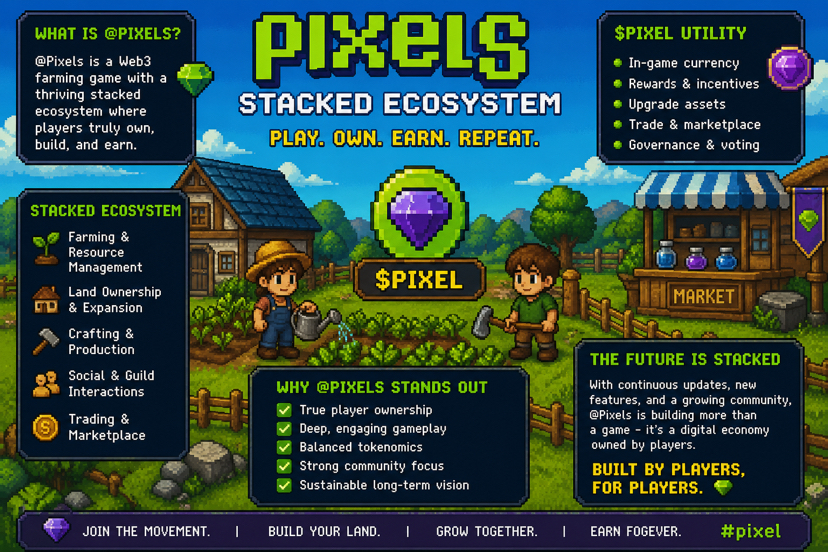
In conclusion, @Pixels is not just another blockchain game; it’s an evolving ecosystem that prioritizes sustainability, engagement, and real utility. With $PIXEL at its core and the innovative Stacked approach, it offers a glimpse into how digital economies can function in a more meaningful way. I’m genuinely excited to see how this project develops over time and how it continues to shape the future of Web3 gaming. #pixel 🚀