
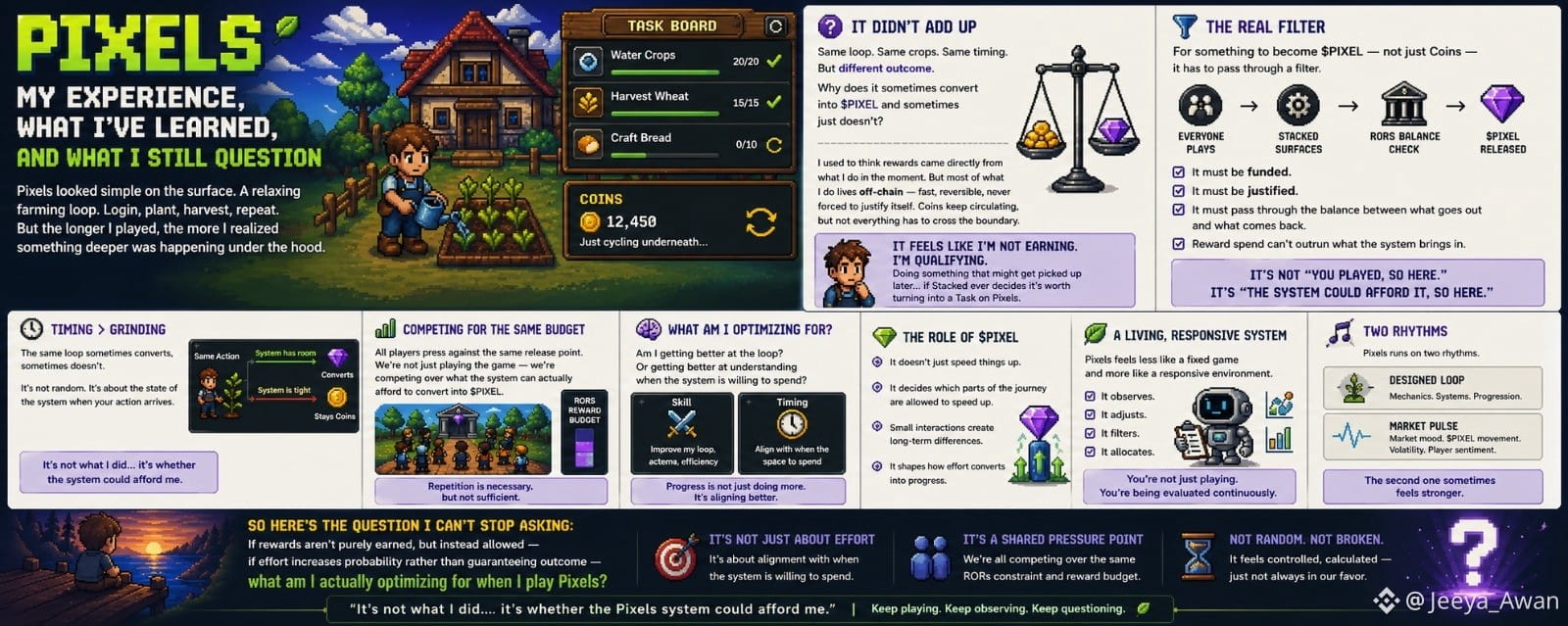
I didn’t notice Pixels while I was actually playing it. Everything felt routine, same crops, same routes, same timing. The Task Board refreshed, Coins circulated, and the loop repeated without asking for much thought. On the surface, it looked stable, almost predictable. But the longer I stayed inside that loop, the more something felt slightly off.
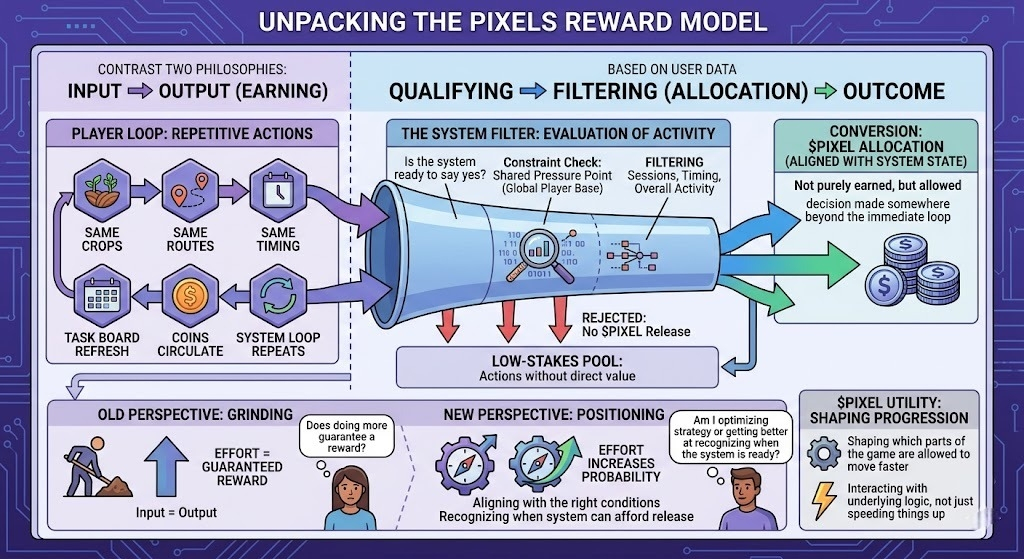
It wasn’t obvious during the session. It only became clear after. I’d repeat the same actions with the same intent, yet the outcomes wouldn’t line up. Sometimes effort translated into value. Other times, it just… didn’t. Not randomly, but not consistently either. That inconsistency is what made me start questioning the system.
At first, I assumed rewards were directly tied to what I did in the moment. That’s the usual expectation in most games, input equals output. But here, that connection feels weaker over time. Most of the activity exists in a kind of low-stakes loop where nothing is forced to justify itself. Coins keep moving, actions keep happening, but not everything crosses into something that actually counts.
That’s when it started to feel like I wasn’t really earning in the traditional sense. Instead, I was qualifying. Repeating behaviors, aligning patterns, staying active, not to guarantee a reward, but to increase the chance of being noticed by the system. And that shift is subtle, but important. It changes the role of effort completely.
Because when something finally does convert into $PIXEL, it doesn’t feel like a direct result. It feels like a decision made somewhere beyond the immediate loop. Like the system is filtering everything, sessions, timing, overall activity, and only allowing certain actions to pass through when it can sustain them.
That’s where the idea of constraint becomes real. Rewards don’t just exist because I played. They seem to depend on whether the system can afford to release them at that moment. Not just based on me, but on everyone interacting at the same time. It’s a shared pressure point.
So repetition alone isn’t enough. I can follow the same loop perfectly and still get different outcomes, because what matters isn’t just the behavior, it’s the state of the system when that behavior arrives. That makes progress feel less like grinding and more like positioning. Less about doing more, and more about aligning with the right conditions.
Even the role of PIXEL reflects this. It doesn’t just speed things up, it subtly shapes which parts of the game are allowed to move faster. Small interactions with it can create long-term differences in progression, not because they overpower the system, but because they interact with its underlying logic.
Over time, the whole experience starts to feel less like a fixed game and more like a responsive environment. One that observes, adjusts, and filters. You’re not just playing, you’re being evaluated continuously, even if you can’t see how.
And that’s where it gets interesting.
Because if rewards aren’t purely earned, but instead allowed, if effort increases probability rather than guaranteeing outcome, then what am I actually optimizing for when I play Pixels?
Am I improving my strategy… or just getting better at recognizing when the system is ready to say yes?
