


I’ve spent some time reflecting on how @Pixels actually operates beneath the surface, and the more I think about it, the more I realize how different it is from what many people assume. There’s a common belief that Web3 games run entirely on blockchain infrastructure, with every action recorded on-chain. At first glance, that idea sounds appealing transparent, decentralized, and secure. But in practice, it would make gameplay painfully slow and almost unplayable. $PIXEL avoids that trap entirely, and that decision is what makes it work.
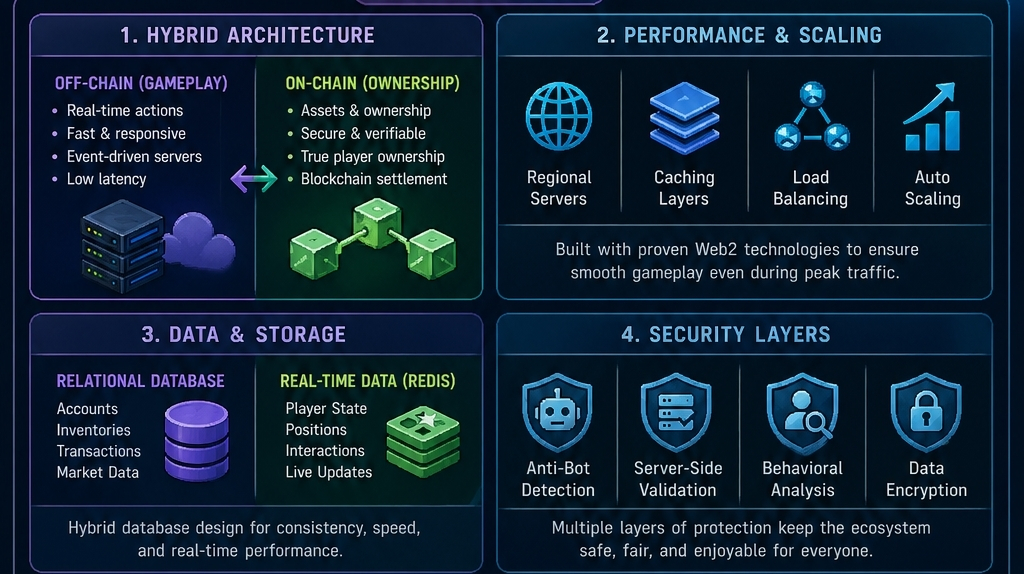
What stands out immediately is its hybrid architecture. Instead of forcing everything onto the blockchain, Pixels separates concerns in a very intentional way. Gameplay movement, farming, crafting, and interactions happens off-chain. Ownership and valuable assets, however, are secured on-chain. At first, this might feel like a compromise. But the more I observed how the system behaves, the more it became clear that this is not a limitation it’s a design strength.
From a player’s perspective, everything feels smooth and responsive. Actions happen instantly, without the delays typically associated with blockchain confirmations. That responsiveness likely comes from traditional backend systems handling real-time inputs, supported by event-driven architecture and efficient networking. It feels familiar, almost like a well-optimized Web2 game. Yet underneath that smooth experience lies a layer of blockchain-based ownership that ensures assets actually belong to the player.
This balance between speed and trust is where things get interesting. Pure decentralization often sacrifices usability, while centralized systems prioritize performance. $PIXEL sits somewhere in the middle, carefully navigating that tension. It accepts that not everything needs to be decentralized to deliver value. Instead, it focuses decentralization where it matters most ownership, scarcity, and value transfer.
The data structure behind this system also reflects that balance. It’s easy to imagine a hybrid database approach powering the experience. Stable, structured data like player accounts and inventories likely sit in relational systems, ensuring consistency and reliability. Meanwhile, real-time game state positions, interactions, and live updates probably relies on fast, in-memory systems. This combination allows the game to maintain both speed and order without exposing complexity to the player.
What I find particularly fascinating is how invisible all of this is. As a player, you’re not thinking about infrastructure. You’re farming, crafting, trading, and exploring. Yet every action is supported by a layered system quietly working in the background. That invisibility is part of the design success. It removes friction while still preserving the benefits of blockchain integration.
The economy inside @Pixels adds another dimension entirely. When I started paying attention to player behavior, I noticed how quickly things shift when too many people focus on the same activity. If everyone farms the same resource, its value drops. It’s a simple principle supply and demand but inside a game, it feels immediate and personal. Suddenly, what seemed profitable becomes inefficient, and players are forced to adapt.
This constant adjustment creates a living economy. Value isn’t fixed; it emerges from player decisions. If a resource becomes scarce, its price rises. If it’s overproduced, it loses value. Trading becomes more than just a feature it becomes the core mechanism that connects everything. Watching this unfold made me realize that Pixels isn’t just a farming game. It’s an economic system disguised as one.
Ownership plays a crucial role here as well. Assets like land, tools, and items are not just decorative or collectible they directly influence productivity and strategy. Having control over these assets changes how efficiently a player can operate. At the same time, the game doesn’t force ownership as a requirement. Renting and participation without full ownership remain possible, which lowers the barrier to entry while still rewarding long-term investment.
There’s also a subtle but powerful onboarding design at work. New players are not overwhelmed with complexity. Instead, they are gradually introduced to core loops gathering, crafting, and trading. At first, it feels like a simple tutorial. But over time, it becomes clear that these early steps are shaping how players think and behave within the system. You’re not just learning how to play; you’re learning how to participate.
As players spend more time in the game, roles begin to emerge naturally. Some focus on farming, others on crafting, and some specialize in trading. No one is forced into these roles, yet the system encourages specialization through efficiency. Progression is no longer just about leveling up it’s about understanding the economy and positioning yourself within it.
What keeps me thinking about Pixels is the ongoing tension it never fully resolves. Decentralization versus performance. Freedom versus optimization. Accessibility versus dominance. These are not problems the game eliminates; they are dynamics it manages. And perhaps that’s the point. Instead of chasing a perfect balance, Pixels creates a system where players continuously respond to shifting conditions.
So the question that stays with me is this: if the most critical parts of the experience happen off-chain, what truly defines a Web3 game? Pixels doesn’t offer a simple answer. Instead, it presents a working model one where practicality takes precedence over ideology. It may not be purely decentralized, but it is functional, engaging, and alive.
And in the end, that might matter more than anything else.