
Headline: Solana’s “DeFi United” rescue — lending USDT to Aave and onboarding AAVE — aims to shore up markets, but won’t necessarily lift SOL out of the mid‑$80s Solana’s community just staged a cross‑chain rescue: the Solana Foundation has lent USDT to Aave and will introduce AAVE on Solana, moves intended to stabilize liquidity after the April KelpDAO exploit. The action has become a rallying cry for “DeFi United” on social media — but markets are treating it as supportive background noise rather than a trigger for a big price breakout. Price action: SOL stuck in the mid‑$80s - Over the past 3–12 hours SOL has traded in a tight range around the mid‑$80s. Gate shows SOL at about $84.22 (down 2.66% over 24 hours) and KuCoin around $84.21 (down ~2.7% on the most recent snapshot), suggesting near‑term selling pressure but no capitulation. Coinbase and CoinMarketCap cluster SOL around $85–$86 with only ~1% intraday swings — a choppy, range‑bound market rather than a trending move. - Prediction markets assign only low single‑digit probabilities to SOL reclaiming $100 this week; prices above $90 are also lightly priced. In short, traders expect consolidation over a sudden melt‑up. What the Solana intervention involves - Solana Foundation chair Lily Liu confirmed on X that the foundation extended a USDT‑denominated loan to Aave to help stabilize dollar liquidity after the April exploit. She added that AAVE will be added to Solana this weekend as part of a broader cross‑ecosystem effort. - Liu framed the move as ecosystem stewardship — “economies do not operate in isolation” — and positioned it as another instance of Solana using treasury resources to support DeFi projects in distress. Why Aave needed help - The intervention follows the April 18 KelpDAO/LayerZero exploit, in which attackers minted unbacked rsETH, used it as collateral on Aave, and drained roughly $190–$293 million in real assets. Estimates place the protocol’s potential bad debt between about $124–$195 million. - Aave founder Stani Kulechov said restoring stability and protecting users is the protocol’s immediate priority. A coordinated DeFi recovery fund has drawn more than 69,000 ETH (about $161 million) in pledged support. Market and narrative implications - The USDT loan is targeted at shoring up Aave’s dollar liquidity as redemptions, deleveraging and tighter borrowing conditions test user confidence. Observers like Intellectia.ai called it a notable cross‑ecosystem intervention, showing that liquidity stress can trigger support across blockchain boundaries. - CoinMarketCap and others flagged the move and the AAVE integration as bullish for AAVE’s perceived resilience — and as a sign of growing institutional and cross‑chain confidence. - For Solana, the intervention continues a recent pattern of using treasury assets to backstop stressed protocols (a precedent noted in past recovery actions such as Tether’s recovery plan for Drift). This time, Solana is stepping in on “foreign turf,” which underscores how interconnected major DeFi players have become. Will this stop SOL falling below the mid‑$80s? Short answer: probably not on its own. The loan and token integration are constructive for DeFi sentiment and may reduce systemic risk, but SOL’s immediate price action appears driven more by range dynamics, liquidity flows and broader market sentiment than by a single treasury deployment. The rescue helps the ecosystem and could support medium‑term confidence; however, with prediction markets pricing low odds for a rapid reclaim of triple digits, traders seem to expect consolidation rather than a decisive SOL rally. Bottom line: “DeFi United” boosts cross‑chain solidarity and helps stabilize Aave, but its impact on SOL’s near‑term price is likely limited — a morale win for the ecosystem rather than a guaranteed catalyst for a breakout. Read more AI-generated news on: undefined/news

Article
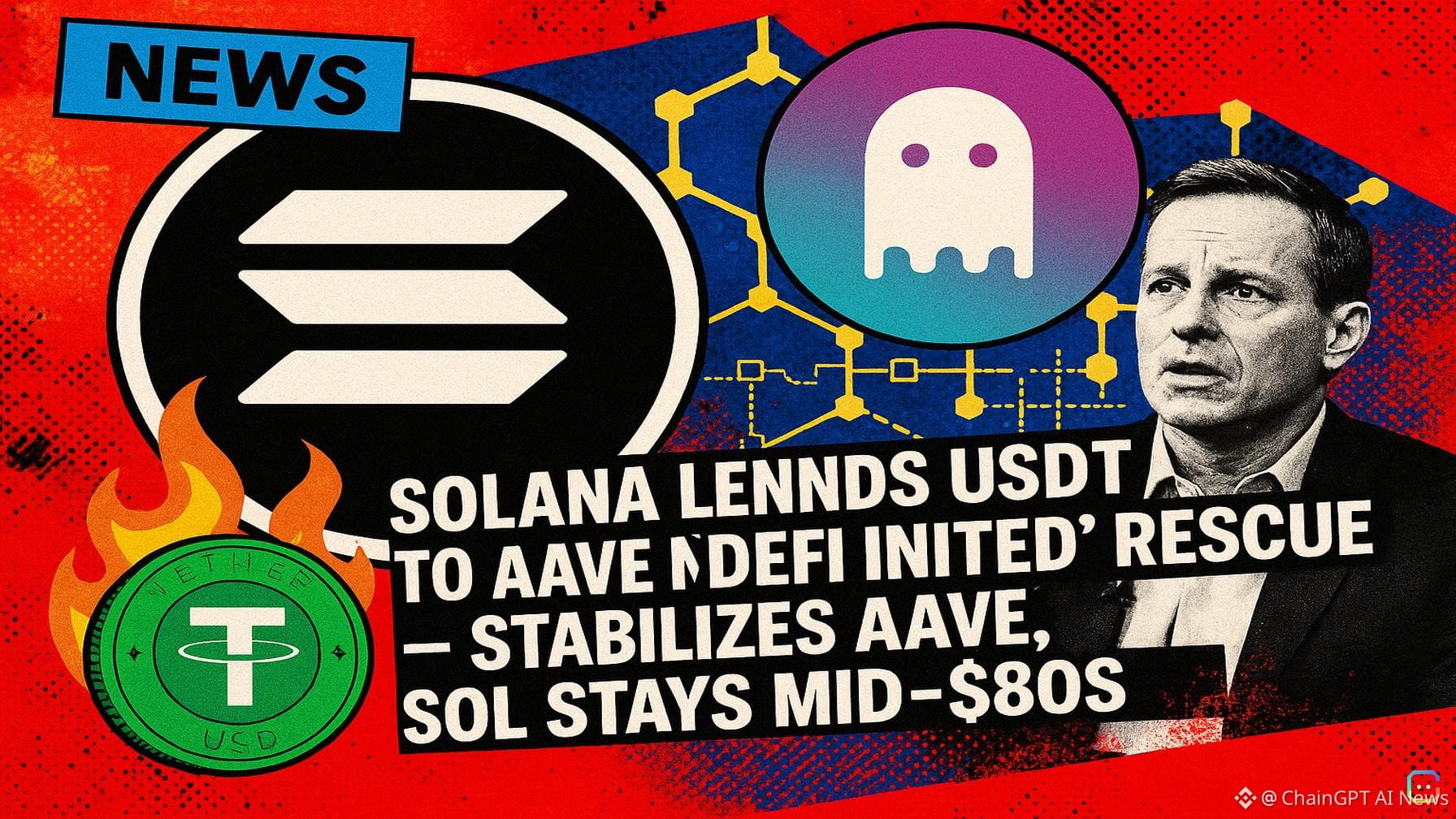
Solana Lends USDT to Aave in 'DeFi United' Rescue — Stabilizes Aave, SOL Stays Mid-$80s
Disclaimer: Includes third-party opinions. No financial advice. May include sponsored content. See T&Cs.