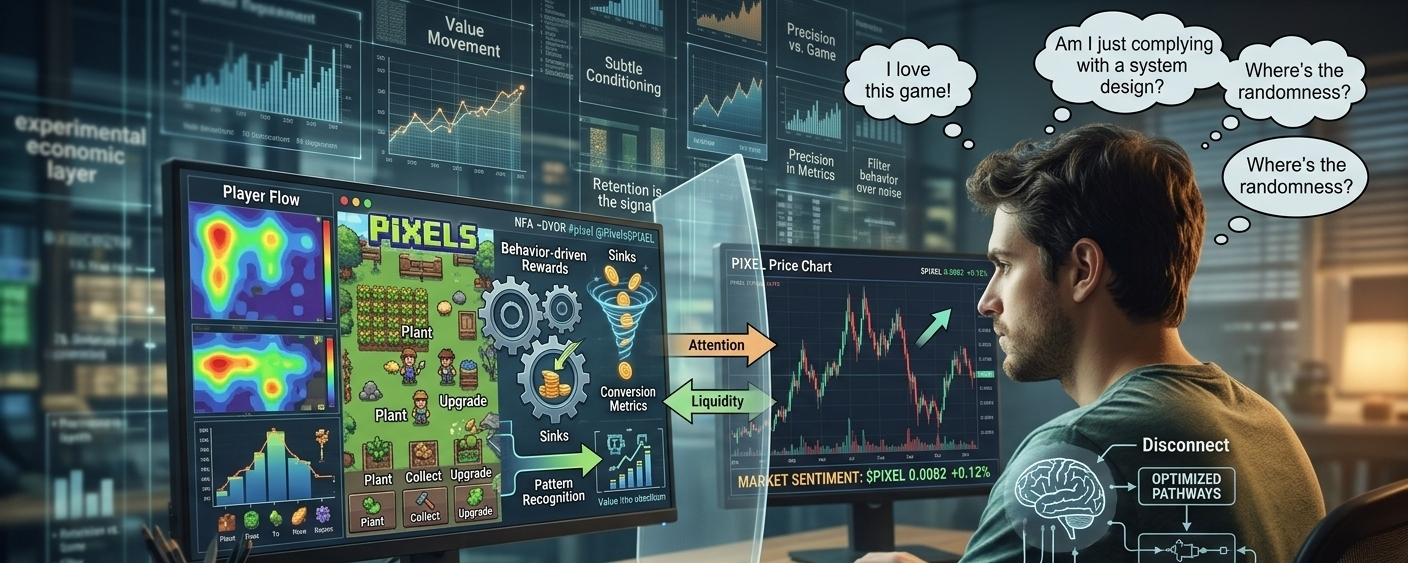
I didn0t notice the exact shift at 1st. It just started feeling a bit different. I have Pixels running like usual doing the same loop I did done so many times before. Plant collect upgrade repeat. Then I checked the PIXEL chart almost out of habit like it was part of the rhythm now.
But somewhere in that routine something clicked in a strange way. I wasn0t really playing anymore. At least not in the way I used to understand it. I was adjusting myself to the system. Changing timing without thinking too much. Choosing certain actions because they made more sense. Skipping things that didn0t feel efficient. It wasn0t loud or obvious. It felt more like quiet conditioning happening in the background.
I always thought I already knew how these Web3 games go. You jump in learn the loop push activity farm what you can & eventually step out when the system starts breaking down or feeling exhausted. That pattern has repeated enough times to feel predictable.
But Pixels didn0t feel like that same predictable cycle. People didn0t just drop off in the same way. And the loop didn0t collapse into pure extraction as fast as I expected. Maybe its just me trying to find meaning where there isn0t any but it didn0t feel like a simple do more earn more setup either.
The longer I stayed the more I started noticing something subtle. Rewards didnot always match effort in a straight line. Some actions felt like they should be equal but weren0t. You could spend similar time doing two things and still end up with completely different outcomes.
At 1st I told myself itz just balancing. Every game tweaks numbers. But this felt slightly more layered than that. It wasn0t just distributing rewards evenly or randomly. It felt like the system was quietly responding to behavior patterns instead of just activity volume.
Thatz when I started seeing it differently.
Itz not just about what you do inside the game. It is about how you do it. Efficiency matters more than raw grinding. And even that word efficiency feels too clean for it because what it actually means in practice is conversion. How well your actions translate into something the system considers meaningful output.
You don0t really see it directly but you feel it over time. Certain patterns get rewarded more consistently. Some actions start feeling lighter in value even if they take the same effort. Slowly you stop playing randomly and start playing strategically without even deciding to.
& that changes the experience in a way thatz hard to ignore.
Most GameFi systems I have seen lean heavily on volume. More activity equals more rewards. Simple loop. But her it feel like alignment matters just as much if not more. Alignment with what exactly isn0t fully visible & maybe thatz the point. The system seems to filter behavior in a way that prioritizes usefulness over noise.
Even the sinks start to look different when you think about it like that. They aren0t just slowing things down. They are shaping flow. Redirecting value. Forcing decisions about where resources actually go instead of letting everything accumulate in one direction. Fees upgrade progression steps they are not just barriers. They are part of how the system controls distribution.
At that point I stopped seeing it as just a game economy. It started feeling more like a controlled environment for observing value movement. Pixels feels like itz experimenting with how behavior & rewards interact when everything is slightly constrained. Almost like different modular pieces are being tested together reward logic friction points retention triggers.
It gives off this framework feeling more than a single closed game. Like something that could exist beyond just this one environment if it keeps evolving.
But then there is another layer sitting above all of it that doesn0t follow the same logic at all the market side.
That part still reacts like a normal token system. Attention moves it. Liquidity moves it. Timing moves it. So even if the system underneath is carefully adjusting rewards based on behavior the token itself still responds instantly to external pressure. & that is where the disconnect shows up clearly.
You can have a system that is trying to optimize behavior quality underneath but if demand doesn0t match emissions at the right moment, the price doesn’t care about any of that design work. It reacts to momentum not structure.
That gap is hard to ignore. 1 layer is trying to reward better behaviour while the other is mostly rewarding attention cycles.
& I am not fully convinced those two ever truly sync. You can build something that feels logically strong on the inside clean incentives controlled flow reduced waste but it can still feel oddly restrictive from the outside. Almost like the system starts guiding you too precisely.
There were moments where I caught myself thinking am I actually playing or just optimizing my actions inside a structure that already decided what matters?
Thatz the uncomfortable part. The more accurately a system defines valuable behavior the more it narrows what people naturally do. You get better efficiency but you also lose a bit of randomness the kind of randomness that usually makes games feel alive.
Because players don0t just respond to rewards. They respond to how those rewards feel over time. If everything becomes too measured, you stop exploring and start complying without realizing it.
Still what keeps me returning isn0t the optimization or the scoring logic. Itz the fact that people actually come back. That part matters more than anything else. Because none of these systems behavior tracking reward shifting sinks progression control mean anything if players don0t reenter the loop voluntarily.
Retention is the real signal.
So I have started seeing Pixel less like a traditional game or even just a token ecosystem & more like a system trying to understand how value should move when behavior becomes the input instead of just activity. Something closer to an experimental economic layer than a typical gameplay loop.
I am not fully convinced it is complete. Maybe itz not supposed to be yet. A system can be technically smart and still miss why people actually enjoy participating in the first place.
But it doesn0t feel like pure extraction either. It feels like itz testing something bigger how far incentive design can go before it starts reshaping how people naturally behave.
And maybe thatz the real tension here.
Not whether it works.
But whether a system that precise still feels like a game at all when U are inside it.
what do you think about it? Feel free to share your experience & opinion.
PIXEL
0.0082
+0.12%