
Look, I’ve seen this movie before. A soft, friendly game shows up, wraps itself in simple mechanics—plant crops, walk around, chat with other players—and then quietly bolts a financial system underneath it. This time it’s Pixels, running on the Ronin Network. It sounds harmless. Almost nostalgic. But once you scratch the surface, it starts to look less like a game and more like an economy that needs constant feeding.
Let’s start with the problem they claim to fix. It’s the old complaint about games: you spend time, maybe money, and you own nothing. Your items sit on a server. You can’t sell them. You can’t take them elsewhere. Pixels says, fine, let’s change that. Let’s give players real ownership. Put assets on-chain. Let people trade freely. It sounds tidy. On paper, at least.
But here’s the part people gloss over. The moment you turn in-game items into tradable assets, you’re not fixing a problem. You’re creating a new one. Now every item has a price. Every action has an economic angle. Players stop thinking like players and start thinking like traders. Fun becomes secondary. Optimization takes over. I’ve watched this happen more than once, and it always bends the system in the same direction.
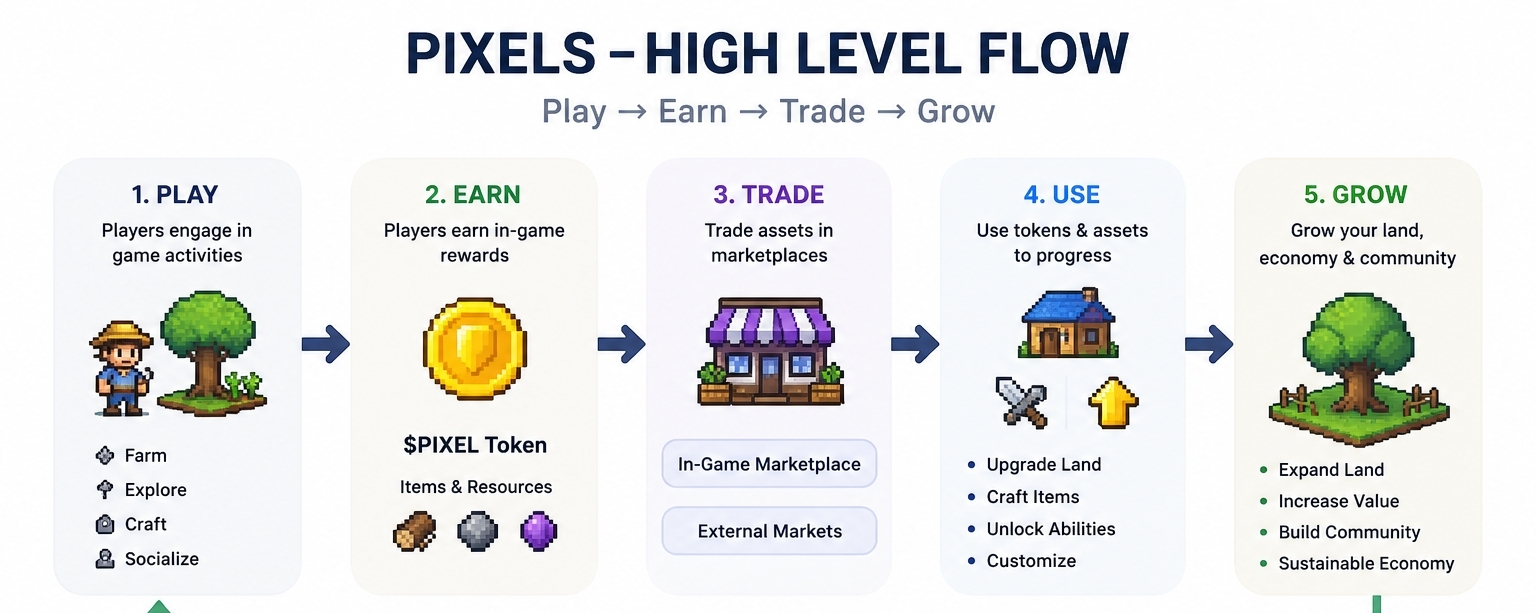
Now look at the solution itself. Blockchain ownership. Tokens. Marketplaces. External exchanges. It’s a stack of systems layered on top of what used to be a simple loop: play the game, enjoy the game, log off. Instead, you get wallets, transaction fees, price volatility, and a constant question hanging over everything—“Is this worth my time financially?” That’s not simplification. That’s added cognitive load.
And let’s be honest about decentralization. Pixels talks about ownership, but most of the actual gameplay still runs on centralized servers. The blockchain records who owns what, sure, but the world itself—the crops, the interactions, the mechanics—lives inside infrastructure controlled by the developers. If they tweak the rules, the economy shifts. If they shut it down, your “owned” assets become relics. So yes, you technically own your land. But only as long as the game exists and people care.
That dependency is the quiet catch.
Then there’s the token. There’s always a token. It’s positioned as utility—used for trading, upgrading, participating. But functionally, it behaves like every other game token we’ve seen. It gets distributed as rewards. It leaks out as players sell. And unless new demand constantly replaces that outflow, the price drifts downward. Slowly at first. Then faster.
I’ve seen this movie before.
Early players benefit. They always do. They get in cheap, accumulate assets, ride the initial wave of attention. Later players arrive when things look stable, maybe even thriving. They provide liquidity, whether they realize it or not. And when growth slows—and it always does—the system tightens. Rewards shrink. Prices wobble. Engagement drops. Suddenly the game that felt like a gentle farming sim starts to feel like work that doesn’t pay anymore.
And here’s the human reality nobody likes to talk about. What happens when it breaks? Not if. When. Maybe it’s economic imbalance. Maybe it’s a security issue—remember the Ronin Network Hack 2022, where hundreds of millions disappeared overnight. Maybe it’s just boredom. Players leave. Liquidity dries up. Assets that once had value become hard to sell at any price.
That’s the part the marketing doesn’t emphasize. They show you growth charts, active users, vibrant communities. They don’t show you the exit door getting crowded.
And then there’s the question nobody asks loudly enough: who is actually making money here? Not in theory. In practice. Developers take fees. Early adopters capture upside. Platforms benefit from volume. The average player? They’re somewhere in the middle, hoping the system holds long enough for their effort to mean something.
It might. For a while.
But strip away the farming theme, the pixel art, the friendly tone, and you’re left with a familiar structure: a token-driven economy that depends on continuous participation to stay afloat. That’s not inherently wrong. It just isn’t as stable as it looks.
So when people say Pixels feels different, I get it. It’s calmer. Less aggressive. Easier to approach. But the underlying mechanics haven’t changed as much as they think.
And those mechanics have a habit of showing their true shape at the worst possible moment.
