
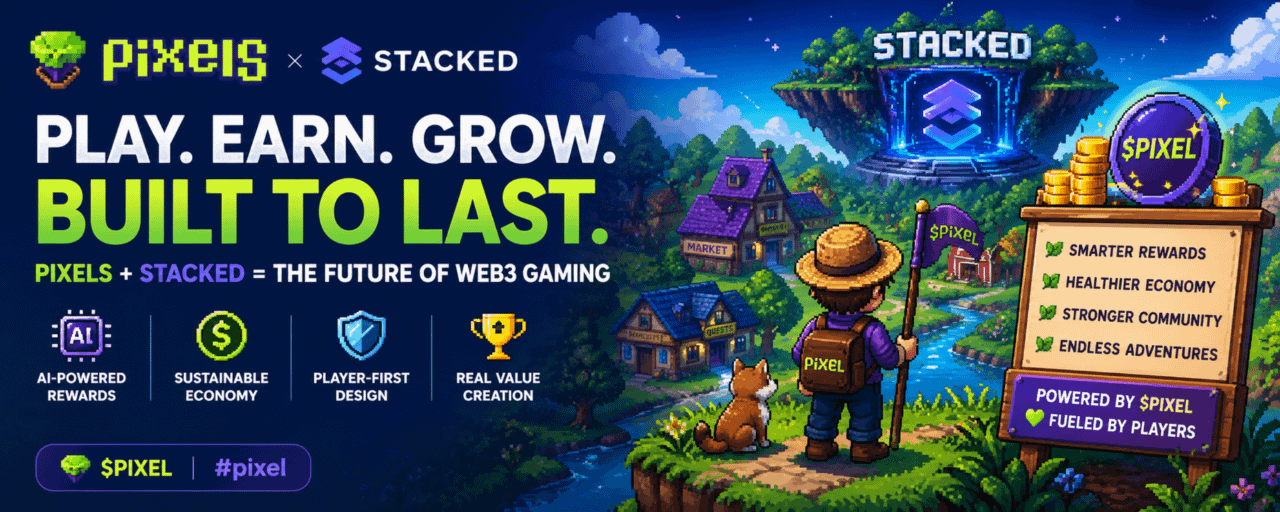
The evolution of Web3 gaming is no longer just about play-to-earn—it’s about sustainability, engagement, and smart reward design. That’s exactly where @Pixels is making a strong move with its ecosystem powered by PIXEL and the introduction of its “Stacked” infrastructure.
Pixels started as a social farming and exploration game built on the Ronin network, where players earn, trade, and interact in a dynamic virtual world. But what makes it stand out is its shift away from traditional reward-heavy models toward a more balanced and enjoyable gameplay economy. Instead of focusing purely on token emissions, Pixels emphasizes utilitywhere PIXEL used for in-game upgrades, NFT minting, VIP perks, and governance.
Now comes the real innovation: Stacked. This AI-powered reward infrastructure is designed to optimize player incentives in real time. It analyzes behavior and distributes rewards more intelligently, rather than blindly emitting tokens. This is critical because one of the biggest problems in Web3 gaming has been token inflation leading to price crashes. Stacked directly addresses this by redesigning how rewards are issued.
Another important shift is the partial move toward USDC-based rewards. This separates gameplay rewards from constant sell pressure on $PIXEL, making the token economy healthier and more sustainable long-term. It’s a strategic move that shows Pixels is not just building a game—but a scalable economic engine for Web3 gaming.
In my view, @Pixels is experimenting with something bigger than a single game. If Stacked succeeds, it could become a standard infrastructure layer for other Web3 games—bringing smarter monetization, better retention, and real value creation.
Key Takeaway:
Pixels is transitioning from a simple play-to-earn model into a data-driven, AI-powered gaming economy—and that’s where the real long-term value of $PIXEL @Pixels