
Two years ago, during the land auction for Pixels, I seriously started pondering this question: if a token in a blockchain game drops from $1.02 to $0.0075, what’s left?
The answer back then was pretty grim—nothing left. When PIXEL launched in March 2024, its market cap shot past $265 million. Now, the circulating supply is 3.38 billion tokens, and the FDV is only around $37.5 million. The all-time high was $1.02, and it hit a historical low of about $0.0045, with over 99% in losses, lying alongside its struggling peers AXS and IMX on the GameFi 'bear market badge' list.
But there's one thing I just can't wrap my head around: why did hundreds of GameFi projects die over the past two years, yet Pixels managed to pull off a single-day rebound of +204% in March 2026, with trading volume skyrocketing by 3,400%?
I started breaking it down into data analysis and discovered a secret: this project has already transformed in a corner into a different route—not relying on issuing tokens to farm rewards, but rather bringing Web2 advertising logic into Web3 and selling ROI.
▌First, from on-chain data, to an unexpected conclusion: Pixels' treasury is no longer reliant on mining and selling.
What's the issue with mining, withdrawing, and selling? The more rewards distributed, the faster the price drops. This inflationary spiral is tied to death.
But there's a metric called RORS—Return On Reward Spend, meaning for every dollar spent on rewards, there must be at least a dollar of protocol income coming in to fill that gap. Pixels has maintained this metric in the positive range of 1 to 1.05 during internal testing, while also keeping an operating profit margin of around 5%.
Don't underestimate it; less than 5% of the projects in GameFi are running positive profits.
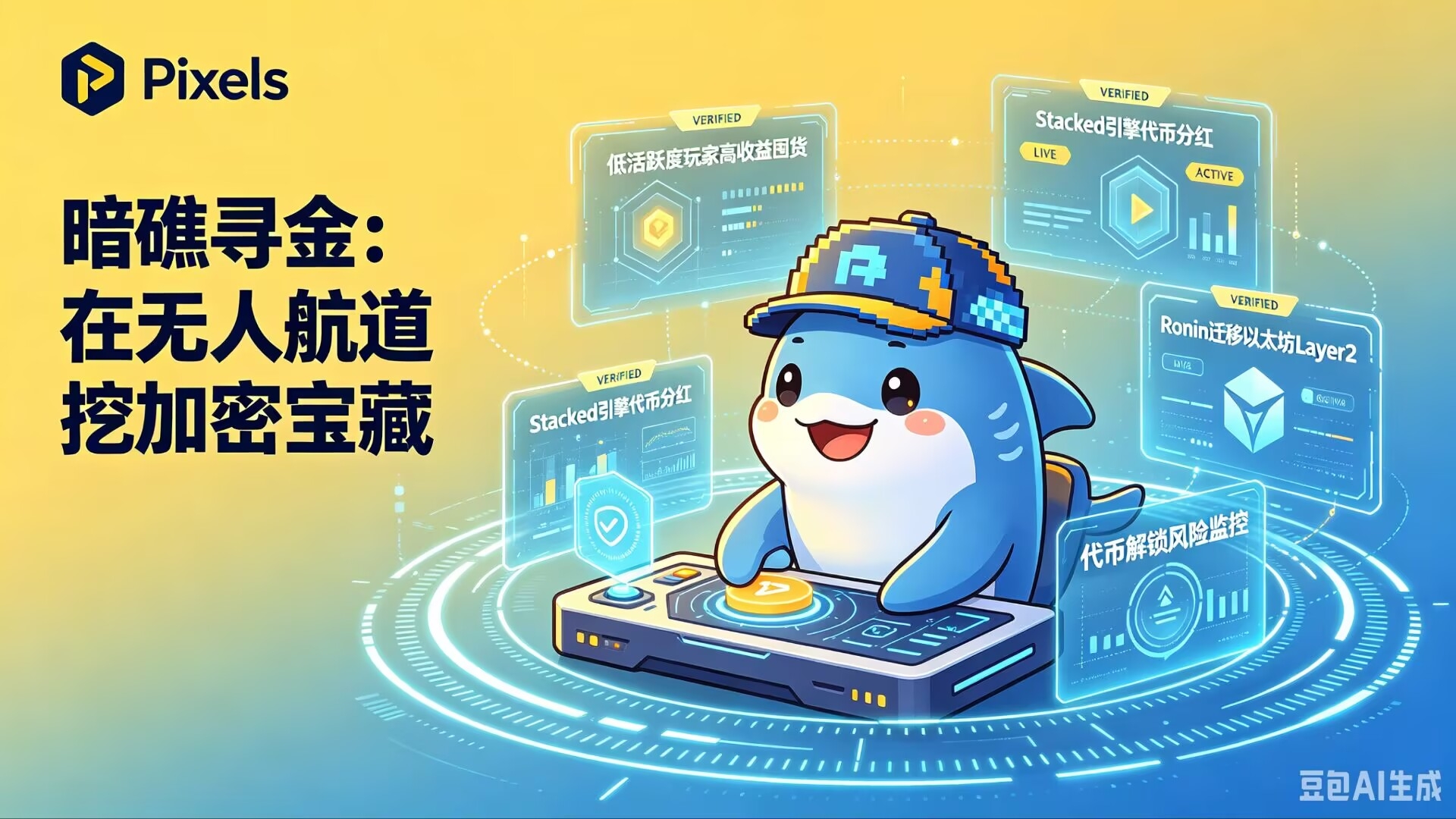
The positive value behind this metric isn't luck; it's a product they've polished for four years, burning $25 million in internal costs to push it to the forefront—Stacked.
▌What exactly is Stacked?
In layman's terms: Every time you log out of the game for three days or get stuck on a key mission, the system's AI can instantly identify 'this player is about to churn' and then allocate suitable rewards to pull you back in.
The traditional approach is to flood the market, distributing tokens to everyone, which results in 80% flowing into script wallets; Stacked does precise targeting, only rewarding those most likely to renew for seven days, complete high-difficulty tasks, or bring new players onboard.
An open case study on churn recall: sending targeted incentives to players who haven't paid for over 30 days increased conversion spending by 178%, active days grew by 129%, and ROI reached 131%.
This means game studios can save most of the indiscriminate user acquisition costs originally burned on Google and Facebook and instead directly convert that budget into USDC real earnings for players.
The key is that under the Stacked framework, players are rewarded with USDC rather than PIXEL. This design completely reconstructs the underlying dynamics: in other chain games, tokens you mine can only be sold; in Stacked, you can choose not to sell $PIXEL and still receive real stablecoin earnings. The one-sided selling pressure on $PIXEL has been greatly reduced, and the retention logic of the token itself has shifted from 'must sell' to 'can sell or not sell.'
With the opening of the USDC payment channel, Pixels' economic structure is no longer driven by 'token inflation subsidizing players.' The monetization logic of the studio is becoming clearer—they're willing to exchange cash for real active players' retention time.
I built a test environment myself, spending three weeks running five rounds.
I've chosen the deep cold metal from the Southwest continent as my observation target. The reason is this material is not labeled with rarity by the officials, its price fluctuates very little daily, and most players pass it by as scrap. But in the Stacked mechanism, the AI will detect the excessive demand for this limited-production resource before a large production event and incorporate it into the reward design logic anchor.
I used a small amount of capital to follow the rhythm, and the first round lasted about 14 days, maintaining low material costs, after which the price jumped about 1.4 to 1.6 times when the event announcement dropped. Completing multiple rounds, all five rounds were positive, and the smoothness of the profit curve exceeded my expectations.
The existence of this arbitrage window, frankly, isn't because many people can't understand it, but because most people have never spent time in such niche assets. The real arbitrage dividends lie in the cracks of 'information timeliness' and 'pricing inefficiencies.' Stacked's existence has turned this gap from 'occasional speculation' into 'repeatable mechanism arbitrage.'
Ronin's migration move comes at a good time.
The key timeline to note: May 12, Ronin officially migrates to Ethereum L2's OP Stack—block height 55,577,490 triggers, requiring about 10 hours of downtime.
The RON inflation rate will be cut from over 20% to less than 1%, and the market fee for the treasury will jump from 0.5% to 1.25%, plus 90 million RON will be redirected as treasury assets.
Additionally, Ronin has introduced a proof-of-distribution mechanism that automatically allocates RON rewards to developers based on gas consumption and user growth metrics.
The essence of these changes is: to shift Pixels' underlying chain costs from 'big ups and downs' to 'stable low consumption.' The migration of Ronin directly changes the user experience by making operations more convenient, like logging in with Google or Apple accounts without needing to fiddle with wallets—this almost eliminates barriers for regular players.
On the flip side, Stacked's external B2B expansion hasn't been easy. After the SDK opens, whether it can attract the first batch of mass-produced non-Pixels native games will become the core suspense of the entire cycle. If fewer than five vendors are onboarded before Q3 2026, or if no active reward activities last more than three months after onboarding, this B2B model will remain at the stage of 'only passing internal tests, not running external validations.'
The critical risk window is May 19, when 91,180,000 PIXEL tokens unlock for advisor allocation, which at the current token price is about $4.7 million. Observing the RORS metric, as long as the quarterly RORS is above 1.0, even if the token price is driven down during the unlocking window, funds typically re-accumulate. On-chain data from the past two weeks shows that after the release on April 19, the price didn't continue to plummet, which somewhat validates the holding capacity of long-term investors. However, this unlocking is only a week apart from Ronin's downtime window; if on-chain transactions are frozen during the downtime, slippage could be dramatically amplified, and the unlocking pressure may surpass the last holding threshold.
Dynamic observation from a competitive perspective
Currently, the entire GameFi mainstream tokens are deeply trapped in the bottom regions, with IMX down 98% from its peak, GALA down over 98%, and PIXEL's 99% decline is a systemic collapse across the entire track. The difference is that Ronin can still handle over 7 million on-chain transactions daily, with daily fees below $0.001, and Stacked has provided the studio with a verifiable retention ROI tool—these two features are nearly impossible to find in similarly ranked projects.
Looking at Pixels' token holder distribution, the structure of retail investors, liquidity pools, teams, and advisor lock-in under a 60-month linear release framework continues. This is actually smoother than competitors that often have 30% controlled by a single market maker.
To wrap it up: The core logic of Pixels is no longer about 'mine, withdraw, sell.' They've transformed the internal economic operation model of the game into a B2B AI reward distribution engine, using USDC to alleviate the selling pressure of tokens, and they've managed to retain millions of real players on-chain thanks to the low-cost environment of RoninL2. Real wealth transfer isn't about script mining or gambling-style entry; it's about identifying time gaps in the market that haven't been repriced yet and calmly positioning your chips before that.
Voting interaction
💬 Where do you think the biggest bottlenecks for Pixels will be in the next six months?
A. Can the number of games integrated externally in Stacked double?
B. Can the RORS quarterly metric stabilize above 1.0?
