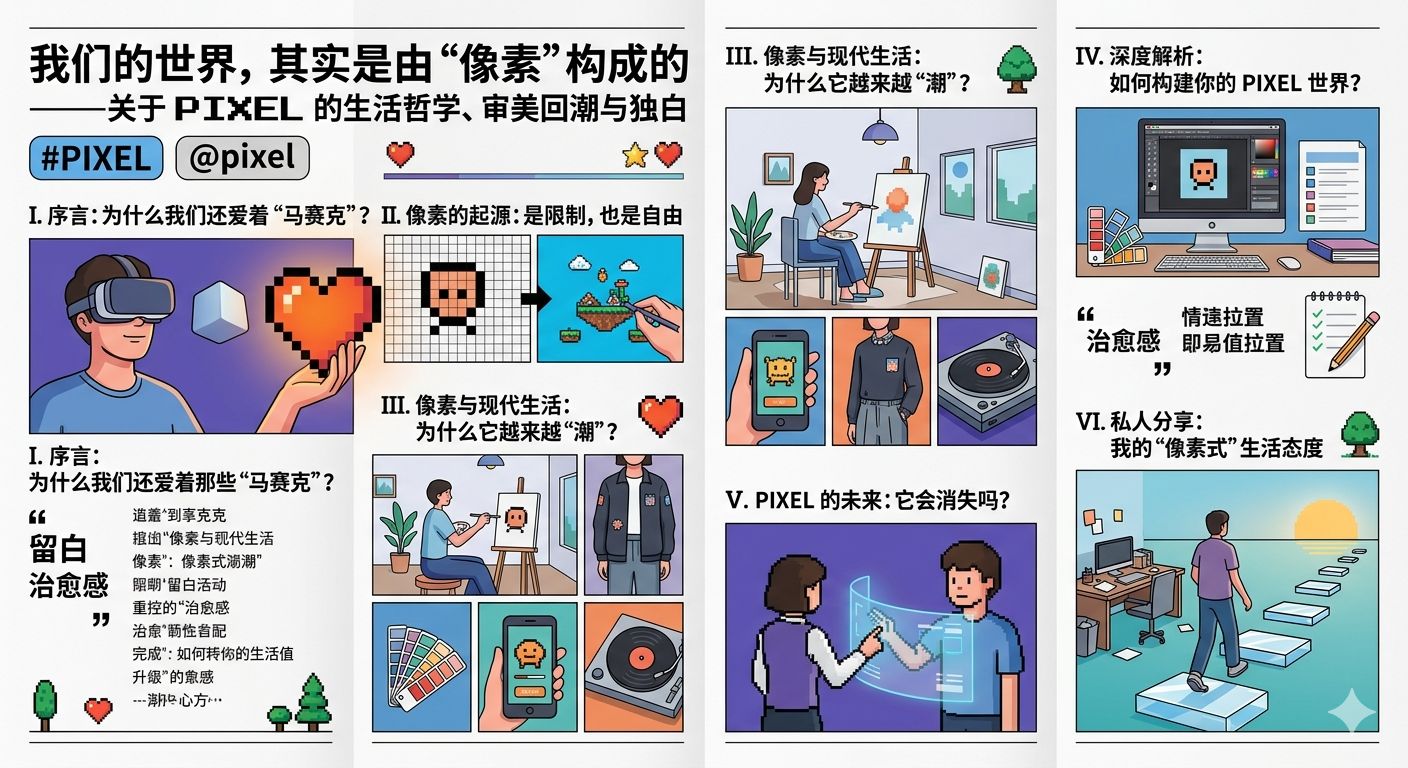
If I asked you what the first image that pops into your mind when you think of "games" is, it probably isn't one of those massive open-world titles that take up hundreds of gigabytes. Instead, it's likely a bouncy dude in red overalls or that yellow circle munching on pellets in a maze. At the very least, it might be a simple ping pong match with just a few bars and a ball. These images all share a common trait: pixels. Back then, we called it "jaggies" and referred to blurry graphics as "graininess." Our wish was: when will games look as real as movies? Interestingly, now that modern games do look indistinguishable from films, we find ourselves frantically searching the Steam store for titles tagged "Pixel Art," like craving a bowl of sweet potatoes roasted over charcoal after getting tired of pre-packaged meals and Michelin-star cuisine. This sentiment, we need to unpack it from the beginning.
Pixels: Are they the tears of the times, or the skeleton of digital art?
We need to understand one thing: pixel art was initially born as a compromise. In the 1980s, memory wasn't measured in GBs, but in KBs. Game designers had to cram a character into a tiny space, so they could only use the simplest color blocks. Here's a little-known fact: Why did early versions of Mario wear hats and have beards? Not because he was fashionable, but because with that pixelated format, it was impossible to draw the texture of hair or the movement of the mouth. A hat and a mustache automatically filled in the gaps in the player's brain: "Oh, this is an Italian uncle." That's it.@Pixels The first layer of charm: white space. Modern games are too complete, so complete that players don't need to use their brains. But pixel games are different; they give you hints. A twinkling white pixel is a star, and also hope; several undulating green squares are a forest, and also the unknown. This process of "filling in the blanks" is actually the highest level of flirting between player and creator.
Why can't we quit PIXEL in 2026?
Our lives are too chaotic. Work is ambiguous, KPIs are fluid, and emotions are complex. But in pixel games, everything is aligned. Even the most chaotic battle scenes are built on a precise 16x16 or 32x32 grid. This "grid-like" feel provides modern people with a strong sense of order and psychological comfort. Watching those blocks arranged one after another, you feel that at least a part of this world can be quantified, aligned, and controlled. I wonder if you've ever felt this way: playing those AAA games sometimes feels like "going to work." You have to learn complex key bindings, navigate long maps, and watch endless cutscenes.
Pixel games often represent a gameplay-first approach.
The satisfying combat of Dead Cells, the management fun of Stardew Valley, and the pure, unadulterated leaps of Celeste—these games strip away the flashy, deceptive exteriors, delivering the core "fun" directly to your face. If you look at 3D games from 20 years ago, you'll find the graphics appalling, the polygons like paper. But if you look at pixel games from 20 years ago (like Metal Slug or Castlevania), you'll still find them works of art. The pixel art style, because it doesn't strive for "realism," will never "go out of style."
@pixel In-depth Player Guide: How to Pick Out "Good Products"?
There are countless pixel games these days, some are true art, others are simply a case of developers lacking funds for quality artwork. As a veteran, let me teach you a few tricks to spot a gem: High-quality pixel art is extremely sophisticated in its color schemes. Good works limit the number of colors, using the contrast between warm and cool tones to create light and shadow. If you see a pixel game with muddy colors, it's most likely generated by a filter. What is "juicy" quality? It's the bouncy feedback of a movement. For example, is there a slight squeezing or deformation when the character lands? Is there a slight pause during an attack? The soul of pixel games lies in these tiny frames. This is high-level operation. Although the graphics are pixelated, if the developers handle it well, the character's movement will be smoother than silk.
PIXEL is a lifestyle
In fact, people who like pixelated graphics might have a touch of minimalism at their core. In this age of information overload, pixelated games tell us: less is more. I know a guy who's a designer at a big company, handling tens of millions of pixels of assets every day. But when he gets home from get off work, he only plays those black and green Game Boy emulators. He says, "In that little box, I can see the meaning of every dot. In reality, I can't." This attitude can actually be extended to life. We don't need to make everything smooth, perfect, and flawless. Sometimes, having a bit of a sharp edge, a bit of a "pixelated" feel, can remind people of your original self.
Conclusion: To all souls who love blocks.
While writing this, I kept having 8-bit electronic music playing in my head. PIXEL is more than just a game label; it's an epitome of an era, a kind of nostalgia for the digital age. It reminds us that no matter how far technology advances, those initial, clumsy, and imaginative moments are the most moving. If you're feeling tired lately, stop grinding levels in open-world games. Open a pixel game, farm, jump, fight monsters, and find that lost summer in those neat little squares. So, what's your favorite pixel game? Is it the one that grinds you to death (Terraria)? Or the one that makes you cry your eyes out (To the Moon)? Tell me in the comments, and share your thoughts!$PIXEL Faith, us@Pixels Let's talk about it.