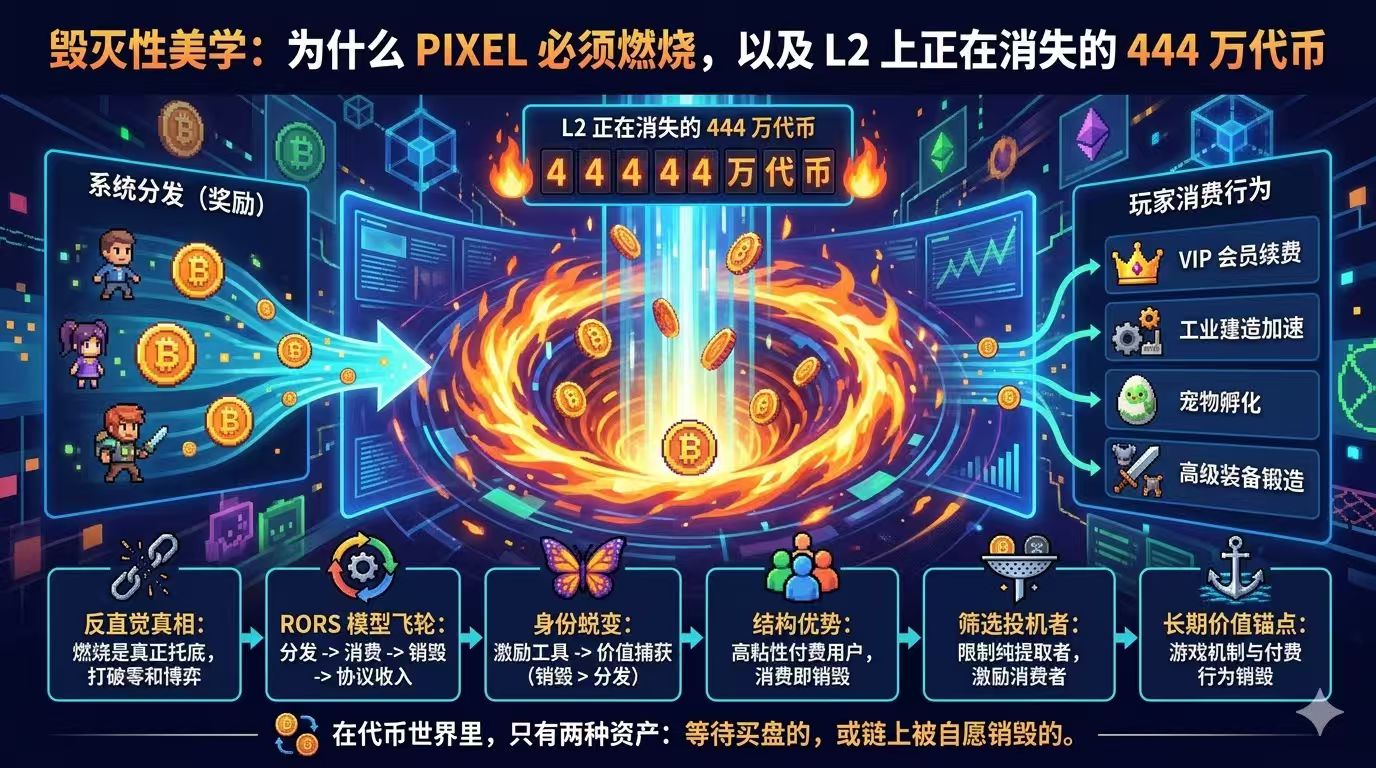
I believe the most counterintuitive truth in token economics is that buy pressure is never the real bottom for prices; burning is.
Any token without a burn mechanism is essentially a relay race of holders stepping on each other. The chips flow from private placements to the secondary market, from retail traders to exchanges, ultimately completing a brutal turnover within a certain price range. And burning is the only reverse force that can break this zero-sum game in the chain—it permanently removes supply from circulation, effectively causing each holder's share to appreciate passively.
@Pixels The team clearly knows the ropes. In their publicly shared RORS model, burning is designed as the ultimate exit for the entire economic flywheel: tokens are handed out as rewards to players, who then spend those tokens on premium services, speeding up builds, and minting assets, with the treasury focused on burning. The goal is almost obsessively clear—every $PIXEL token distributed as a reward must generate at least $1 in protocol revenue through fees and destruction. Measured by the vanishing number of tokens on L2, this flywheel is gaining momentum.
Data shows: during the community Guild Wars event, the system distributed 485,000 PIXEL as incentives but destroyed 524,000 PIXEL and 3.4 billion in-game tokens, marking the first time that destruction surpassed distribution. This seemingly ordinary numerical reversal has far deeper implications in token economics than the hollow narratives of 'hundredfold coins'—because at that moment, PIXEL transformed from a mere incentive tool into a value-capturing vehicle.
Understanding the devastating aesthetics behind this absolute value requires dissecting its internal mechanisms. The burning in Pixels is not a crude deflation that arbitrarily destroys the total supply, but a precise on-chain purification that matches player consumption behavior: players need to consume tokens to purchase VIP memberships, accelerate industrial build times, hatch pets, and forge high-end equipment. This destruction model does not rely on manual intervention but deeply binds the token's lifecycle to player behavior—consumption equates to destruction, and destruction equates to value.
The more subtle structural advantage lies in the fact that Pixels' user base itself serves as a natural accelerator for the burning mechanism. Over 63,000 wallets hold NFT assets in-game, and the proportion of paid accounts continues to rise. These high-engagement users are the main force behind the burns. Compared to free players, paying players not only have a stronger spending willingness but also a more frequent consumption pattern—each VIP renewal is a re-locking of tokens, and every item purchase is accompanied by the permanent destruction of tokens.
Unlike altcoins solely driven by buy-side sentiment, consumption-driven burning can form a structural resistance mechanism. By December 2024, in-game consumption reached a historic high of 10 million tokens per month, with net losses narrowing to -10 million tokens. This sharply contrasts with the early mining and selling phase (where reward ROI was only 0.5). More critically, the continuous rise in reward ROI—ultimately aiming to break 1—means the system is on the verge of achieving net positive token consumption, at which point it won't need to rely on any external incremental funds to maintain its valuation.
Behind this lies a harsh economic truth: the burning itself acts as a filter, weeding out pure speculators. Pixels strictly limits the reward cap for free players, marginalizing those pure extractors who refuse to become 'consumers' within the incentive system. While this strategy has sparked discontent among many 'farmers', it is precisely accurate in its economic design—using willingness to pay as a dividing line, splitting the user base into value contributors and cost consumers, and creating differentiated profit distribution at the incentive level.
Of course, the burning mechanism is not a universal shield. According to Tokenomist data, $PIXEL has currently unlocked only 15.42% of its circulating supply (about 771 million tokens), with over 80% of the supply still locked, and the full unlocking schedule stretches to 2029. Each unlocking is a stress test on burning capability—whether the consumption rate can keep pace with the release rate determines whether the token trends toward scarcity or dilution during the unlocking period. But at least, burning provides the only reverse momentum for this inevitable race.
Those still trading PIXEL based on the logic of 'whale protection' and 'community calls' are missing the essential value anchor of this token. What truly determines the long-term price trend of $PIXEL is not the thickness of orders in exchanges, nor the emotional fluctuations of wallet addresses, but the tokens quietly disappearing on the Ronin chain every day—they are consumed by the game mechanics, destroyed by players' spending behavior, and become the fuel burned in the economic perpetual motion machine. 4.44 million disappearing supply units represent the sexiest fundamentals in L2 economics. After all, in the world of tokens, there are only two types of assets: one waiting for buy-side interest in the secondary market, and the other voluntarily destroyed on-chain by players. #pixel