
 Most tokens fail because they lack demand.
PIXEL doesn’t.
It has usage, activity, and constant participation. But none of that has translated into stable price behavior. That disconnect points to something deeper.
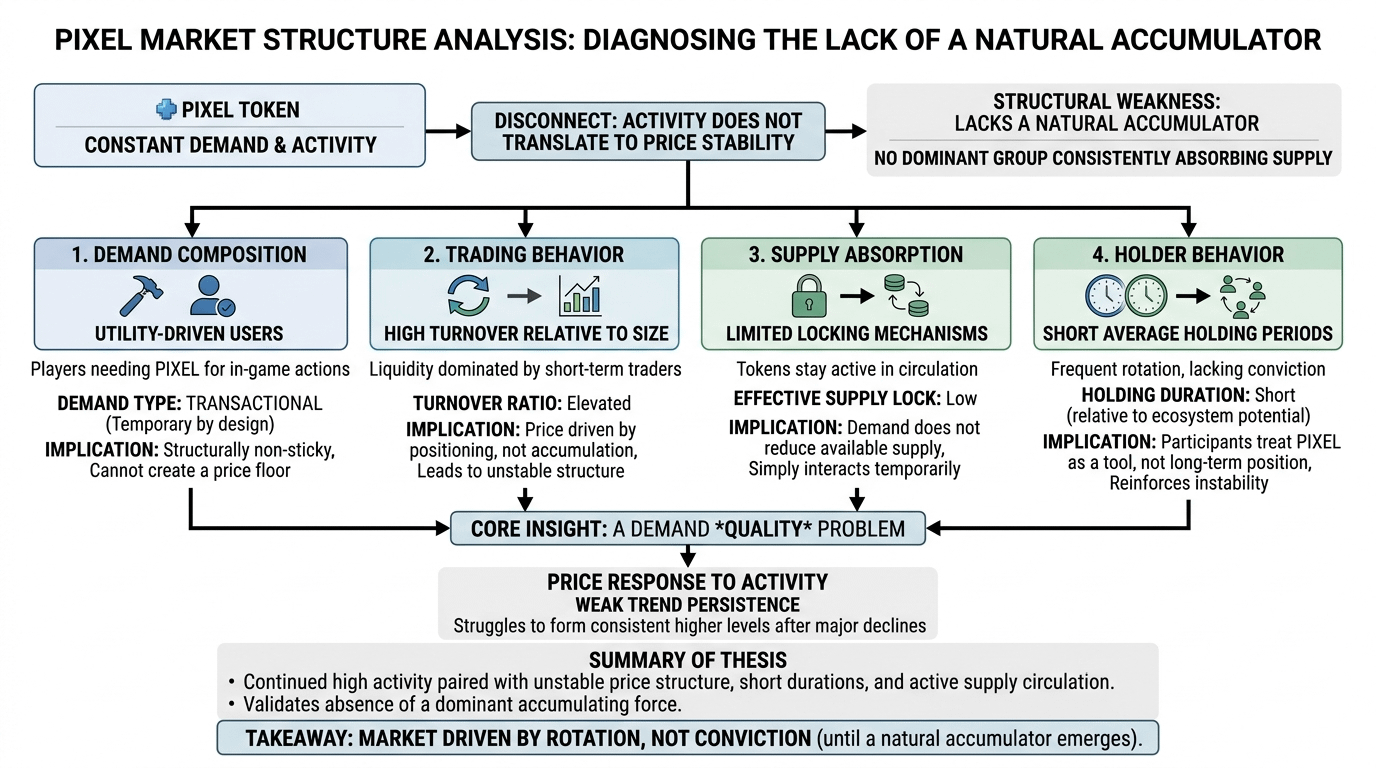
Thesis: PIXEL’s market is structurally weak because it lacks a natural accumulator—no dominant participant group is consistently absorbing supply, which leaves price driven by rotation instead of ownership.
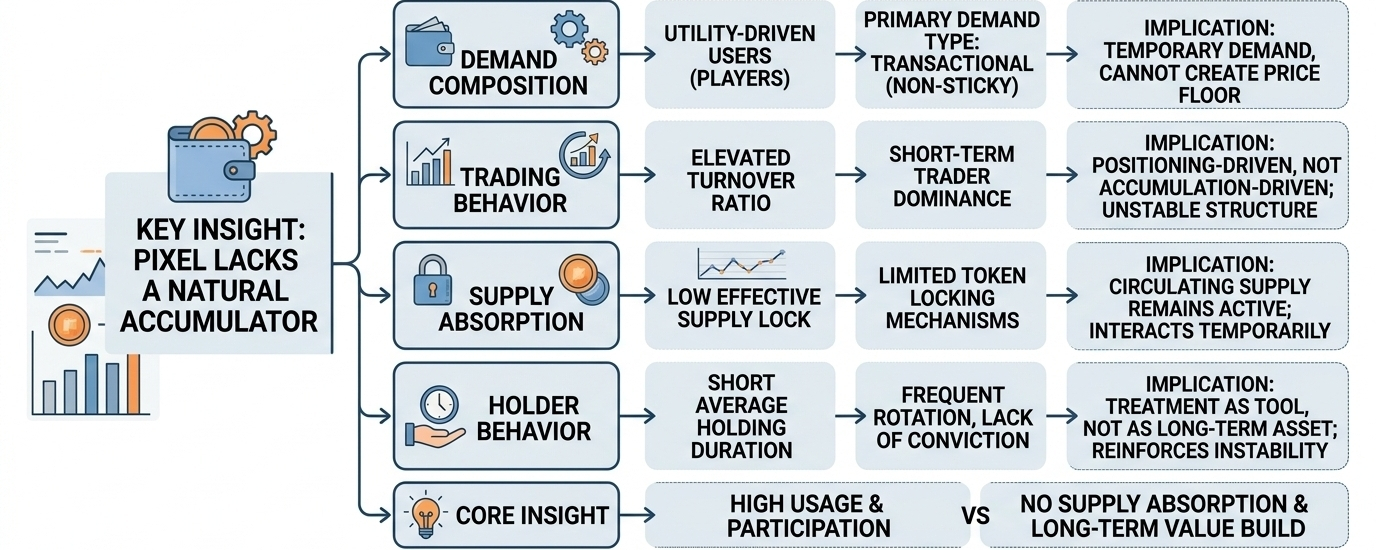
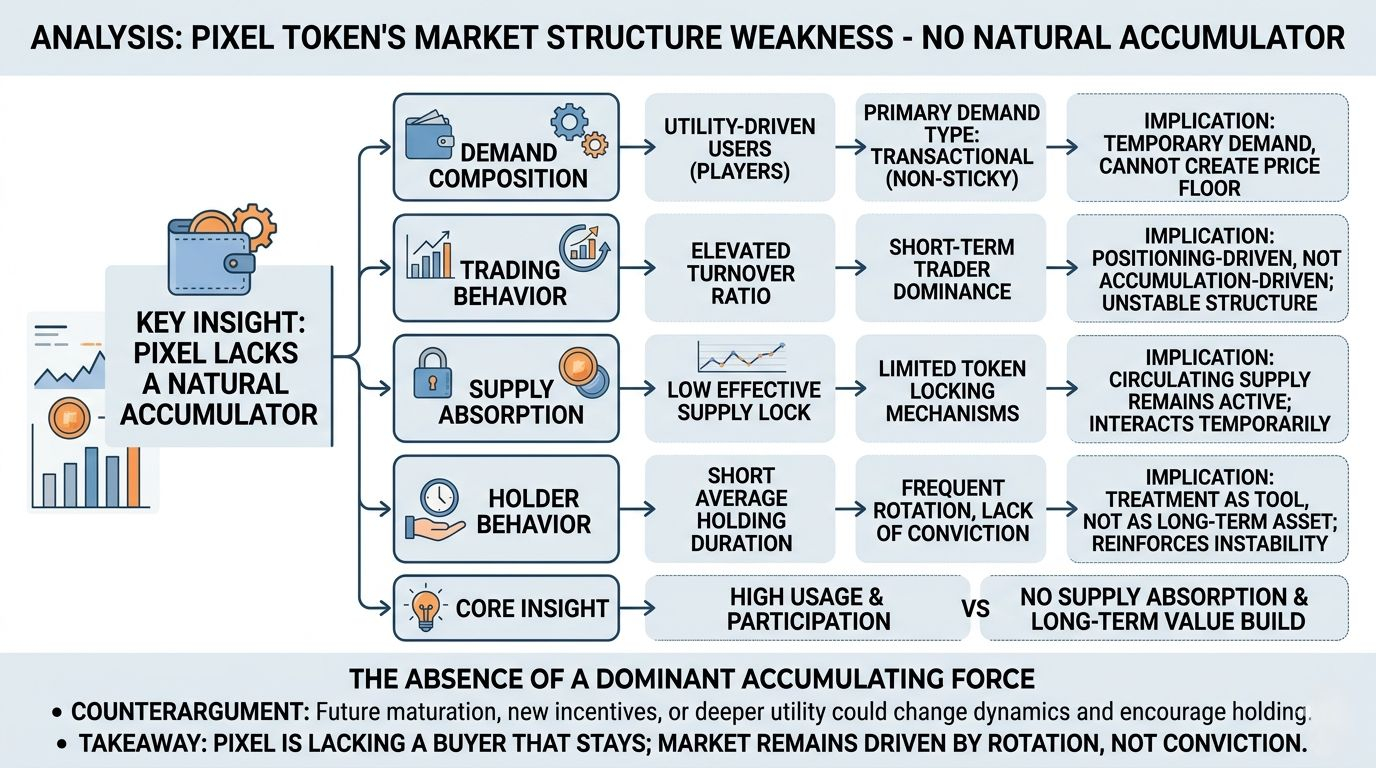
The first signal is in demand composition. The majority of interaction with PIXEL comes from utility-driven users—players who need the token for in-game actions. The metric here is demand type, and it is primarily transactional. This matters because utility demand is temporary by design. Users acquire tokens to use them, not to hold them. The implication is that the largest demand segment is structurally non-sticky, meaning it cannot create a price floor.
The second signal is trading behavior. PIXEL shows persistently high turnover relative to its size, indicating active participation. The metric here is turnover ratio, and it remains elevated. This matters because high turnover suggests liquidity dominance by short-term traders. Traders contribute volume, but not stability. The implication is that price movement is driven by positioning, not accumulation, which leads to unstable structure.
The third factor is supply absorption. There are limited mechanisms that remove tokens from circulation or lock them for extended periods. The metric here is effective supply lock, and it remains low. This matters because without absorption, circulating supply stays active. The implication is that even when demand appears, it does not reduce available supply—it simply interacts with it temporarily.
The fourth observation is holder behavior. Average holding periods remain relatively short for a token tied to a long-term ecosystem. The metric here is holding duration, and it indicates frequent rotation. This matters because longer holding periods typically signal conviction and reduce sell pressure. The implication is that current participants are not treating PIXEL as a long-term position, reinforcing instability.
The fifth signal is price response to activity. Despite ongoing usage and participation, PIXEL has struggled to form consistent higher levels after major declines. The metric here is trend persistence, and it remains weak. This matters because sustained price trends require continuous accumulation. The implication is that demand exists, but it is not strong enough—or persistent enough—to shift market structure.
The core insight is straightforward. PIXEL does not have a demand problem in the traditional sense. It has a demand quality problem. Activity is present, but it is not the kind that absorbs supply and builds long-term value.
A reasonable counterargument is that this dynamic could change as the ecosystem matures. Increased adoption, new incentive structures, or deeper utility could encourage longer holding behavior. If users begin to treat PIXEL as an asset rather than just a tool, a natural accumulator class could emerge.
To confirm this thesis, you would expect continued high activity paired with unstable price structure, short holding durations, and consistent circulation of supply without meaningful reduction. That would indicate the absence of a dominant accumulating force.
To invalidate it, the data would need to show clear signs of accumulation—longer holding periods, reduced turnover, and price stabilization even as trading activity declines. That would signal the emergence of a participant group willing to absorb and hold supply.
The takeaway is specific.
PIXEL is not lacking attention or usage.
It is lacking a buyer that stays.
Until that changes, the market will remain driven by rotation, not conviction.