I keep a small habit when I play games. Nothing serious. I just notice how long I’m willing to wait before I try to skip something. Sometimes I wait it out. Other times I don’t even think and just spend whatever the system asks for. It’s inconsistent. Depends on mood, time, even how tired I am. But after a while, you start to see your own pattern.
That’s where my thinking around $PIXEL started to shift a bit. I used to treat it like a normal game token, something tied to one loop, one environment. But it doesn’t sit still like that. The way it shows up, especially around moments where you choose between waiting and moving forward, feels less like a currency and more like a kind of memory. Not a perfect one, but enough to hint at how you behave.
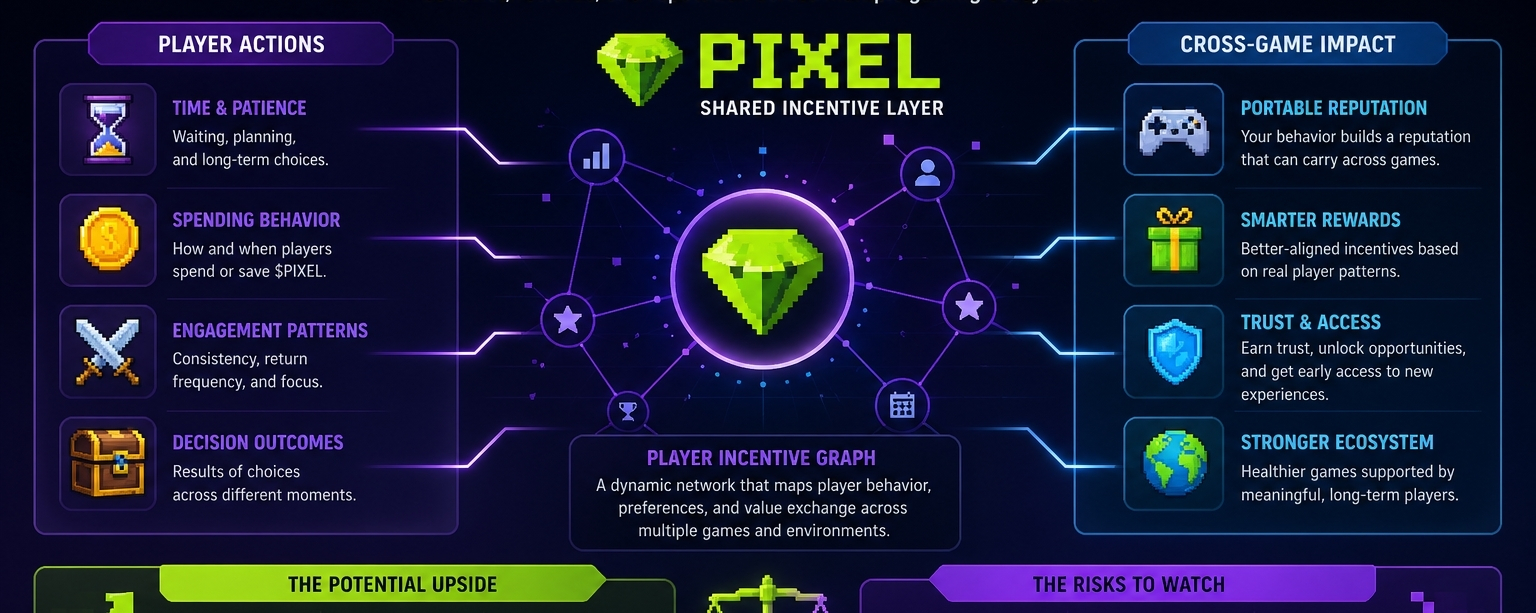
If that same token starts appearing across multiple games, even lightly connected ones, something changes. Not suddenly. It’s gradual, almost easy to ignore. But your decisions stop being isolated. They begin to echo. You spend here, you skip there, you hold back somewhere else. Over time, those small actions start forming a pattern that isn’t tied to a single game anymore.
People call this a graph sometimes. That word sounds technical, but it’s actually simple. It just means a web of connections. In this case, the connections are between your actions, your timing, and how often you rely on the token. If $PIXEL sits in the middle of that, it quietly links these moments together. Not perfectly. Not cleanly. But enough to make your behavior somewhat traceable.
I’m not even sure players will notice it happening. Most people just play. They don’t think about how their decisions today might shape something tomorrow in a different game. But systems notice patterns even when people don’t. And once those patterns start to matter, behavior shifts. It always does.
There’s also this strange tension. On one hand, a shared incentive layer could make things feel more consistent. A player who shows up regularly, makes thoughtful decisions, doesn’t rush everything… that kind of behavior could carry weight across games. It saves new systems from guessing who you are. In a way, it builds a quiet reputation.
But then I catch myself thinking, what happens when players realize this? Because they will, eventually. And when they do, behavior stops being natural. It becomes intentional. People start acting in ways that look good to the system. Not necessarily what they actually want to do. That’s where it gets a bit uncomfortable.
You can already see something similar on platforms like Binance Square. There’s this visible layer of rankings and influence scores. It’s not just about posting often. It’s about how your activity is evaluated over time. Consistency matters. Originality matters. But once people understand that, they begin adjusting. Writing changes. Timing changes. Even tone changes. It becomes a quiet feedback loop between the system and the user.
I wonder if Pixel is drifting toward something like that, but for gameplay. Not a scoreboard you can easily see, but a background process that shapes how value flows. Who gets rewarded faster. Who gets access to better opportunities. Who becomes “reliable” in the eyes of the system.
At the same time, there’s a real upside if this is handled carefully. Instead of rewarding random bursts of activity, the system could focus on behavior that actually sustains over time. That sounds good in theory. It filters noise. It rewards players who stick around, not just those who show up once and disappear.
Still, systems like this rarely stay neutral. They lean. Either toward over-optimization, where everything becomes predictable and a bit lifeless, or toward chaos, where signals lose meaning because too many people learn to exploit them. Keeping that balance… I haven’t really seen it done well for long.
What makes this harder to pin down is how quiet it is. There’s no clear moment where someone announces, “this is now a cross-game incentive graph.” It doesn’t work like that. It’s more like small adjustments over time. A new use case here. A subtle connection there. Suddenly, behavior starts carrying weight in places it didn’t before.
I’m still not fully sure if this becomes a strong layer or just an interesting experiment that fades. It probably depends on whether the patterns it captures stay meaningful, or if they get diluted as more players and more games plug in.
For now, I just keep noticing that small habit again. When I choose to wait. When I don’t. And whether those choices start to feel like they matter beyond the moment.
#Pixel #pixel $PIXEL @Pixels

Article
$PIXEL Might Be Building a Player Incentive Graph Across Multiple Games
Disclaimer: Includes third-party opinions. No financial advice. May include sponsored content. See T&Cs.