
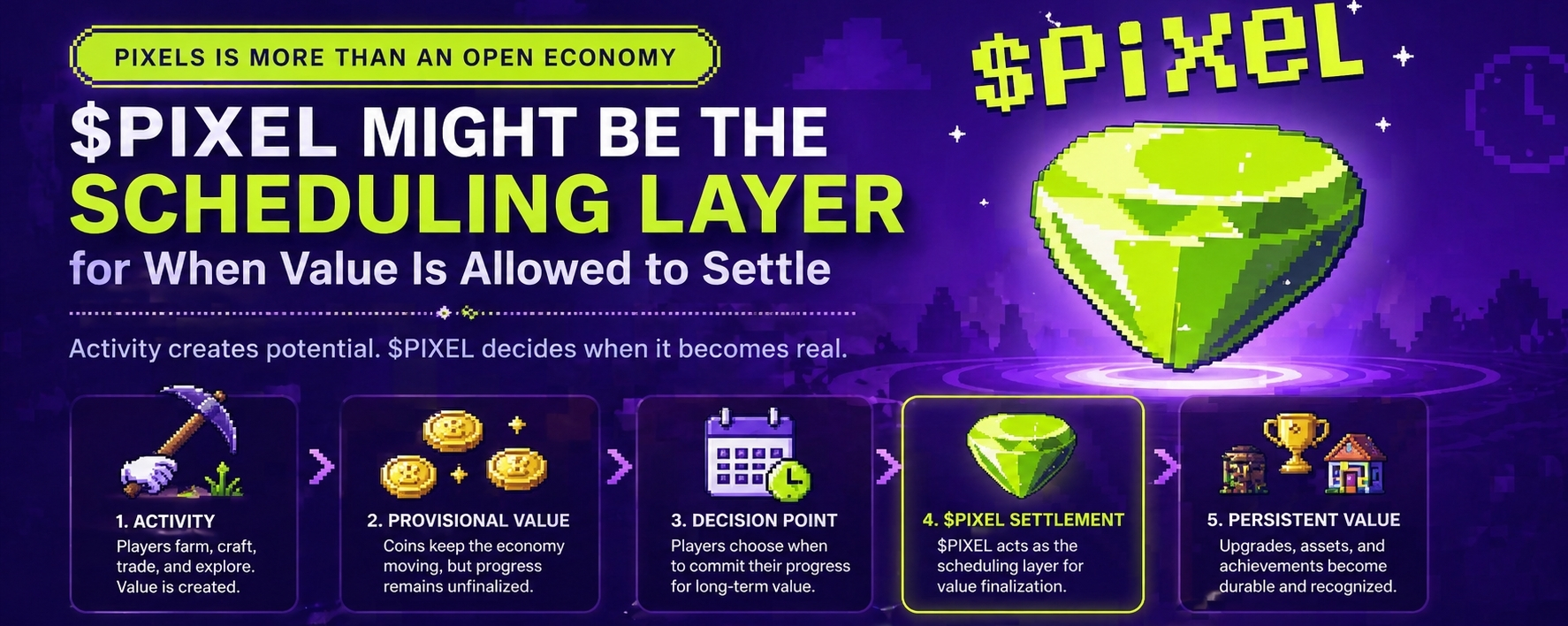

I used to think “open economy” in games meant freedom. You log in, you play, you earn something, and that something is yours. Simple loop. It sounds clean when you say it like that. But after watching a few of these systems long enough, especially the ones that survive past the first hype cycle, I’m not sure openness is the right word anymore. It feels more staged than open. Not fake, just… sequenced.
Pixels gave me that feeling pretty early, but I couldn’t place it. The game doesn’t block you in obvious ways. You can grind, craft, trade, move around. Coins keep everything flowing. It feels alive. And yet, there’s this quiet delay between doing something and that thing actually counting in a lasting way. That gap doesn’t shout at you. You just notice it after a while.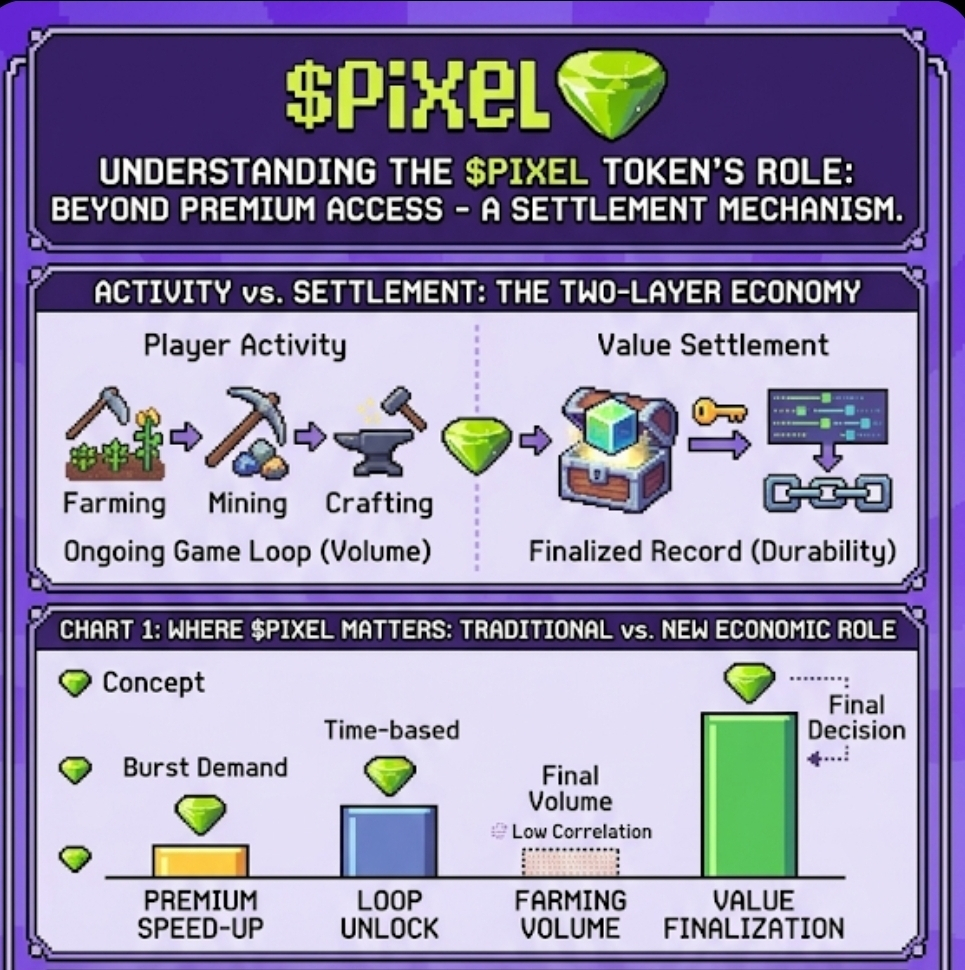
That’s where I started looking at $PIXEL differently.
At first glance, it behaves like a typical premium token. Speed things up, unlock certain features, get access to better loops. Nothing new. But when you trace where it actually gets used, it’s rarely at the beginning of an action. It shows up closer to the end. Not when you start doing something, but when you decide it should matter.
I don’t mean “matter” in a vague sense. I mean economically recognized. Persisted. Something that can be pointed to later and still exist as value.
There’s a subtle difference between activity and settlement. In traditional finance, settlement is just the boring backend moment when trades finalize. Most people don’t think about it. But systems break there more often than they do at the surface. Delays, mismatches, reversals. The messy part lives underneath. Pixels seems to have pulled that layer up into gameplay, but without calling it that.
You can spend hours generating output in-game. Farming, crafting, optimizing routes. All of that builds something. But it doesn’t automatically cross into a form that the broader system treats as final. That crossing point is selective. And $PIXEL tends to sit right there, almost like a quiet confirmation step.
I caught myself noticing it in a small moment. I had accumulated enough in-game progress to upgrade something meaningful. The upgrade itself wasn’t the interesting part. It was the pause before doing it. I hesitated. Not because I couldn’t, but because I started thinking about whether it was the right time to “lock it in.” That’s not how most game economies feel. Usually, you just upgrade and move on. Here, it felt closer to making a small financial decision.
That hesitation is doing more work than it looks like.
If every action immediately becomes final, players stop distinguishing between effort and value. Everything blurs into output. That’s what we’ve seen in a lot of play-to-earn systems. High activity, low durability. People optimize the loop, extract what they can, and the system quietly weakens underneath.
Pixels doesn’t fully prevent that. I don’t think any system can. But it introduces this thin layer where not everything gets finalized automatically. You can keep playing in a kind of provisional state. Productive, but not fully crystallized into something persistent. To move beyond that, you interact with $PIXEL.
I keep coming back to the idea that Pixel isn’t just pricing access or speed. It’s pricing timing. When do you convert what you’ve done into something the system will carry forward?
That’s a strange role for a token. It’s not about volume. It’s about moments.
And those moments aren’t evenly distributed. Some players rush to finalize. Others wait, stack, optimize. Some probably ignore it until they can’t. That creates a pattern where token demand doesn’t follow activity in a smooth line. You can have a very active system with relatively quiet token usage, simply because people are delaying that conversion step.
From a market perspective, that’s awkward. It breaks the usual assumptions. We like clean correlations. More users, more activity, more demand. But here, demand might show up in bursts, tied to specific decisions rather than constant usage. That makes the system look weaker or stronger than it actually is, depending on when you’re measuring it.
There’s also a risk hiding in this design. If the cost or friction around using Pixel drifts too high, players may just stay in that provisional zone longer. Keep grinding, keep producing, but avoid finalizing. That could hollow out the part of the economy that actually anchors value. On the other hand, if it becomes too easy, too cheap, then everything settles too quickly and you’re back to the same overproduction problem.
It’s a narrow balance. Probably harder to maintain than it looks from the outside.
I also wonder how many players are even aware of this layer. Most won’t describe it as “settlement timing” or anything close to that. They’ll just feel small nudges. A sense that some actions are worth committing, others aren’t yet. That’s enough. Systems don’t need users to understand them fully. They just need them to behave in slightly different ways.
What makes this interesting to me is that it extends beyond games. A lot of blockchain adoption problems come down to deciding what deserves to be recorded and when. Not everything should hit the chain immediately. But if you delay too much, you lose trust or clarity. Finding that middle ground usually requires heavy coordination or centralized rules.
Here, it’s being handled through a token, almost indirectly.
I’m still not convinced it holds under scale. These kinds of designs often look elegant until real pressure hits. Player behavior shifts, incentives get gamed, timing strategies emerge. The system can drift without anyone noticing until it’s already off balance.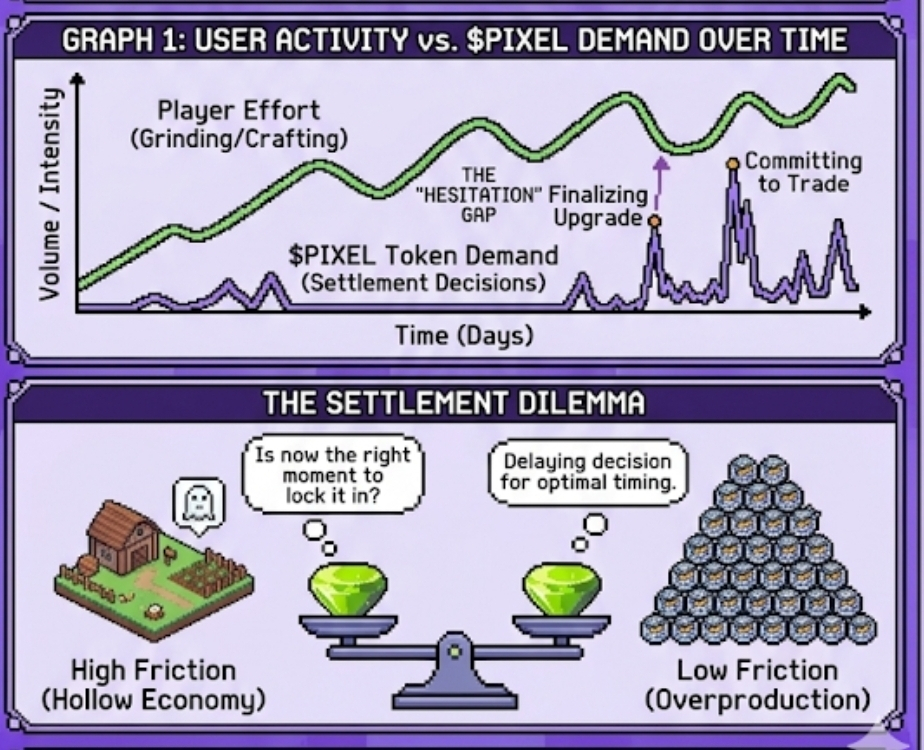
But I can’t unsee the pattern now. Pixels doesn’t feel like it’s just letting value flow freely. It feels like it’s spacing it out. Letting activity exist first, then asking, quietly, whether it should settle.
And Pixel is sitting right at that question, not answering it for you, but definitely shaping when you choose to answer it yourself.