
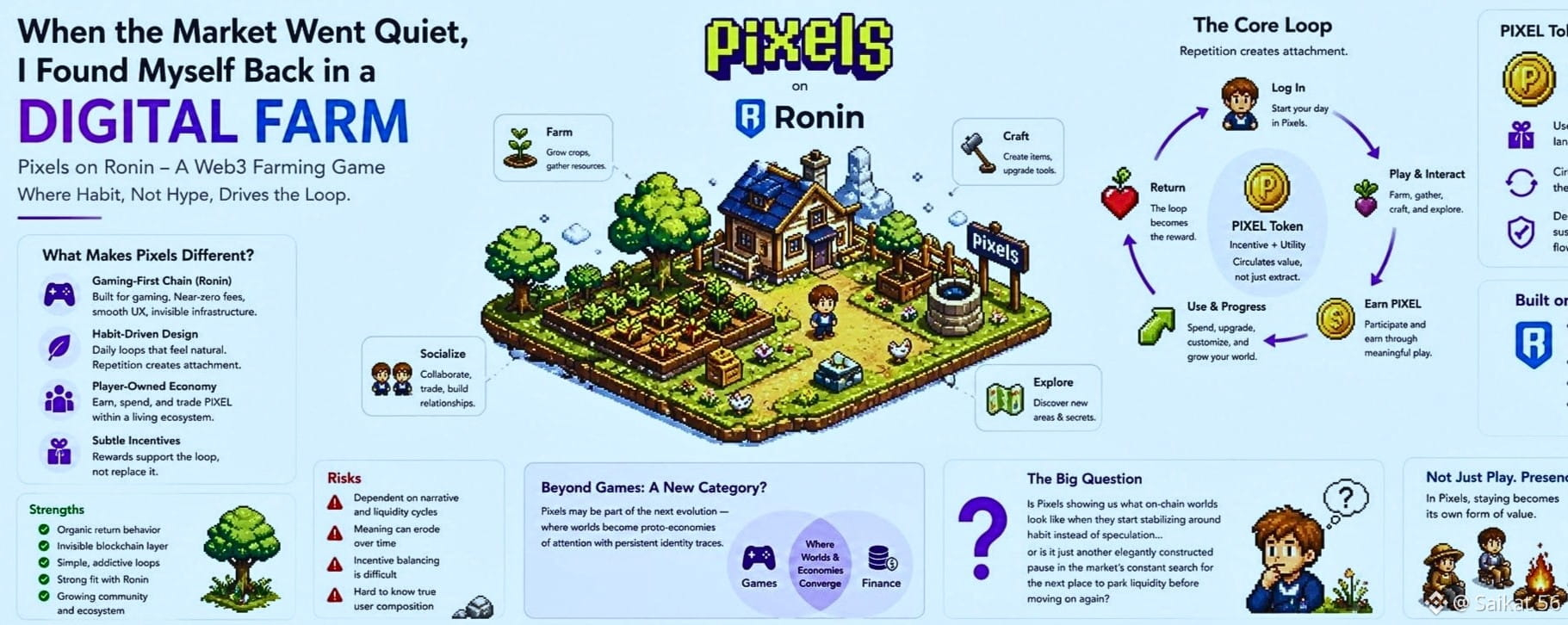
These days, I’ve developed a habit of pausing a little before dismissing things as “just another Web3 project.” In earlier cycles, I used to overlook them quickly. But experience has shown that the bigger stories rarely look big at the beginning. They usually grow quietly, almost unnoticed, until they eventually take their place. 😏
That’s how Pixels on Ronin caught my attention again. No hype flood, no aggressive marketing push. It doesn’t scream on timelines. Instead, it exists with a kind of steady silence. People are still logging in, building small routines, finding their own space inside this virtual landscape while everything outside keeps shifting rapidly: markets, trends, narratives.
At first, my reaction wasn’t very deep. Just another Web3 farming game that category already feels over-familiar. We’ve seen many “play and earn” models rise strongly and then collapse over time. In many of them, gameplay wasn’t really gameplay; it was an economic layer wrapped around an experience, where users slowly stopped being players and became calculators.
Pixels doesn’t initially position itself in that same way. It doesn’t claim to reinvent everything or speak in the language of revolution. And that “not trying too hard” attitude is exactly what makes it harder to dismiss. In Web3, things often become suspicious the moment they try too aggressively to sell themselves.
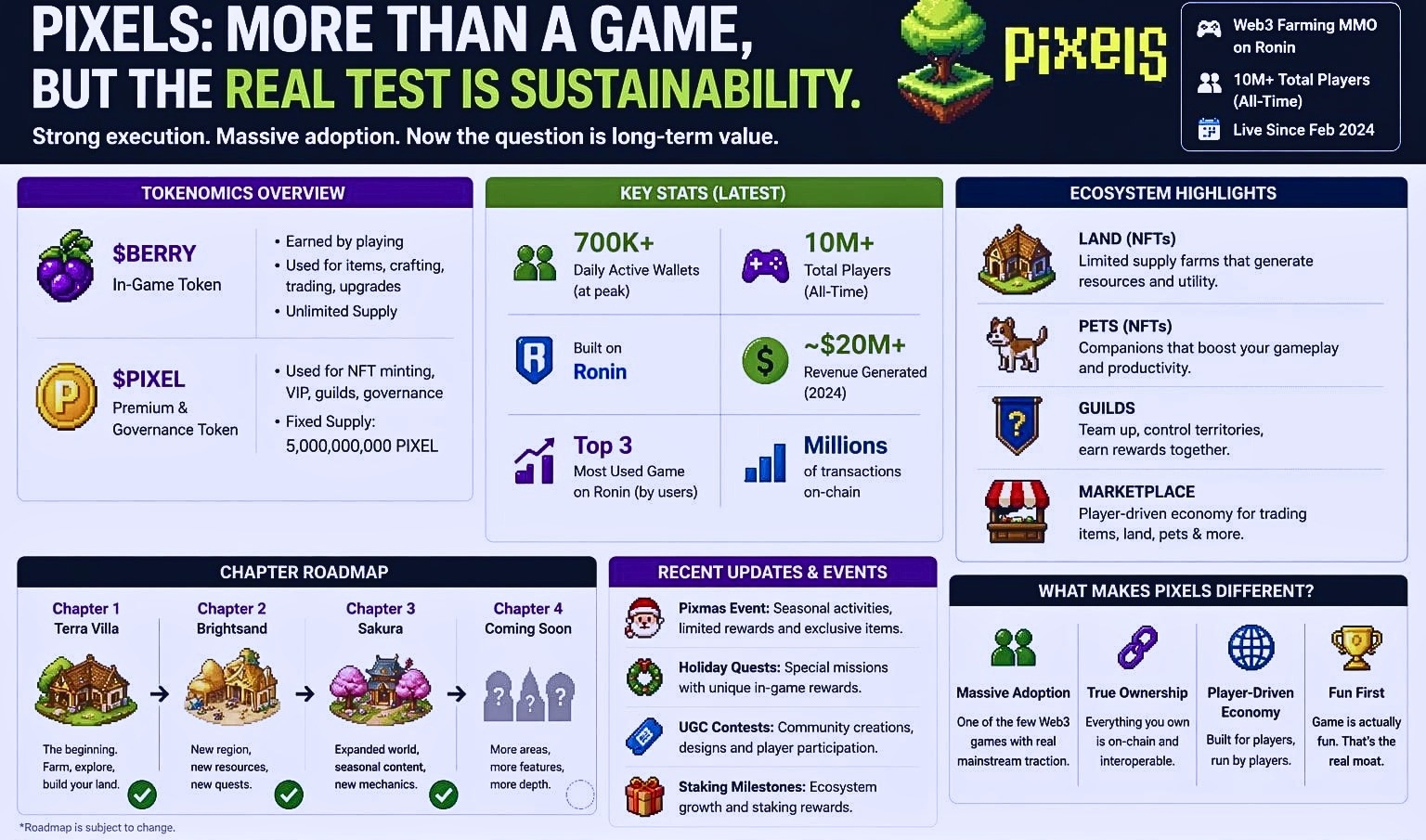
Another important factor is Ronin itself. It’s not a general-purpose chain. It’s a gaming-first environment, with low latency and near-zero friction, where users don’t constantly feel like every click is a financial decision. In that context, Pixels’ presence is not just technical it’s also philosophical in terms of design.
The real question here is not about the game or the token. It goes much deeper: if financial incentives gradually move into the background, can a digital world still create its own pull?
Because most crypto games today still rely heavily on incentives. They attract users, hold them for a while, and then lose them. Users rarely “stay” they just rotate between projects, moving wherever the reward or attention seems better.
Pixels seems to be trying to break that loop, but not directly. Instead, it turns the loop itself into the experience. Farming, crafting, upgrading, trading, social interaction everything is designed so that repetition itself slowly becomes a habit. Here, the reward is not just tokens, but the act of returning itself.
From the outside, it looks simple. A user logs in, manages land or resources, and progresses gradually. But the important point is that the blockchain layer is not in your face. It operates in the background. Many users don’t even feel like they are interacting with “Web3” they just feel like they are playing a game. That invisibility is actually a deliberate design choice, and in Web3 gaming, that’s not a small shift.
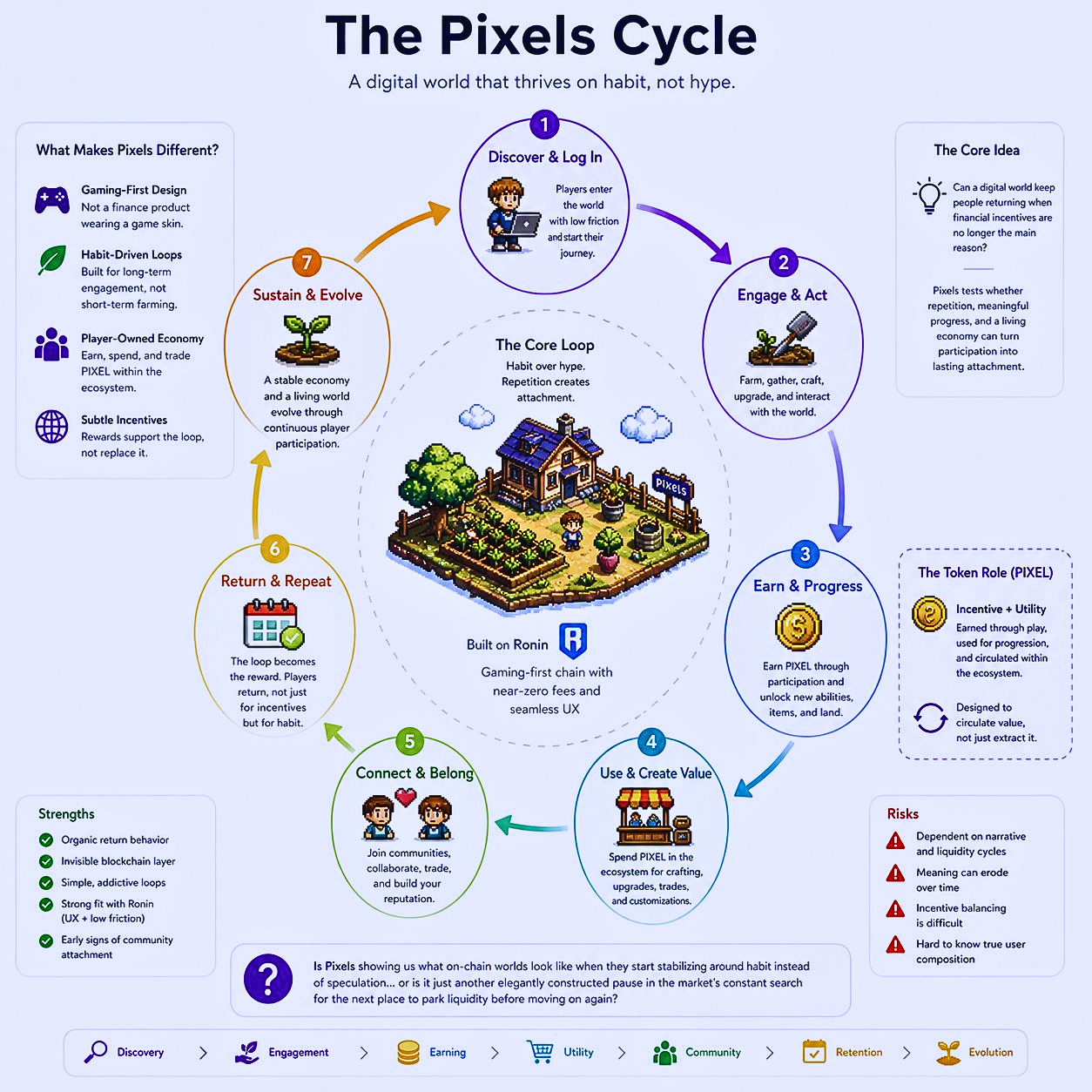
The $PIXEL token works as both an incentive and a utility within this system. It can be earned through participation and spent within the ecosystem. In theory, value circulates rather than simply leaving the system. This model is not new, but its real challenge lies in how stable it remains in practice.
However, there is a subtle risk here. When a system successfully feels “organic,” it can easily lead to overconfidence. In crypto, what feels natural can shift very quickly if the underlying incentives change.
The user base itself is also mixed. Some come for the game, some for rewards, some just to explore the ecosystem. This diversity initially drives growth, but over time it can also create stability challenges because expectations are completely different for each group.
At this stage, retention becomes the key question. But retention is not just about whether users stay or leave it’s about why they stay. If the reason is purely financial, behavior will always follow market cycles. If it’s experiential, it has a better chance of stability.
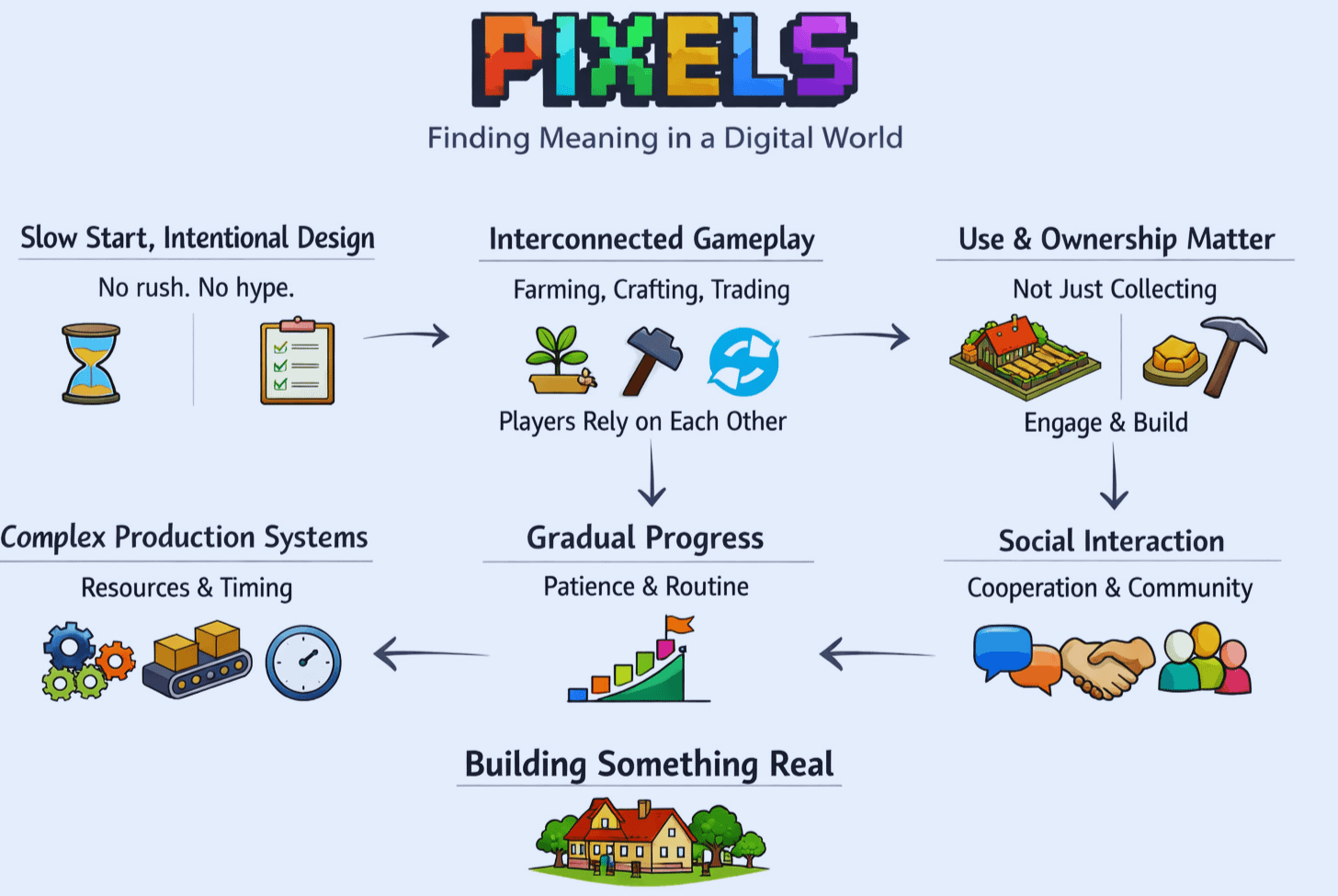
What makes Pixels interesting is that it hasn’t reached a final state yet. It’s still an ongoing experiment. There is rhythm, there is structure, but also uncertainty. Users are not purely optimizing, but they’re also not fully emotionally attached. That middle ground is important.
Still, the risks are clear.
First, narrative dependency. When broader market sentiment weakens, even well-designed systems struggle to maintain attention. Engagement drops when focus shifts elsewhere.
Second, meaning erosion. What starts as an experience can slowly turn into routine. And once routine loses meaning, even a functional system begins to feel empty.
Third, the incentive paradox. High rewards attract the wrong type of users, while low rewards slow growth. There is no simple solution to that trade-off.
Despite all of this, Pixels’ biggest strength is that it doesn’t present itself as something final. It’s still in a learning phase. Web3 gaming as a whole is still at a stage where real-world usage keeps testing assumptions and breaking old models.
From that perspective, Pixels is neither a success story nor a failure story. It’s an ongoing experiment where the core question is still unanswered.
And maybe the most honest way to describe it right now is this:
It is still being built.
It is still changing.
And it is still figuring out what it is meant to become. 😎