
 This morning, I logged into Pixels quite early, a habit of checking a few rounds before the in-game market gets bustling. One thing that caught my attention is that the same farming loop as usual feels like the 'value received' is no longer linear like it used to be.
I used to think simply that in Pixels, whatever you do, you get something corresponding in return. Farming yields resources, crafting yields items, trading yields price differences. The game economy always revolves around actions, and actions are the units creating value.
But the deeper I observe, the more I start to feel this assumption is a bit off. At least in Pixels when Stacked is added.
There are days when I farm the same type of resource for the same duration, but the rewards don’t sync up. Same behavior, but it feels like the 'output' is skewed, no longer steady like before. On the surface, nothing changes, but it feels like the system is reacting differently.
In the past, I thought that was just normal economic volatility. Supply and demand, or fluctuations within the game loop. But looking closer, it resembles something else entirely.
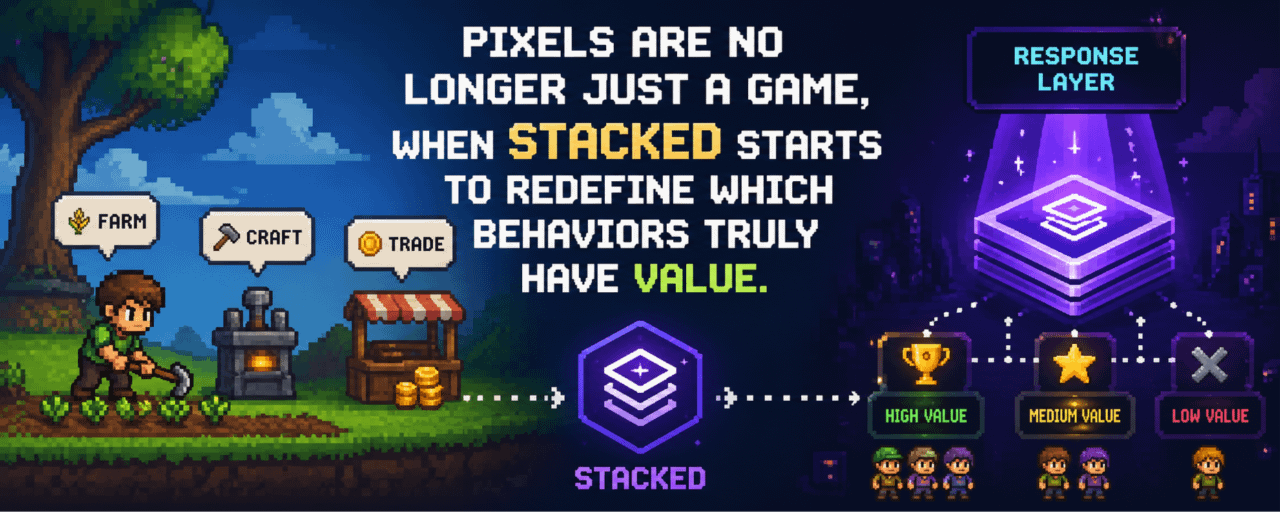
In Pixels, every action still exists like a massive graph. But Stacked is like a layer above it, not generating actions but weighting each of those actions. It picks out which behaviors are 'valued,' and which ones are just noise in the system.
This shifts my perspective quite clearly. It’s no longer about 'which behaviors create value,' but 'which behaviors are recognized by the system as valuable.'
A clear example I’ve noticed while playing is when some player groups start following certain action chains in Pixels, like farming combined with some flow crafting, the system starts reacting differently compared to those who just farm solo and sell on the market. It’s not because the outputs differ too much, but because the behavior patterns fall within the area that Stacked is prioritizing.
In other words, the same farming behavior, but if it falls within a 'sequence' that the system considers as having contribution, the rewards will be adjusted differently.
I’m starting to understand it as a scoring layer over the behavior graph.
Stacked doesn’t change Pixels by adding content or new mechanics. It’s like a feedback layer. Pixels is where behaviors occur, while Stacked is where the system decides how much 'weight' that behavior carries.
I try to visualize it more simply. It’s like a city where many people do the same work every day. But the government doesn’t reward based on what you do; it rewards based on which behaviors they want to promote in that economy. Today they need logistics, so logistics have higher value. Tomorrow they need production, and production gets boosted. Pixels is the city. Stacked is the policy feedback mechanism on each behavior.
What I find interesting is that the feeling 'value is defined by the response system' becomes much clearer in this setup. Value no longer sits fixed in behaviors, but in how the system reacts to those behaviors at any given moment.
But this also raises a tricky question. If value relies too much on the response layer, are player behaviors still naturally optimal, or do they start becoming optimal according to 'what the system wants to see in behavior'?
I might be looking a bit too far ahead, but I see a very clear trade-off in this design type. On one hand, Stacked helps avoid locking the Pixels economy into a few fixed optimal farm loops. It creates dynamic weighting, making the system more flexible. On the flip side, it also pulls behaviors toward the patterns that are rewarded rather than the natural patterns of the players.
This makes me think broader about blockchain design. From my mindset, incentives follow behaviors, like feedback. But the more I look at systems like Pixels + Stacked, I see that incentives are no longer just feedback. They redefine behavior from the get-go.
Ultimately, what I derive isn’t just about Pixels or Stacked individually, but something broader. In a crypto system, value rarely lies in the base behaviors. It’s in how the system chooses to respond to those behaviors, and that response is what truly redefines whether a behavior is meaningful or not.
