
There's a truth that anyone who's been through multiple GameFi cycles knows all too well: the hardest part isn't creating a Play-to-Earn model, but keeping it from crashing down.
Many projects have pumped up before. Players flood in, tokens skyrocket, and rewards are enticing. But then, almost all end up the same way — the system fails to generate real value, just redistributes value among each other, and eventually runs dry.
That's why when @Pixels starts talking about having found a sustainable Play-to-Earn formula, it's not just a statement. It's the result of a lot of experimentation, mistakes, and continuous adjustments.
The crux lies in the shift in mindset.
Rewards are no longer just 'handed out' to retain players.
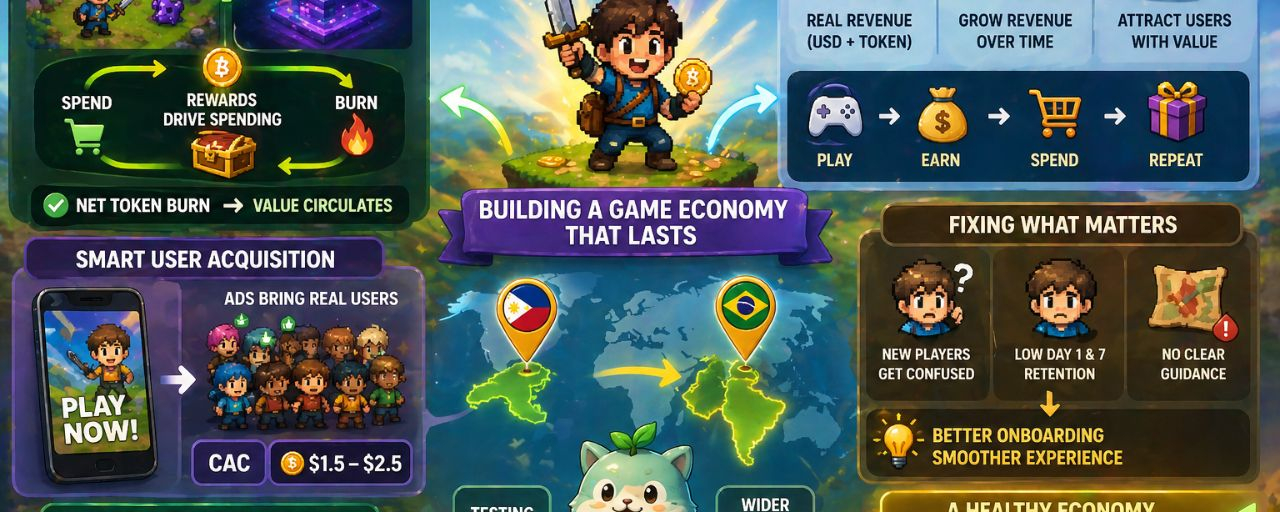
It has become a tool to stimulate valuable behavior — encouraging players to spend, engage more deeply, and return to the system. Core Pixels combined with Stacked creates a loop where tokens not only flow out but also come back, even getting burned net. An economy that starts to have its own rhythm, rather than relying on new cash flow.
But if it stops there, it’s still not enough.
A sustainable system at a small scale doesn't mean it can scale up. And that's why Pixels is making a very clear pivot: focusing on sustainable scaling and real revenue.
No longer just tokens.
But USD + tokens.
No longer just a crypto player.
But a real user in the market.
They're approaching growth in a very 'Web2' way: advertising, measuring, optimizing user acquisition costs. And the initial results from Chubkins show an extremely noteworthy signal — the user acquisition cost is only about 1.5–2.5 USD.
This number is not just a metric.
It's proof that the system can scale.
When you can spend 2 USD to acquire a user, and that user generates greater value over time, you’ve entered a completely different game — the game of real growth.
The expansion into markets like the Philippines and Brazil is no coincidence. These are places with low costs, a large user base, and most importantly: they are willing to invest time in experiences that provide real value.
Of course, there are still unresolved issues. New players haven't stuck around long enough. The initial experience has many areas that need optimization. But the difference this time is how the team perceives it: no avoidance, no hiding, but focusing on fixing the right issues.
Pixels is no longer chasing short-term excitement.
They're building something much harder: a system that can exist.
And if you look closely, the most valuable thing is not what has been achieved but the direction they have chosen.
From a fragile Play-to-Earn model,
to a self-sustaining economy that generates revenue and scales.
Not fast. Not flashy.
But if successful, this could be the first time GameFi truly edges closer to becoming part of the real world.
