
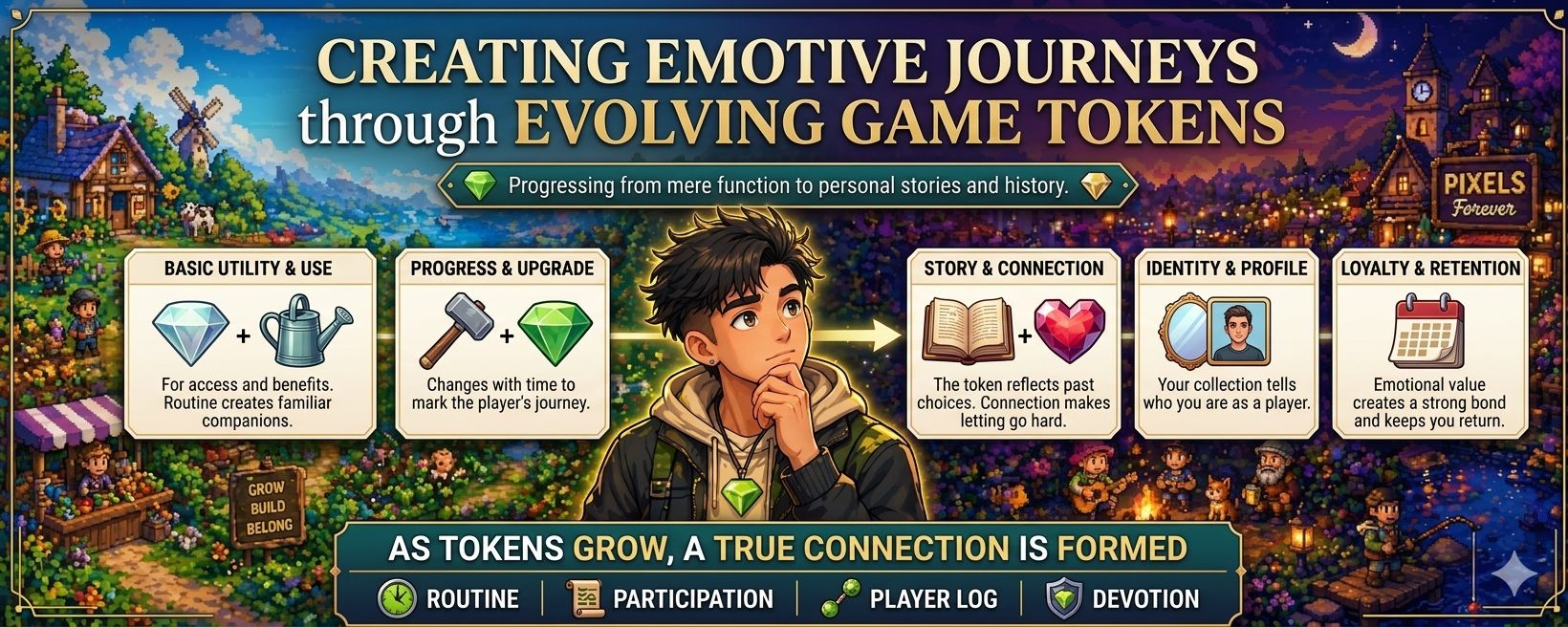
We often judge Web3 game assets too early.
The moment they appear, we ask the obvious questions:
What do they unlock?
How rare are they?
Can they be sold?
Does the market care yet?
Those questions aren’t wrong.
But they’re incomplete.
Because they only capture the asset at the moment it appears — not what it becomes over time.
---
From Inventory to Timeline
In a system like Pixels, assets don’t stay static.
They move with you.
At first, a token or item feels purely functional:
it speeds something up
unlocks access
improves efficiency
Simple.
But Pixels isn’t built around one-time actions.
It’s built around repetition:
farming
waiting
upgrading
returning
And over time, that repetition changes how assets feel.
They stop being just inventory.
They start becoming a timeline.
---
Meaning Comes From Use, Not Just Ownership
An item earned through weeks of routine doesn’t feel the same as one bought instantly.
An upgrade carried through multiple cycles holds more weight than something flipped quickly.
Even cosmetics shift in meaning.
What once looked rare might later feel familiar — not because of its supply, but because it was present during a period when you kept showing up.
That difference matters.
Because ownership alone is thin.
What gives an asset depth is contrast:
early vs later versions
messy beginnings vs refined setups
optimal vs sentimental
And sometimes, the strongest signal isn’t value…
It’s hesitation.
That moment when you could sell — but don’t.
---
The Layer Most Markets Miss
Markets are good at pricing rarity.
They’re worse at pricing experience.
An evolving asset quietly records something:
time spent
decisions made
friction absorbed
Not as strict proof.
But as a kind of trace.
A signal that this asset didn’t just exist — it was lived through.
And in a system like Pixels, where value comes from repeated participation, that trace matters more than a single outcome.
---
Where It Breaks
This layer is fragile.
If evolution starts feeling engineered — designed mainly for resale — the meaning collapses.
If every step becomes a checklist, the experience turns into optimization.
And when assets are valued only for exit potential, the emotional layer disappears.
That’s where many game economies lose depth.
They try to manufacture attachment through scarcity…
When real attachment comes from:
repetition
imperfection
and a bit of inconvenience
---
A Different Kind of Value
The most meaningful assets in Pixels may not be the rarest or the loudest.
They may be the ones players hesitate over.
Not because of price uncertainty…
But because letting go feels like losing a piece of time they passed through