


Whenever I see a game economy collapsing, the usual narrative is the same: "the market turned," "players left," "the hype is over." Rarely does anyone point out the real issue.
Poorly distributed rewards kill a game's economy faster than any market cycle.
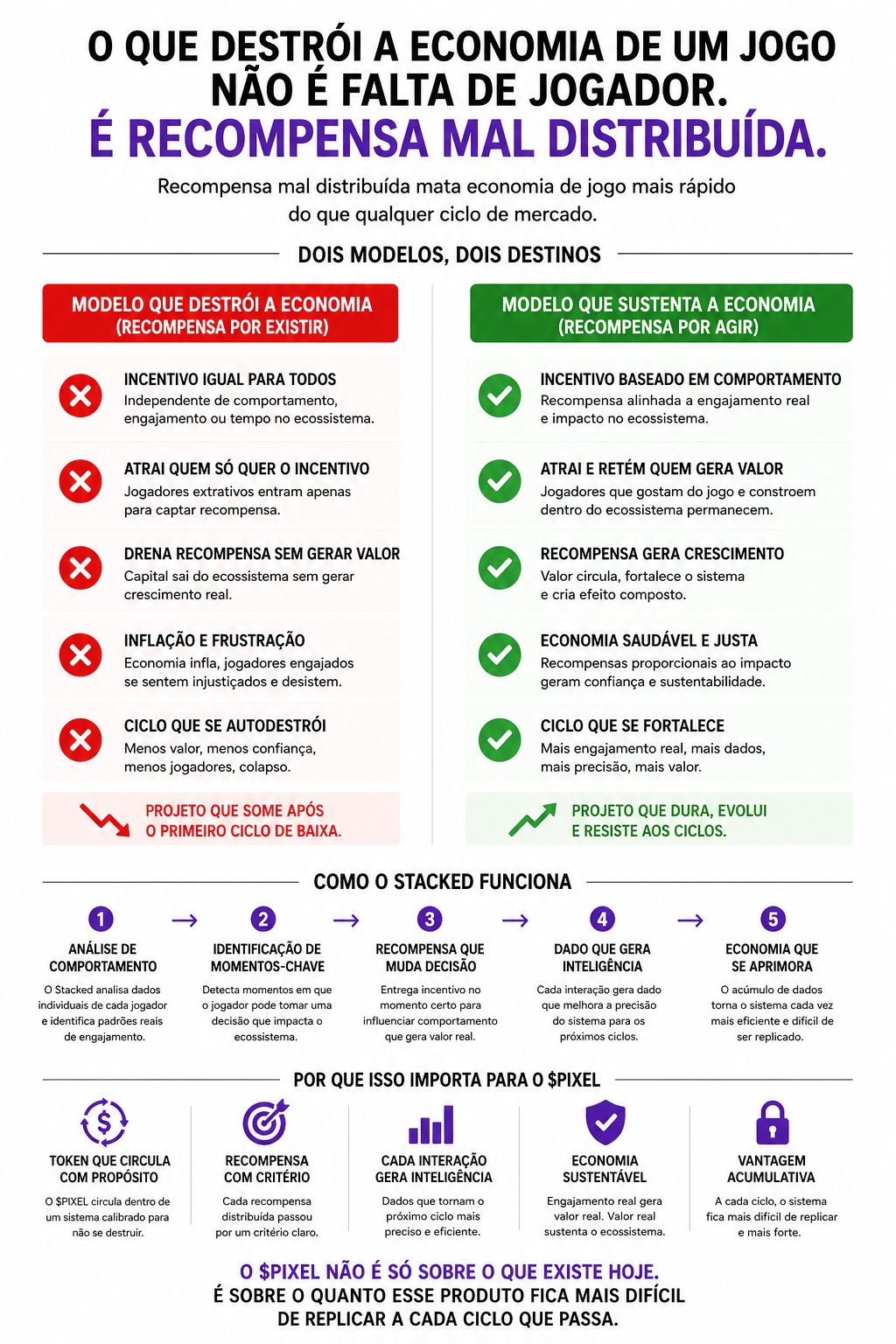
When everyone gets the same incentive, regardless of behavior, engagement, or how long they've been in the ecosystem — the system attracts those who came just for the incentive and repels those who came for the game. The former drain rewards without generating real value. The latter get frustrated with an inflated economy and leave. The outcome is predictable.
It was exactly this cycle that the Pixels team experienced internally — which forced them to build something different.
The Stacked doesn't distribute rewards equally. It analyzes individual behavior, identifies patterns of real engagement, and delivers incentives at the moment they genuinely change a decision. It's not a reward for mere existence; it's a reward for acting in ways that matter to the ecosystem.
This distinction might seem minor, but it has huge consequences. An economy that rewards real engagement sustains itself. One that rewards mere presence empties out. The difference between these two models is what separates a project that lasts from one that disappears after the first bear cycle.
For the PIXEL thesis, this matters directly. The token circulates within a system that's calibrated not to self-destruct. Every distributed reward has gone through a criterion. Every interaction generated data that makes the next cycle more precise.
It's this accumulation of economic intelligence that keeps me closely monitoring the $PIXEL . It's not just about the product that exists today — it's about how much harder that product becomes to replicate with each passing cycle.
